Silvia Insights · April 6, 2026
Stocks to Buy for Kevin Warsh’s Fed Regime
Kevin Warsh's Senate confirmation hearing on April 16 will force an answer to a question the market has been dodging for two months. Rate-sensitive sectors are priced for two contradictory Fed chairs simultaneously, and the 35-percentage-point YTD spread between energy stocks and homebuilders reveals the size of the bet.
What to Know
- The divergence trade is long XLE (+29.7% YTD) against short XHB (-5.6% YTD) and IGV (-21.9% YTD), reflecting a market that prices a hawkish Warsh in energy but a dovish Warsh in housing and software.
- Warsh's "productive dovishness" thesis, built on AI-driven productivity gains allowing lower rates, collides with Brent crude at $121 per barrel and core PCE running 0.4% month-over-month. The oil shock alone could add 0.8 percentage points to headline inflation by Q3.
- The April 16 hearing is the catalyst that collapses this dual pricing. If Warsh signals he will hold rates through summer, homebuilders (LEN, down 39% from its 52-week high) and growth software face another leg down, while regional banks (KRE) and REITs (VNQ) remain stuck below their 50-day moving averages.
Rate-Sensitive Sectors Are Pricing Two Different Fed Chairs
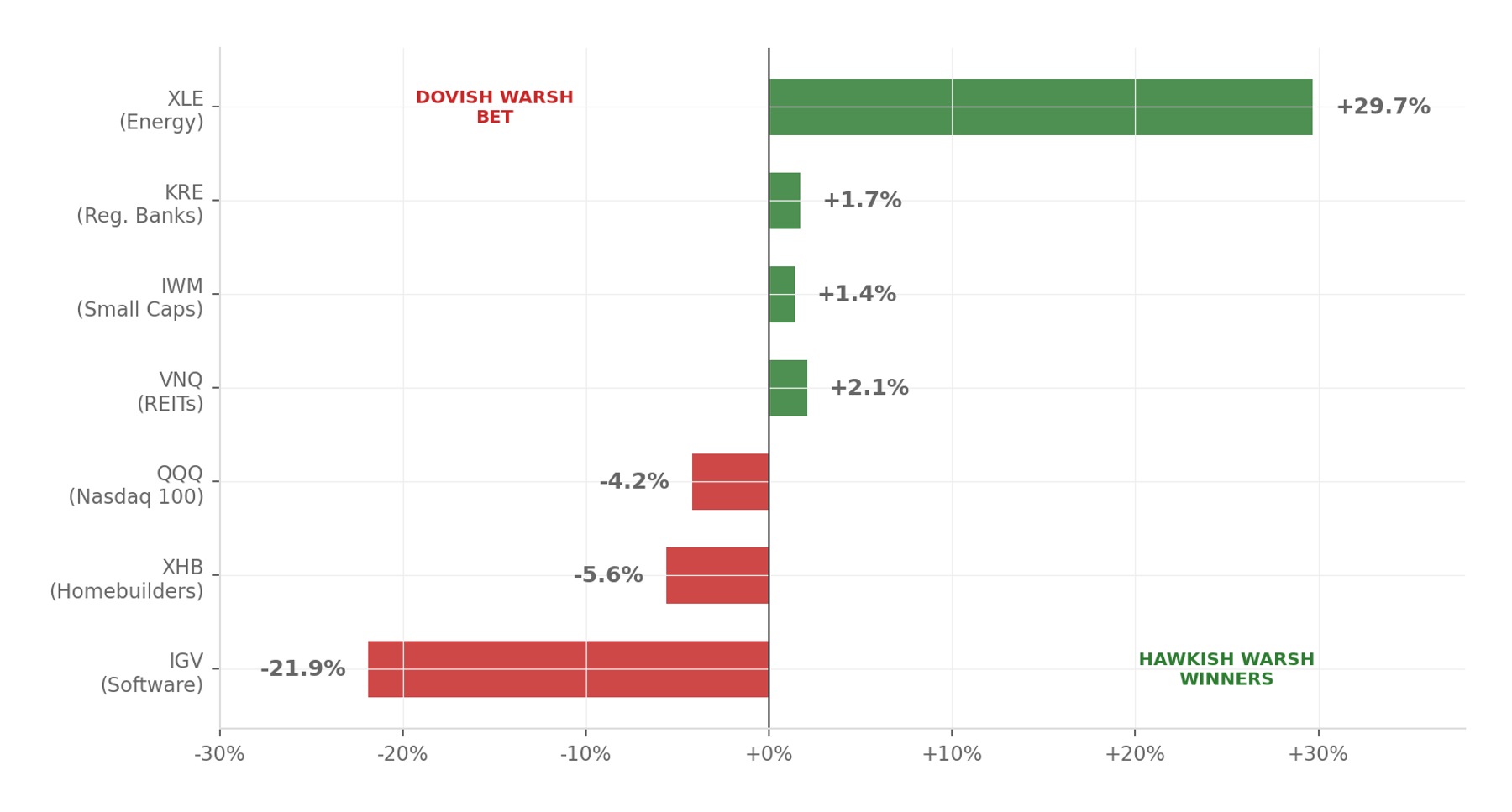
FMP via OpenBB. YTD returns as of April 3, 2026.
The Warsh Confirmation Meets the Oil Shock
The Senate Banking Committee will hold Kevin Warsh's confirmation hearing for Federal Reserve Chair on April 16, 2026. The White House formally transmitted his dual nominations, for a four-year term as Chairman and a 14-year term as Governor, to the Senate on March 30.1
Warsh arrives at the hearing with the worst possible backdrop for his stated monetary philosophy. His "productive dovishness" framework argues that AI-driven productivity gains allow the Fed to cut rates without reigniting inflation. That framework was designed for a world where Brent crude sat below $75 per barrel.2
Brent closed at $121.88 on March 30, up 70.9% from $71.32 on February 27, after Iran closed the Strait of Hormuz on March 4.3 The International Energy Agency has characterized this as one of the largest supply disruptions in recent decades, disrupting flows that normally account for roughly 20% of global oil trade.4
The Market Misread
Financial media has framed the Warsh confirmation as a political story about Fed independence, Trump's pressure campaign against Powell, and whether Warsh will serve as a "rubber stamp" for the White House. Senator Elizabeth Warren's letter calling Warsh a tool for Trump's "Wall Street First Agenda" set the narrative frame.5 That framing is incomplete.
The real story is that the market itself cannot decide which Warsh will show up. Rate-sensitive sectors are priced for two contradictory outcomes, and the gap between them is at levels not seen since the 2022 rate-hiking cycle.
Energy stocks (XLE, +29.7% YTD) are priced for a world where inflation stays elevated and rates stay high or go higher.6 Homebuilders (XHB, -5.6% YTD) and growth software (IGV, -21.9% YTD) are priced for a world where rates stay elevated and crush demand. Both camps cannot be right about the same Fed chair.
The misread is treating this as binary, dove or hawk. Warsh's actual record suggests a third possibility. During his 2006-2011 tenure as Fed Governor, he never dissented from a single FOMC vote, even while his speeches consistently warned about inflation risks and central bank credibility.7 He is a hawk by philosophy who votes with the consensus.
Brent Crude Doubled in One Month, Destroying the Dovish Case
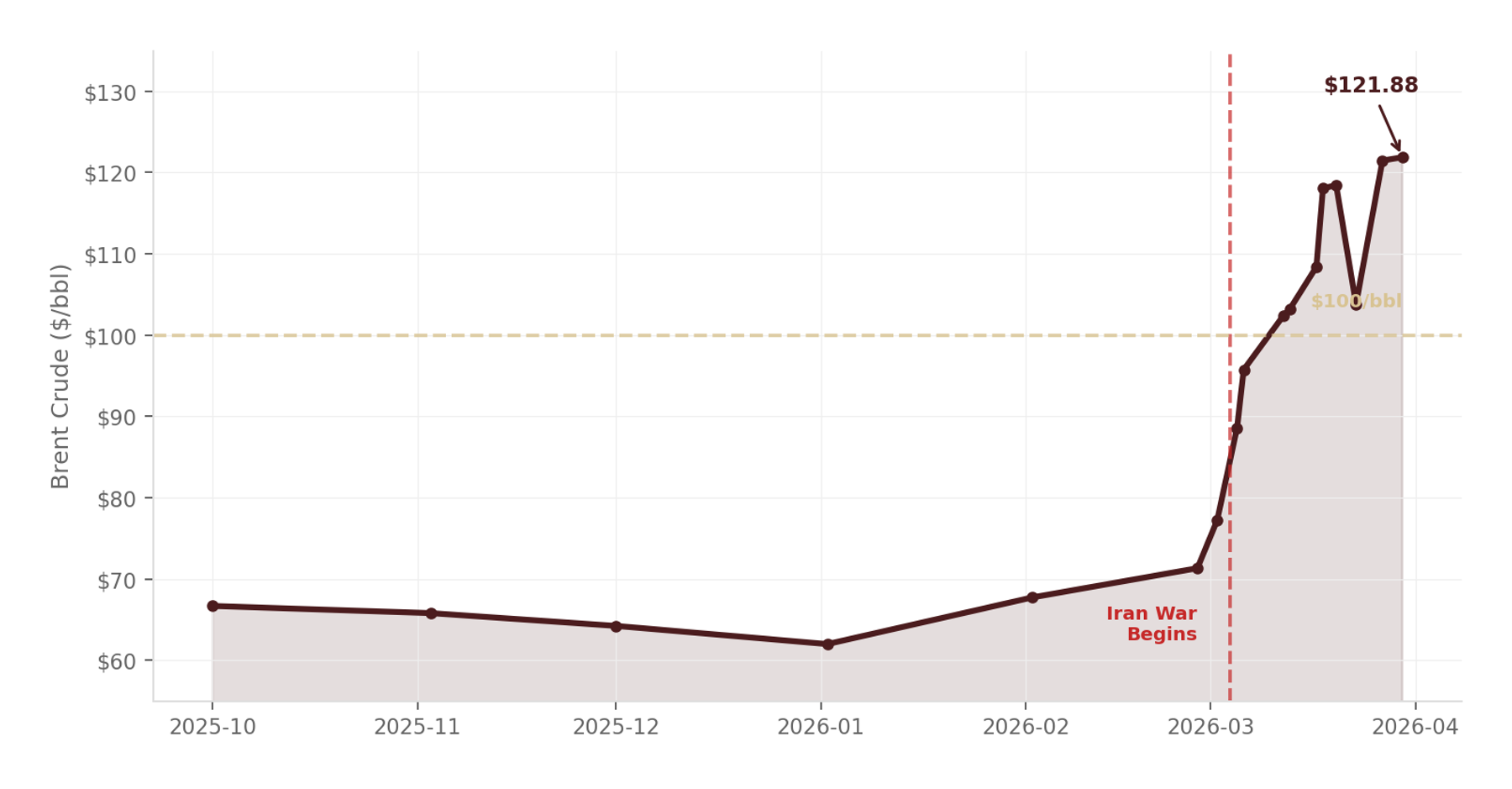
EIA via FRED/OpenBB. Daily spot prices.
The Investable Angle
The "Dovish Warsh" portfolio and the "Hawkish Warsh" portfolio show among the widest performance spreads since the 2022 hiking cycle. Mapping which sectors win under each scenario reveals where the mispricing is most extreme.
The Hawkish Warsh Portfolio wins if he prioritizes inflation credibility over Trump's demands. This portfolio favors energy (XLE at $59.17, +29.7% YTD), commodities producers, and short-duration value names.
It also favors shorting or avoiding the most rate-sensitive losers. XLE trades above its 50-day moving average of $55.62, confirming the trend.6
The Dovish Warsh Portfolio wins if his "productive dovishness" thesis holds and he cuts rates despite oil. This portfolio favors homebuilders (XHB at $98.56, its 50-day MA sits at $108.89), regional banks (KRE at $66.19, 50-day MA at $67.60), REITs (VNQ at $90.38, 50-day MA at $92.04), and growth software (IGV at $79.90, its 200-day MA sits at $103.23).6
The individual names tell the story more starkly. Lennar (LEN) trades at $87.71, down 39.2% from its 52-week high of $144.24. Western Alliance Bancorporation (WAL) trades at $72.77, down 25.2% from its 52-week high of $97.23.8
American Tower (AMT) trades at $175.86, down 25.0% from its 52-week high of $234.33. Snowflake (SNOW) trades at $148.31, down 47.2% from its 52-week high of $280.67.8
If hawkish Warsh shows up, which the oil data strongly favors, these beaten-down names face another leg lower. If dovish Warsh somehow prevails, the snapback in XHB and KRE alone could be 15-20% as they revert to their 50-day moving averages.
Energy and Homebuilders Are Trading as if They Have Two Different Fed Chairs
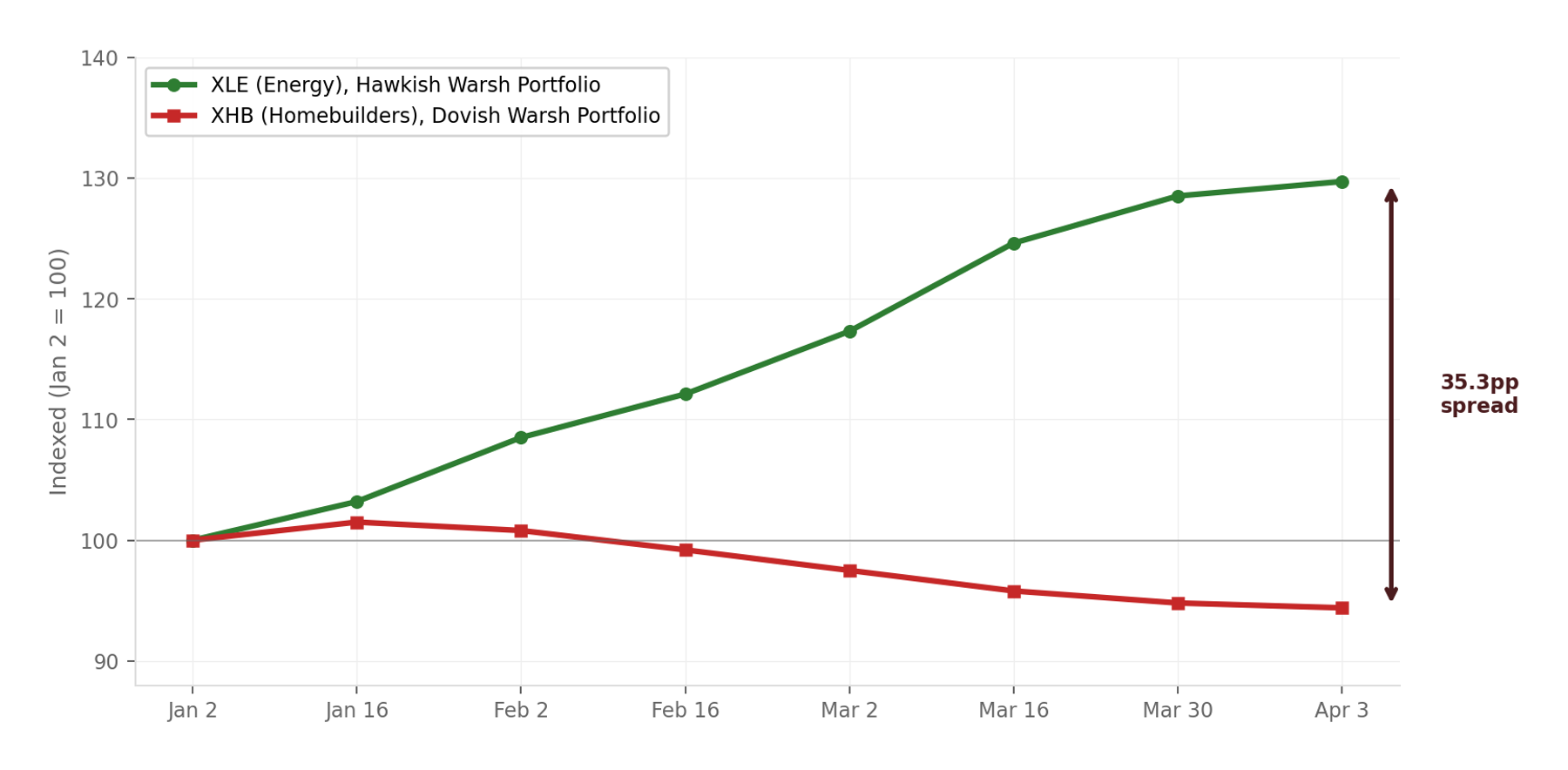
FMP via OpenBB. Indexed to 100 on January 2, 2026.
The Counter-Argument
The strongest case for dovish Warsh surviving the oil shock rests on three pillars, and none of them are dismissible.
First, Warsh has spent the past two years building his "productive dovishness" framework specifically to make the intellectual case for lower rates. He argues that AI-driven productivity gains are deflationary enough to offset supply-side shocks, and that a 1970s-style stagflation comparison fails because the supply side of the economy is structurally different today.2
There is real academic support for this view. The Atlanta Fed's GDPNow model showed productivity growth running above 2% annualized in late 2025, and unit labor costs decelerated through Q3 2025.
Second, the political pressure on Warsh is real. The DOJ, under U.S. Attorney Jeanine Pirro, opened a criminal investigation into Powell, which Powell has publicly called a pretext for pressuring the Fed to cut rates.9 Those are documented events.
The analytical inference from those events is that Warsh, who observed the administration's treatment of his predecessor, faces a political incentive structure that tilts heavily toward dovishness, particularly heading into the 2026 midterms. That inference is directional, not certain.
Third, the oil shock may prove transitory in the original, non-ironic sense. If diplomatic channels reopen the Strait of Hormuz within 60-90 days, oil could retrace to the $85-90 range, removing the strongest argument against cuts. Goldman Sachs has modeled scenarios where Brent returns to $85-95 under a partial reopening.10 The European Central Bank already postponed its rate reductions in March on the same uncertainty, suggesting the data is too fluid for any central banker to commit to a hawkish path.4
The GDP data also favors doves. Q4 2025 real GDP grew just 0.16% quarter-over-quarter, near stall speed.11 Unemployment rose to 4.4% in February 2026 before ticking back to 4.3% in March.12 A Warsh who focuses on the growth mandate rather than the inflation mandate has a real data set to cite.
These are not weak arguments. The counter-thesis has teeth, particularly if the Strait of Hormuz reopens before summer.
The Fed Rate Path Forks When Warsh Takes Over
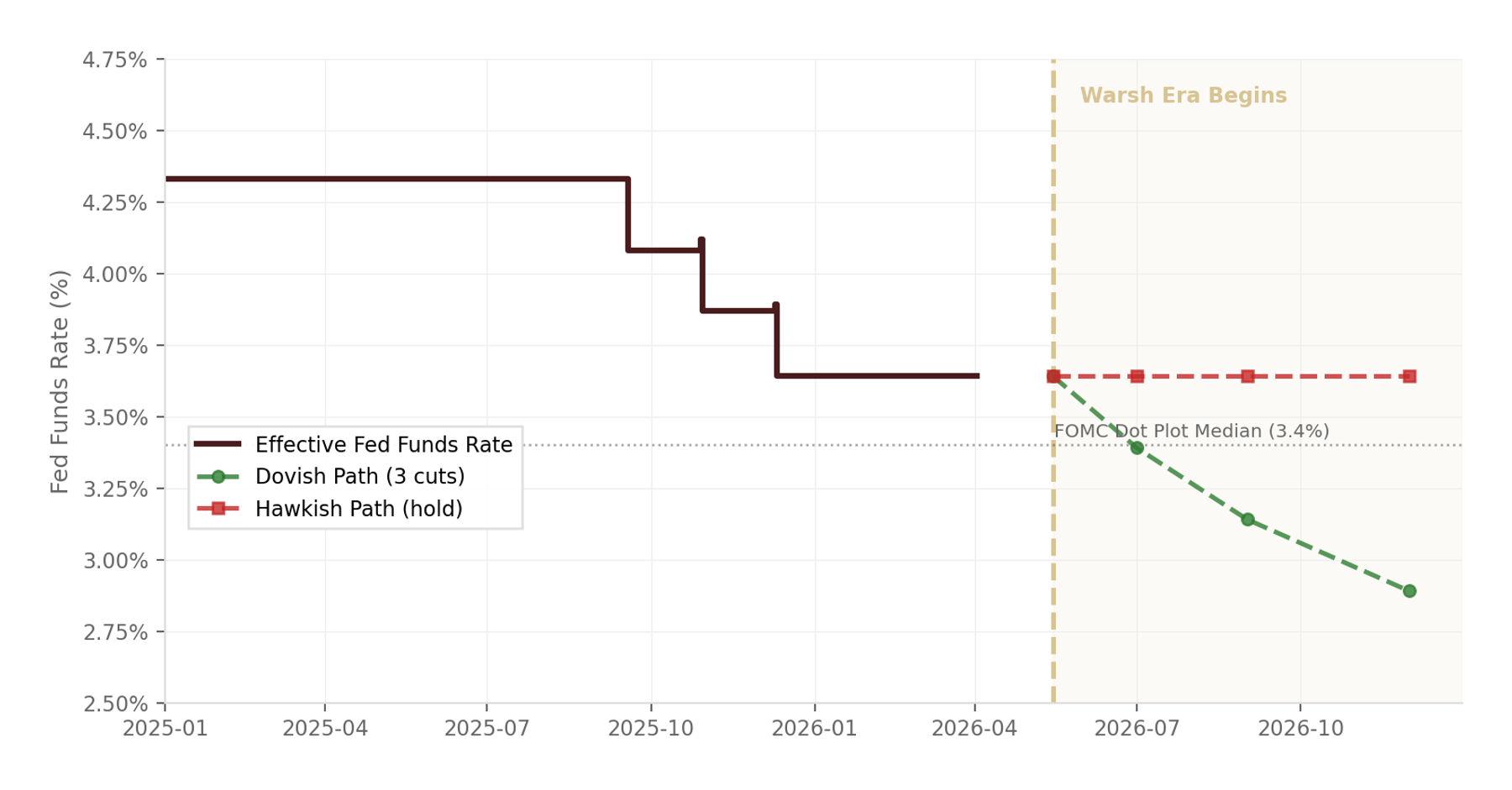
FRED/OpenBB, effective federal funds rate. Scenario projections are illustrative based on Warsh confirmation hearing outcomes.
Key Data Table
Prices, 50-day and 200-day moving averages as of April 3, 2026 close. YTD returns from FMP. 52-week highs from YFinance via OpenBB.
| Sector / Name | Ticker | Price | YTD | 52-Wk High | vs. 50d MA | Warsh Bet |
|---|---|---|---|---|---|---|
| Energy Select | XLE | $59.17 | +29.7% | $63.46 | Above | Hawkish |
| Regional Banks | KRE | $66.19 | +1.7% | $74.08 | Below | Dovish |
| Homebuilders | XHB | $98.56 | -5.6% | $123.13 | Below | Dovish |
| REITs | VNQ | $90.38 | +2.1% | $96.23 | Below | Dovish |
| Software | IGV | $79.90 | -21.9% | $117.99 | Below | Dovish |
| Lennar | LEN | $87.71 | n/a | $144.24 | Below | Dovish |
| Western Alliance | WAL | $72.77 | n/a | $97.23 | Below | Dovish |
| American Tower | AMT | $175.86 | n/a | $234.33 | Below | Dovish |
| Snowflake | SNOW | $148.31 | n/a | $280.67 | Below | Dovish |
| D.R. Horton | DHI | $140.74 | n/a | $184.55 | Below | Dovish |
Catalyst Map
| Date | Event | Market Impact |
|---|---|---|
| Apr 16 | Senate Banking Committee Warsh hearing | First public signal on rate philosophy under oil shock conditions |
| Apr 29-30 | FOMC meeting (Powell's last as Chair) | 94.8% probability of hold. Statement language on inflation expectations is the variable. |
| May 2026 | Powell term expires, Warsh assumes Chair (if confirmed) | Market reprices every rate-sensitive sector within 48 hours of confirmation vote |
| Jun 2026 | First FOMC meeting under Warsh | First policy decision. Cut or hold determines which portfolio wins. |
| Ongoing | Strait of Hormuz diplomatic negotiations | Reopening would remove hawkish catalyst and favor dovish portfolio |
| Q3 2026 | CPI and PCE prints reflecting full oil shock pass-through | If headline CPI breaches 4.0%, dovish Warsh thesis collapses regardless of AI productivity |
The Bottom Line
The data tilts toward the hawkish Warsh outcome, with core PCE running 0.4% month-over-month and a roughly 70% oil shock making rate cuts difficult to justify, though a reopening of the Strait of Hormuz within 60-90 days would substantially weaken that case. The April 16 Senate hearing is the catalyst that collapses the dual pricing. If Warsh signals rates hold at 3.50-3.75% through summer, the "dovish Warsh" names face 10-15% additional downside from current levels while energy extends its lead.
Sources
1. Senate Banking Committee schedule; CNBC, "Warsh Fed nomination hearing set for mid-April," April 4, 2026.
2. FinancialContent, "The Warsh Revolution: A New Era of 'Productive Dovishness,'" February 10, 2026.
3. EIA via FRED/OpenBB, Brent crude spot prices (DCOILBRENTEU), daily data as of March 30, 2026.
4. IEA Oil Market Report, March 2026 (supply disruption characterization); ECB monetary policy decision, March 19, 2026; Dallas Fed, "What the closure of the Strait of Hormuz means for the global economy," March 20, 2026; CSIS, "The Iran Conflict Is Sending Oil Prices Soaring," 2026.
5. Sen. Elizabeth Warren letter to Kevin Warsh, March 2026, cited in Yahoo Finance.
6. FMP via OpenBB, equity price performance and quote data, as of April 3, 2026.
7. Yahoo Finance, "A closer look at Fed chair pick Kevin Warsh's voting record," 2026.
8. YFinance via OpenBB, equity quotes including 52-week highs, as of April 3, 2026.
9. NBC News, "Fed's fight with DOJ could hurt prospects for more interest rate cuts," 2026.
10. Goldman Sachs, "How Will the Iran Conflict Impact Oil Prices," 2026.
11. EconDB via OpenBB, Real GDP data, Q4 2025 reading: +0.16% QoQ.
12. FRED/OpenBB, UNRATE series: 4.4% (Feb 2026), 4.3% (Mar 2026).