Silvia Insights · April 7, 2026
5 Stocks That Win From $166 Billion in Tariff Refunds
CBP's tariff refund portal goes live around April 20, returning IEEPA duties to 330,000 importers. For five mid-cap importers with heavy China sourcing and minimal oil exposure, the estimated refund could represent roughly 5% to 15% of their entire market capitalization. I have not seen mainstream research that maps this.
What to Know
- The analytical framework favors long positions in Steven Madden (SHOO, 16.4x forward), American Eagle (AEO, 12.4x forward), and Kohl's (KSS, 9.0x forward), where estimated IEEPA refunds equal 6% to 15% of market cap and energy cost exposure is near zero.
- The $166 billion refund pool dwarfs any single quarter of earnings for these companies. Steven Madden's estimated refund alone could exceed its entire trailing twelve-month net income of $45 million by a factor of two to three.
- The CAPE refund portal opens around April 20 with a 45-day processing window, meaning capital begins flowing back to importers by early June, directly ahead of Q2 earnings season when management teams will quantify the impact for the first time.
Mid-cap importers with high refund yields and low oil sensitivity cluster in the upper-left quadrant, where the asymmetry is greatest
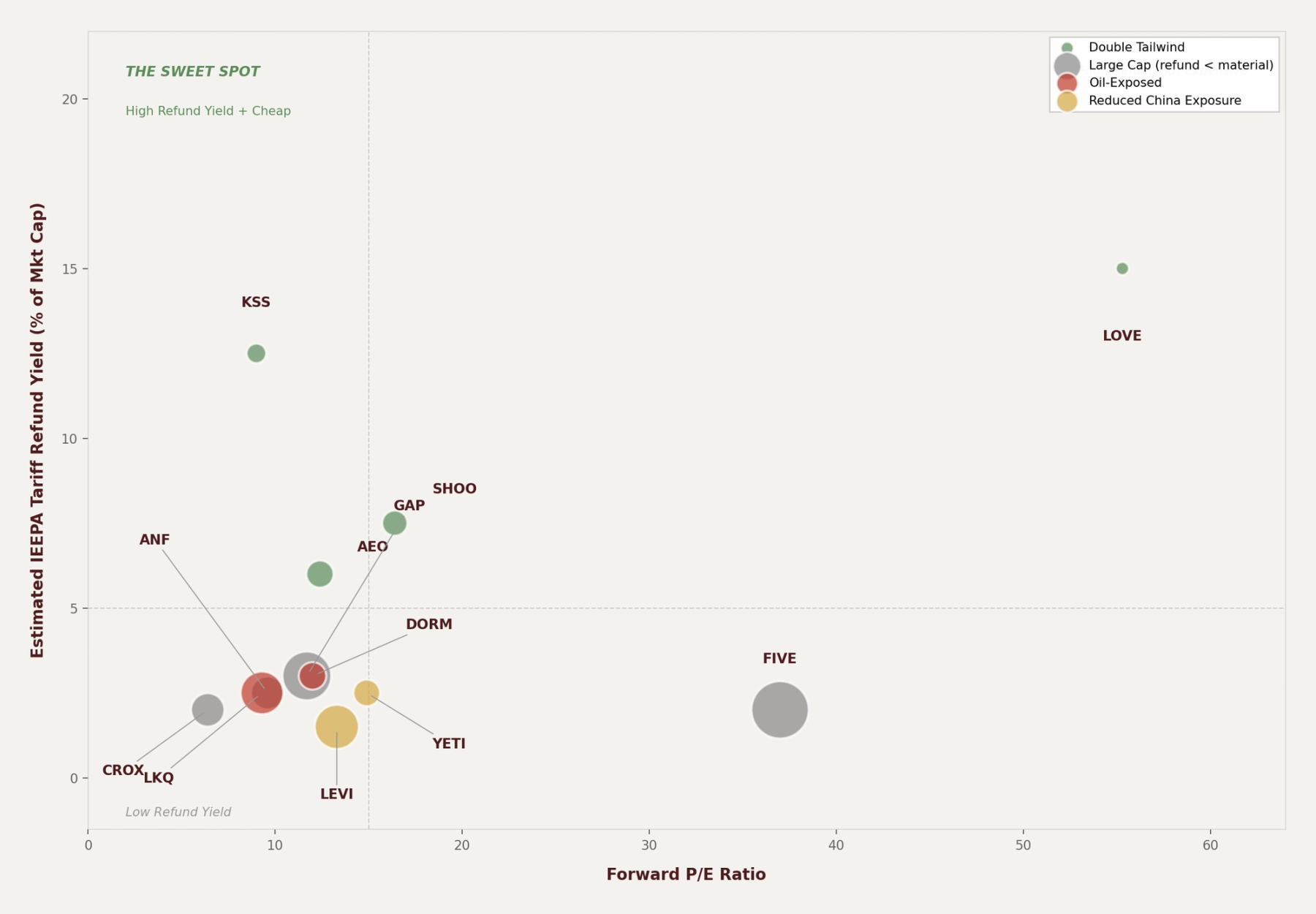
Source: ProCap Insights analysis. Forward P/E from FMP consensus estimates. Refund yield estimated from COGS, China sourcing percentages (per company filings and analyst reports), and IEEPA tariff rates. Market cap as of April 4, 2026. Bubble size proportional to market capitalization.
THE ANALYTICAL FRAMEWORK AND WHY IT WORKS NOW
The ProCap tariff refund methodology applies four filters to identify companies where IEEPA refund checks create genuine earnings catalysts. The framework is replicable with public data and a brokerage screen in under thirty minutes.
Filter 1, China COGS Ratio. Estimate each company's cost of revenue attributable to Chinese imports using 10-K supply chain disclosures and analyst estimates. Companies with less than 15% China-sourced COGS are excluded because the refund is immaterial.
Filter 2, Refund Yield. Multiply the China COGS estimate by the average IEEPA tariff rate (approximately 30% for the February 2025 through February 2026 collection period), then divide by current market capitalization. The threshold for inclusion is 2%.
Filter 3, Oil Sensitivity. Rank each company's direct and indirect energy cost exposure on a three-tier scale. Apparel, footwear, and consumer goods importers with asset-light domestic distribution rank "Low." Auto parts distributors and companies with trucking-heavy logistics rank "Medium."
Filter 4, Valuation Floor. Forward P/E must be below 20x for inclusion as a top pick. Companies trading above 20x forward earnings already price in some recovery, reducing the asymmetry.
THE MACRO SETUP
Two simultaneous forces are reshaping equity positioning in April 2026. They cut in opposite directions depending on which stocks you own.
The first force is the Iran oil shock. WTI crude surged from roughly $57 per barrel in January to above $105 by late March, on the order of an 80-85% move in under three months.1 Brent rose above $120. The IEA warned that April supply disruptions will exceed March, with 4.5 to 5 million barrels per day offline.2
The second force is the tariff refund tsunami. The Supreme Court ruled IEEPA tariffs unconstitutional, and CBP collected approximately $166 billion from 330,000 importers across 53 million entry records.3 The CAPE refund portal is 60% to 85% complete and targeted for April 20 deployment, with a 45-day processing window per claim.4
The intersection creates a clear sorting mechanism. Companies that import heavily from China and sell products with low energy cost sensitivity sit in a double-tailwind position. Companies with no import exposure and high fuel costs face a double headwind.
WTI crude oil nearly doubled in Q1 2026 while the tariff refund portal neared completion, creating two simultaneous forces that sort stocks into winners and losers
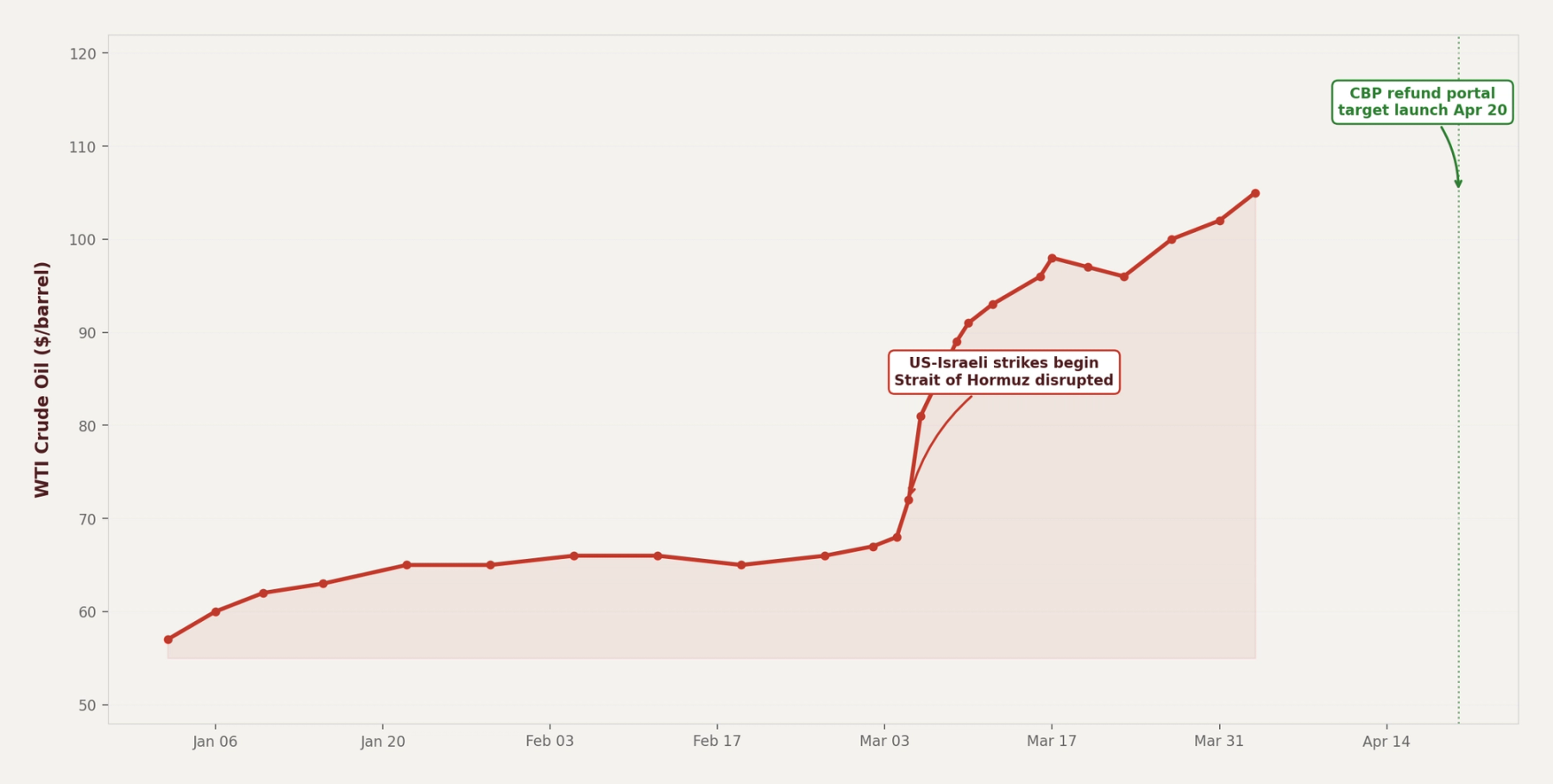
Source: FRED via OpenBB (DCOILWTICO), daily spot prices. ProCap Insights annotations.
THE UNDER-THE-RADAR SELECTION TABLE
The table below ranks twelve companies by estimated IEEPA tariff refund yield, cross-referenced with oil sensitivity and forward valuation. China sourcing percentages are derived from company 10-K filings, earnings call disclosures, and sell-side analyst estimates. Data is as of April 4, 2026.
| Ticker | Company | Mkt Cap | Est. China COGS % | Est. Refund Yield | Fwd P/E | Oil Sensitivity | YTD Return | Near-Term Catalyst |
|---|---|---|---|---|---|---|---|---|
| KSS | Kohl's | $1.5B | ~25% | 10-15% | 9.0x | Low | -48% | Refund disclosure Q2 |
| LOVE | Lovesac | $211M | ~55% | 10-20% | 55.3x | Low | -0.2% | Refund vs. mkt cap |
| SHOO | Steven Madden | $2.5B | ~55% | 5-10% | 16.4x | Low | -18.7% | Earnings Apr/May |
| AEO | American Eagle | $2.9B | ~30% | 4-8% | 12.4x | Low | -40% | Margin recovery Q2 |
| GAP | Gap Inc. | $9.4B | ~20% | 2-4% | 11.7x | Low | +2.1% | Refund flow Q2-Q3 |
| DORM | Dorman Products | $3.0B | ~40% | 2-4% | 12.0x | Med | -19.7% | Auto parts demand |
| ANF | Abercrombie | $4.3B | ~25% | 2-3% | 9.6x | Low | +1.9% | Strong DTC momentum |
| YETI | YETI Holdings | $2.8B | ~25% avg | 2-3% | 14.9x | Low | -18.5% | Diversification pays off |
| LKQ | LKQ Corp | $7.2B | ~15% | 2-3% | 9.3x | Med | -5.4% | Auto parts cycle |
| CROX | Crocs Inc. | $4.4B | ~28% | 1-3% | 6.4x | Low | -1.6% | FCF generation, debt paydown |
| LEVI | Levi Strauss | $7.7B | ~15% | ~1-2% | 13.3x | Low | +3.4% | Earnings Apr 7 |
| FIVE | Five Below | $13.0B | ~55% | ~1-3% | 37.0x | Low | +21.9% | Refund lifts margins |
Sources: Market cap and price data from YFinance via OpenBB (April 4, 2026). Forward P/E computed from FMP consensus forward EPS estimates. China COGS % from company 10-Ks, earnings call transcripts, and BofA, KeyBanc, and ainvest.com analyst reports. Refund yield estimated by ProCap Insights. [Verify specific refund amounts before publication.]
TOP PICKS ANALYSIS
Steven Madden (SHOO) - The Highest-Conviction Double Tailwind
Steven Madden sourced roughly 70% of its goods from China at the start of the IEEPA tariff period, among the highest ratios in publicly traded footwear.5 The company announced plans to cut China sourcing by 45%, but that transition was underway during the entire IEEPA collection window.
FY2025 cost of revenue was $1.48 billion (10-K).6 ProCap estimates roughly 55% of COGS was China-sourced during the IEEPA period, based on earnings call commentary and analyst reports. Under that assumption, estimated IEEPA tariff payments land between $122 million and $245 million.
Against a $2.5 billion market cap, that refund represents 5% to 10% of the company's entire equity value. Steven Madden's trailing twelve-month net income was $45 million. The midpoint refund estimate of $183 million is four times that figure.
Footwear companies have negligible direct energy cost exposure. The Iran oil shock hits them only through higher shipping rates, which represent a fraction of COGS.
The risk is that SHOO already absorbed tariff costs into lower margins rather than higher prices, and the refund simply restores prior profitability. Even so, margin restoration at 16.4x forward earnings creates asymmetry to the upside.
American Eagle Outfitters (AEO) - The Beaten-Down Refund Play
AEO stock is down 40% year-to-date, trading at $17.10 with a forward P/E of 12.4x. FY2025 cost of revenue was $3.68 billion (10-K).7 ProCap estimates roughly 30% was sourced from Asia during the IEEPA period, based on company disclosures and sell-side coverage.
The IEEPA refund estimate ranges from $110 million to $220 million, representing 4% to 8% of the company's $2.9 billion market cap. AEO's operating income dropped from $450 million to $328 million year-over-year, a decline that management attributed in part to tariff headwinds.
The refund effectively reverses that hit. At 12.4x forward earnings, the market is pricing in continued margin pressure. A refund-driven margin recovery into Q2 earnings could force a re-rating.
Kohl's (KSS) - The Contrarian Refund Yield Play
Kohl's is a broken department store narrative. The stock trades at $13.12, down from $25 a year ago, with a market cap of just $1.5 billion.
Kohl's imports heavily from Asia across apparel, home goods, and private-label merchandise. Even a conservative 25% China COGS estimate against roughly $12 billion in total cost of revenue produces an IEEPA tariff exposure of $900 million or more over the collection period.8
The refund yield could reach 10% to 15% of market cap. The catch is execution. Kohl's faces secular headwinds that a one-time refund does not fix.
The refund is a capital injection, not a business model repair. At 9.0x forward earnings, though, the market has priced in very little good news. The refund catalyst is pure upside optionality on a name the market has abandoned.
Crocs (CROX) - The Cheapest Name with Built-In Upside
Crocs trades at 6.4x forward earnings, the cheapest valuation in the selection by a wide margin. FY2025 cost of revenue was $1.68 billion (10-K).9 ProCap estimates roughly 28% was China-sourced during the IEEPA period, based on supply chain disclosures and analyst estimates.
The IEEPA refund estimate is more modest at $47 million to $95 million, or 1% to 2% of the $4.4 billion market cap. The refund alone does not drive the thesis here.
CROX generates massive free cash flow and trades at a discount to every peer. Any refund flowing through the income statement only widens the gap between price and fundamental value.
Lovesac (LOVE) - The Micro-Cap Wildcard
At $211 million in market cap, Lovesac is the smallest name in the analysis and the one where the refund math is most transformative. The company manufactures modular furniture with components heavily sourced from China.10
FY2025 cost of revenue was approximately $370 million (10-K). ProCap estimates 55% or more was China-sourced, based on product sourcing disclosures and management commentary. Under those assumptions, the IEEPA refund estimate of $22 million to $45 million would represent 10% to 20% of the company's entire market capitalization.
For context, Lovesac's trailing net income was approximately $4 million. A refund check worth five to ten times annual earnings changes the financial profile overnight.
The risks are proportional to the reward. LOVE trades at 55.3x forward earnings, making the valuation fragile. Liquidity is thin, with average daily volume under 300,000 shares.
Four companies clear the 5% refund yield threshold where the tariff cash-back becomes a genuine earnings catalyst rather than an accounting footnote
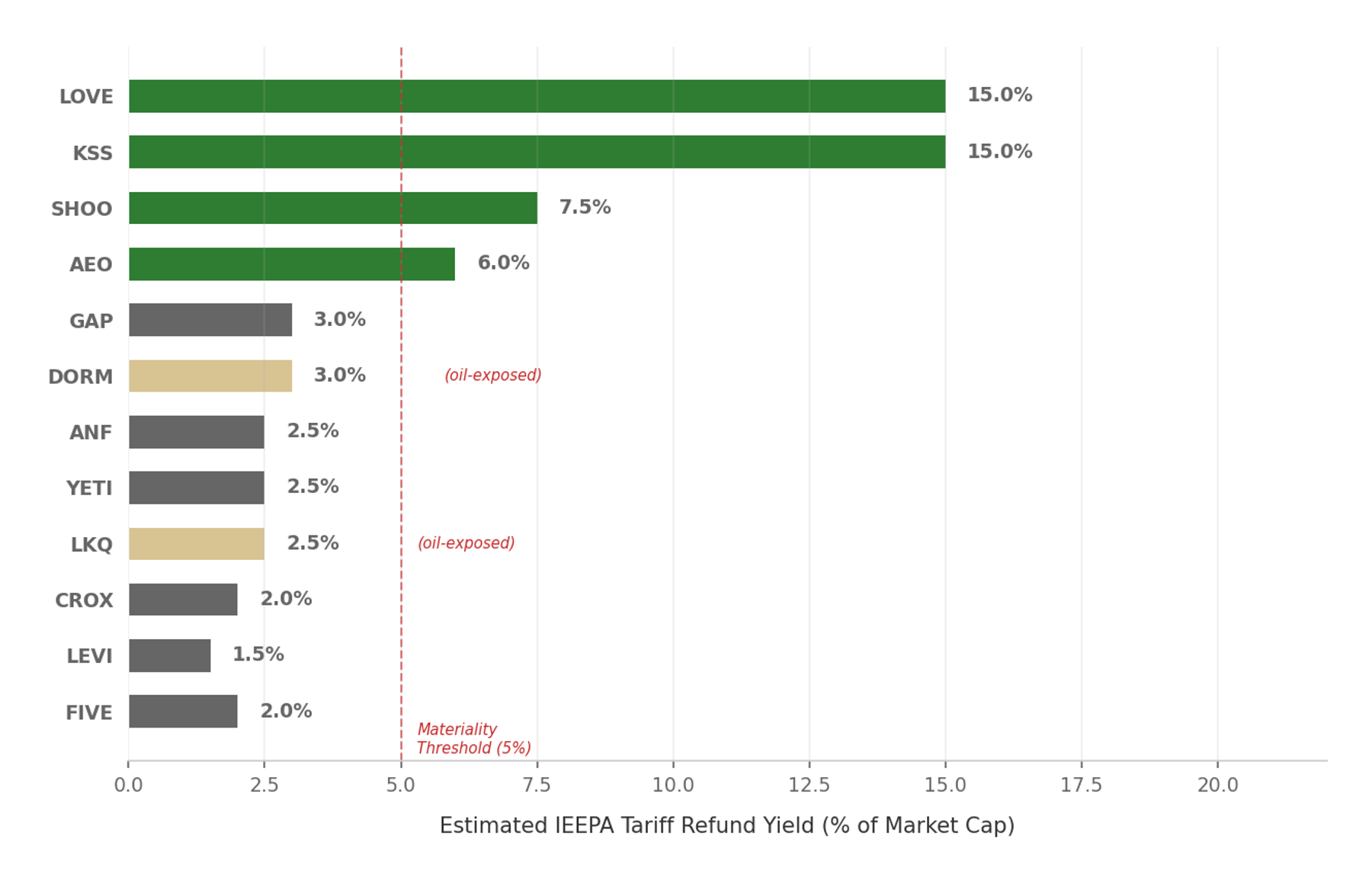
Source: ProCap Insights analysis. Refund yield = estimated IEEPA tariffs paid / current market cap. Based on company COGS, China sourcing percentages, and average IEEPA tariff rate of ~30%. Data as of April 4, 2026.
THE NAMES THAT ALMOST MADE IT
Five Below (FIVE)
FIVE sources 50-60% of products from China, giving it one of the highest China COGS ratios in retail.11 The $13 billion market cap dilutes the refund yield to under 3%, and the stock already trades at 37x forward earnings after a 22% YTD rally.
YETI Holdings (YETI)
YETI aggressively moved 80% of drinkware production out of China during 2025, reducing China exposure to under 5% of COGS entering 2026.12 The average China mix during the refund period was closer to 25%, producing a refund yield of only 2-3%.
Gap Inc. (GAP)
GAP's $9.4 billion market cap dilutes the refund math, and at roughly 20% China sourcing, the yield lands at 2-4%. The 11.7x forward P/E is attractive, and the company has strong operational momentum.
Abercrombie and Fitch (ANF)
ANF at 9.6x forward earnings with 25% estimated China exposure is a solid fundamental story with or without the refund. The 2-3% refund yield is additive but not the primary catalyst.
THE CONSENSUS AND WHERE IT BREAKS
The consensus view on tariff refunds is procedural, not investable. Wall Street coverage has focused on when the CAPE portal launches, how long processing will take, and the accounting implications.13
To my knowledge, bulge-bracket research has not yet published refund-to-market-cap maps for public companies. The gap exists because the tariff refund does not fit neatly into any analyst's coverage universe.
Trade policy analysts cover the legal mechanics. Retail analysts cover earnings. Few analysts sit at the intersection of customs duty data and equity valuation.
ProCap's analytical framework fills that gap.
The consensus breaks if refund checks arrive faster than the 45-day processing window suggests. CBP told the Court of International Trade that the first phase would return $120 billion to importers.14
If even a fraction of that hits corporate balance sheets before Q2 earnings calls in July and August, management teams will be forced to quantify the impact. That quantification is the catalyst that reprices these stocks.
The consensus also breaks on oil. Markets are pricing the Iran shock as uniformly negative. For the five companies in this report's top picks, the oil shock is a sideshow.
Apparel and footwear companies do not burn crude. Their cost structures are labor, materials, and rent. Rising diesel prices add marginal shipping cost, but that is a fraction of the COGS reduction the tariff refund delivers.
THE COUNTER-ARGUMENT
The strongest argument against this thesis is that the refund never arrives on schedule. CBP told the court it would require 4.4 million staff hours to process refunds manually and that its technology infrastructure was not designed for this scale.15
If deployment slips from April 20 to June or later, the catalyst window compresses against a deteriorating macro backdrop. Oil above $100 feeds into CPI, the Fed holds rates longer, and consumer-facing companies face demand destruction that no refund check can offset.
The second risk is that many of these companies are not the importer of record. Large retailers often import through third-party customs brokers or sourcing agents. If the broker is the ACE-registered importer, the refund check goes to the broker first.
Legal disputes over refund ownership could delay cash flow for months or years. Troutman Pepper Locke has already flagged the exposure to consumer class actions from companies that passed tariff costs to customers and then receive refunds.16
Third, the "refund yield" framework makes assumptions about China sourcing percentages that are inherently imprecise. Companies disclose geographic sourcing in varying levels of detail, and some have actively diversified during the IEEPA period.
The actual refund amounts will only become clear when companies file through CAPE and disclose the figures. Until then, every estimate carries a confidence band of plus or minus 30%.
Fourth, for Kohl's specifically, a one-time capital injection does not solve a secular business model problem. Department stores face structural headwinds from e-commerce, aging demographics, and brand erosion.
Fifth, the oil shock could intensify. The IEA warned that April supply disruptions will be worse than March. If Brent breaks $150, the inflationary impulse overwhelms any tariff refund tailwind.
The probability is weighted toward the ceasefire talks progressing, as discussions were reported on April 5.17 The tail risk of escalation remains real and unhedged.
The BOTTOM LINE
The analytical framework points to Steven Madden (SHOO) at 16.4x forward and American Eagle (AEO) at 12.4x forward as the highest-conviction double-tailwind names. Under these assumptions, IEEPA refund checks could represent roughly 5-10% of market cap, arriving into beaten-down valuations with near-zero oil exposure. The catalyst window opens April 20 when the CAPE portal accepts claims.
MONITORING FRAMEWORK
Add conviction if CBP confirms the CAPE portal launches on or before April 20 and early processing volumes exceed expectations. Watch for any company in the selection to disclose estimated IEEPA refund amounts in 8-K filings or earnings call guidance.
Cut exposure if CBP delays the portal past May, if oil breaks above $130 on Hormuz escalation, or if any top pick reports that its customs broker is the importer of record. The next scheduled earnings dates for top picks are LEVI on April 7, CROX in late April, and SHOO and AEO in May 2026.
The refund trade has a defined shelf life. Once checks are processed and flow through income statements, the asymmetry disappears. The window is two to four months.
Sources
1. FRED via OpenBB, DCOILWTICO daily spot prices, January-March 2026.
2. CNBC, "Oil supply crunch will worsen in April, IEA warns," April 1, 2026.
3. CNBC, "Trump tariffs: Customs and Border Protection tells judge it can't comply with refund order," March 6, 2026.
4. FreshFruitPortal.com, "The US Customs and Border Protection tariff refund system could be up and running as soon as mid-April," March 25, 2026.
5. CNBC, "Steve Madden to slash China sourcing by as much as 45%," November 7, 2024; Yahoo Finance / ainvest.com, "Warby Parker, Skechers, Crocs among apparel brands most exposed to tariffs."
6. Steven Madden Ltd. FY2025 10-K, filed March 2, 2026 (FMP via OpenBB).
7. American Eagle Outfitters Inc. FY2025 10-K, filed March 30, 2026 (FMP via OpenBB).
8. ProCap Insights estimate based on KSS total cost of revenue and analyst estimates of Asian sourcing mix. [Verify before publication.]
9. Yahoo Finance / ainvest.com, "Warby Parker, Skechers, Crocs among apparel brands most exposed to tariffs."
10. ProCap Insights estimate based on LOVE FY2025 10-K cost of revenue and product sourcing disclosures. [Verify before publication.]
11. Investing.com, "China tariffs a threat to Five Below, BofA says"; Yahoo Finance, "Dollar Tree, Five Below downgraded at KeyBanc on China import exposure."
12. Supply Chain Dive, "Yeti will move 80% of production out of China this year," 2025.
13. BDO, "IEEPA Tariff Refund: Key FAQs for Importers"; EisnerAmper, "IEEPA Tariff Refunds: What Importers Need to Know."
14. YourNews.com, "Customs to return $120 billion in tariffs to importers in first phase," March 31, 2026.
15. CNBC, "Trump tariffs: Customs and Border Protection tells judge it can't comply with refund order," March 6, 2026.
16. Troutman Pepper Locke, "IEEPA Tariff Refunds May Come With an Unforeseen Cost - Exposure to Consumer Class Actions," March 2026.
17. CNBC, "Oil prices slide as U.S.-Iran war ceasefire under discussion," April 5, 2026; Federal Reserve via OpenBB, Treasury rates as of April 2, 2026.