Silvia Insights · April 29, 2026
Sun Pharma's acquisition of Organon reveals a new playbook that could benefit 3 stocks next
Sun Pharma's $14 takeout of Organon, struck at roughly 103% above the unaffected pre-rumor price, is not a generics consolidation story. It is the moment a foreign manufacturer crossed over to acquire the US-originated science it had spent fifteen years out-producing. The same arc is now mid-run in shipbuilding, drone components, and lithium refining.
What to Know
- The trade is long the US-listed IP holders sitting on the same arc as Organon. Huntington Ingalls (HII) at $355 and AeroVironment (AVAV) at $190 are the cleanest expressions, both broken down hard from 52-week highs and tagged by foreign-acquirer activity.15,16
- Sun paid 2.03x the unaffected pre-rumor price for Organon, a calibration that implies roughly $386 for AVAV and $722 for HII at today's prices. Even a 50% premium yields a 50 to 60% upside band on a thesis the market is not pricing.1,11,15
- Hanwha's Philly Shipyard buy, the HD Hyundai-HII MOA, and the FCC ban on foreign UAS prove the arc is no longer hypothetical. Watch the AVAV Q4 FY26 print on June 23, 2026, which clears the BADGER/SCAR overhang and resets BlueHalo margins.3,4,7,18
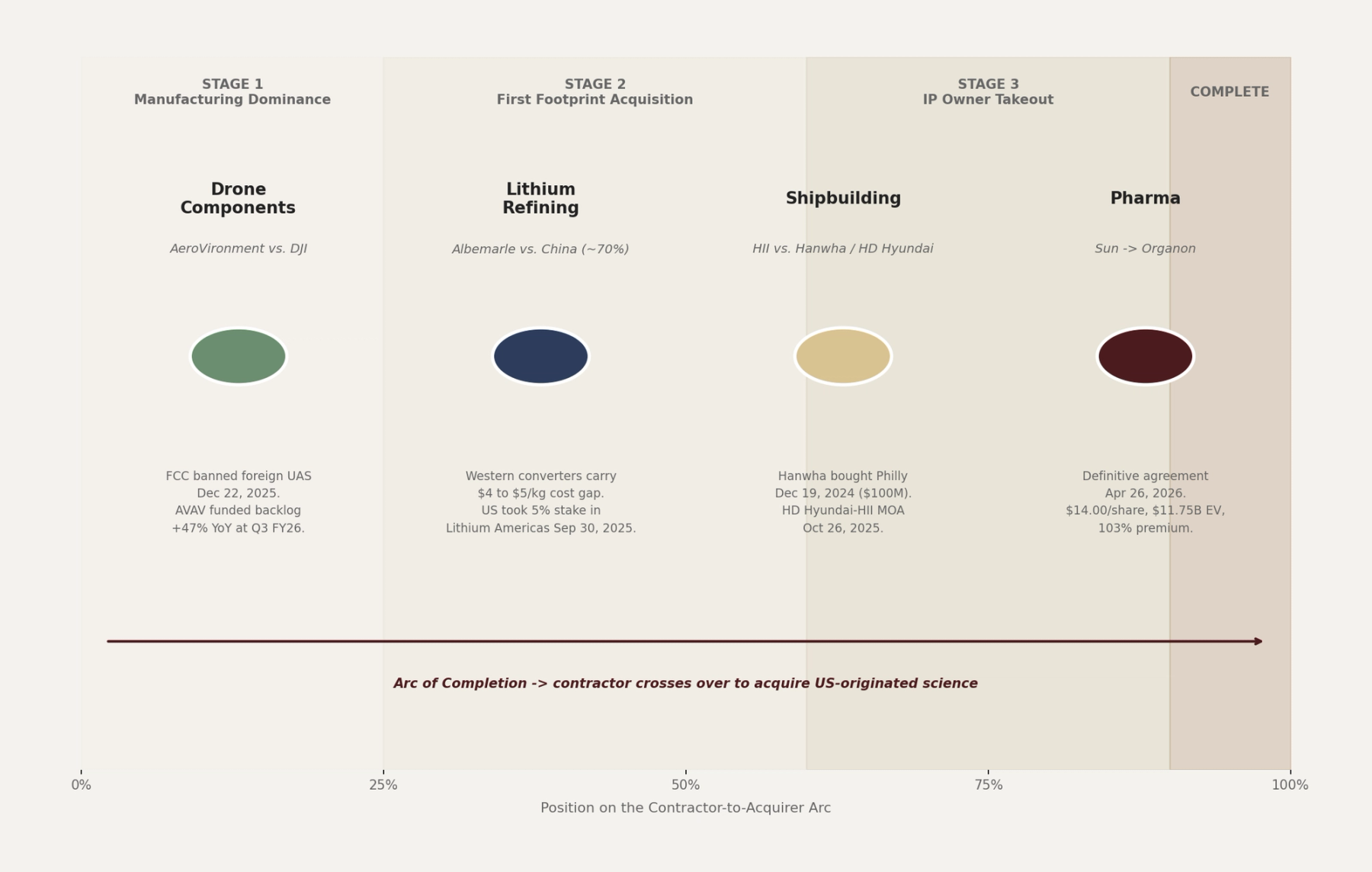
Four industries on the same contractor-to-acquirer arc. Pharma just closed it.
Sources: see endnotes 1, 2, 7, 8.
The Theme
A foreign manufacturer spends fifteen years scaling capacity, undercutting the originator on cost, and turning a US-invented science into a commodity it dominates.
Then the contractor's cash flow and balance sheet reach a size at which it is cheaper to buy the IP holder outright than to keep paying license, distribution, or compliance costs.
The arc completes.
That is what Sun Pharma agreed to do with Organon on April 26, 2026, with the definitive agreement signed and close expected early 2027.
Sun is the world's leading specialty generics company. Organon is a Merck spinoff carrying women's-health and biosimilar IP that originated inside US labs.1
Sun bought it at $14, against the April 9, 2026 unaffected closing price of $6.91, the reference price specified in the Sun Pharma definitive agreement.1,16 Early-March 2026 closes ranged $6.87 to $6.90, an essentially identical level.
On the April 24 close of $11.26, after the rumor-driven ramp, the headline premium was roughly 24%. On the April 9 unaffected reference, the premium was roughly 103%, and that is the figure that captures the strategic value of the IP rather than the trading-momentum value.
The premium tells the story. A 103% pre-rumor premium in pharma is not what a strategic pays for an EBITDA arbitrage. It is what an acquirer pays when the asset is the only way to get the science.1
Sun's prepared remarks framed it explicitly. Innovative medicines move from 20% to 27% of revenue, the company graduates into the global top 25, and the manufacturing moat now wraps around US-origin drug IP.1
This is the playbook, and the question is which industries are next on the arc and which US-listed names sit closest to where Organon was on April 25.
The Consensus and Where It Breaks
Consensus reads each of these stories as standalone industrial-policy issues. Drones are a tariff fight. Lithium is a commodity cycle.
Shipbuilding is treated as a defense-budget question. Each is framed as locally driven, with no shared structural logic.
Sun-Organon proves the structural logic exists. A foreign manufacturer with a fifteen-year head start on capacity, cost discipline, and operational scale, sitting on cash flow that the US-origin IP holder cannot match, will eventually find that buying the IP is cheaper than continuing to license or compete around it.
The 103% pre-rumor premium is the calibration for what completion looks like in cash terms.1
Where consensus breaks is in how the market prices the targets. The US-listed IP holders trade as if the arc does not exist.
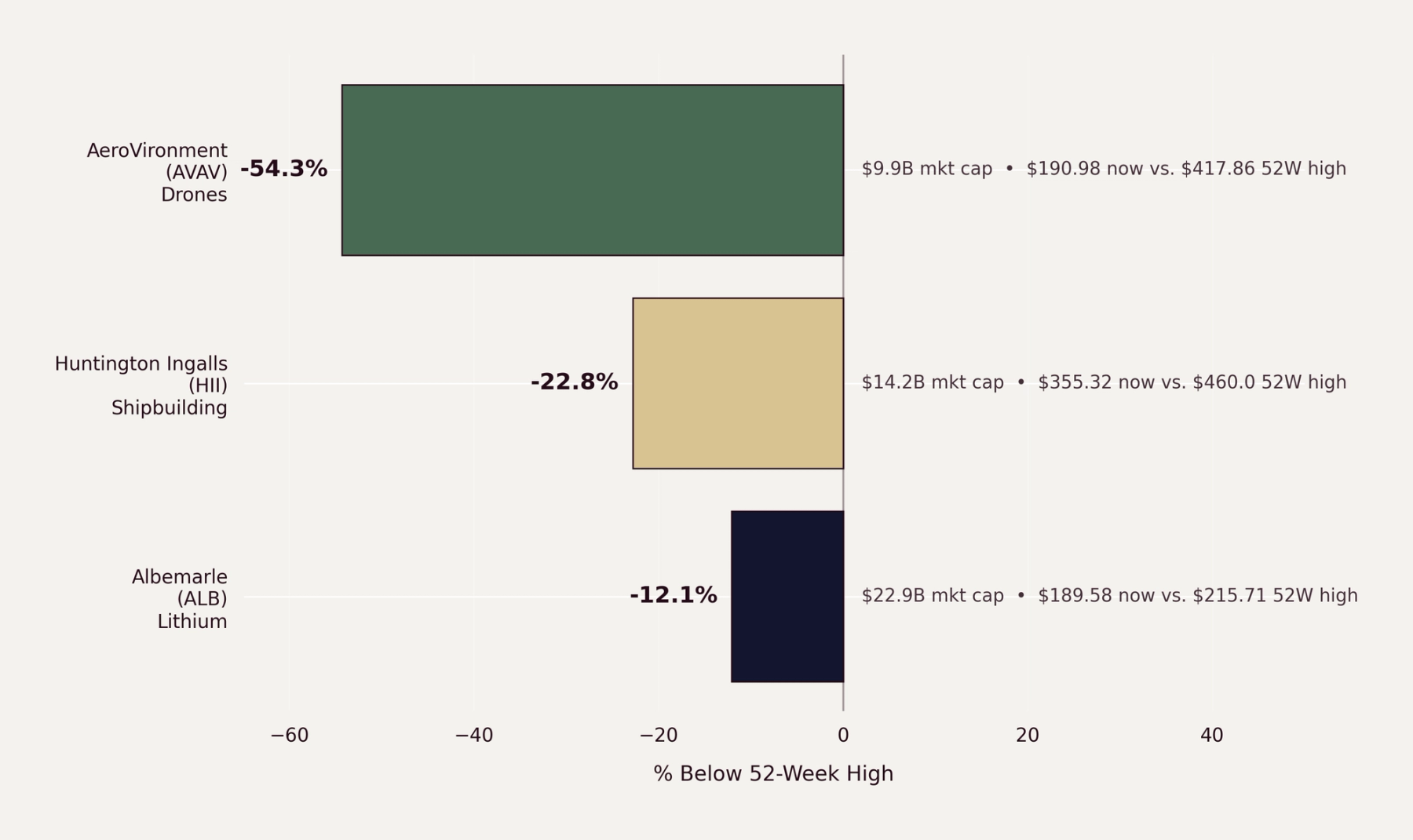
AeroVironment trades 55% off its 52-week high after a sequence of bad-news events.
Those include the BADGER phased-array stop-work order issued January 16, 2026 and publicly disclosed in an 8-K filed January 20, 2026 (which alone caused a roughly 20% one-week drop), the Q3 FY26 revenue and EPS miss on March 10, and the termination-for-convenience of the BADGER agreement under the SCAR program revealed with that print, which removed approximately $1.49B in SCAR-related unfunded backlog options and prompted a guidance cut to $1.85 to $1.95B.11,18 BlueHalo gross-margin compression compounds the picture, and most of the items are widely understood to be one-time or already discounted in guidance.
Huntington Ingalls trades 23% off its 52-week high on negative quarterly free cash flow and a soft 2026 ship-margin guide.12,15
Albemarle trades 13% off its high on a continued lithium glut and a Rothschild Redburn downgrade.13,20
Each is being valued as a broken cyclical.
None is being valued as the IP-holder endpoint of a contractor-to-acquirer arc that has already closed once this month.
The TSMC Inversion
The standard framing of US-versus-Asia manufacturing uses TSMC as the cautionary tale. US science (transistors at Bell Labs, integrated circuits at Fairchild, x86 at Intel) ceded the manufacturing floor to a Taiwan contractor that built the moat one node at a time.
Two decades on, TSMC is so dominant the US is paying it to build fabs in Arizona.
The arc, importantly, has not completed in semiconductors. TSMC has not bought Intel.
That is the analytical mistake. The TSMC arc is the longest-running version of a pattern that completes elsewhere on shorter cycles.
Pharma generics took roughly sixteen years from Sun's September 2010 acquisition of a controlling stake in Taro Pharmaceutical (the full Taro merger closed in June 2024) to the April 2026 Organon takeout, and shipbuilding is running on a similar clock.
Drone components
The US originated the loitering munition.
AeroVironment's Switchblade was developed with US Special Operations Command and is now central to US Army doctrine.6
For fifteen years, DJI captured the commercial drone market with over 50% of US sales by 2024, and Chinese suppliers locked up motors, batteries, and flight controllers.
The FCC closed that door on December 22, 2025, adding all foreign drones to the Covered List, with the action affecting only new imports and authorizations.7
AeroVironment, as a US-domestic loitering-munition manufacturer, is not on the FCC Covered List, and the Army wrote a $186M Switchblade order in February 2026.6 Funded backlog reached a record $1.1B as of January 31, 2026, up from $726.6M at the start of FY26 (April 30, 2025), with nine-month bookings of $2.1B and a 1.6x nine-month book-to-bill ratio per the company's Q3 FY26 press release.17
Consolidated revenue grew 143% YoY at Q3 FY26 to $408.0M, primarily reflecting BlueHalo lapping into the base after the May 1, 2025 acquisition close.
The contractor (DJI) is gone.
The science (Switchblade IP) is unprotected from a foreign-allied acquirer.
Lithium refining
US chemistry companies invented modern lithium processing. Albemarle inherited that IP through Rockwood and Ketjen catalysts, and built it into a global leader.
China then refined 70% of world lithium, and Western converters now run at a $4 to $5 per kilogram cost disadvantage.8 Albemarle idled its Kemerton Australian conversion plant. 2026 capex is guided to $550 to $600M, roughly flat versus 2025, after the 65% reduction completed in 2025.9
The Trump administration arranged a 5% federal equity stake (warrant-based) in Lithium Americas announced September 30, 2025, tied to a $2.26B Department of Energy loan to the Thacker Pass project.10 That is a tell that critical-minerals industrial policy is being weaponized through the loan-and-equity vehicle, not through Pentagon equity. Direct Pentagon equity stakes have been used in MP Materials and Trilogy Metals.
Shipbuilding
This is the cleanest live case.
The US invented modern naval architecture and nuclear propulsion.
China captured 53% of global ship orders by tonnage during the first eight months of 2025 per CSIS analysis of S&P Global data; the figure varies by methodology and window: China's Ministry of Industry and Information Technology reported full-year 2025 shares of 56.1% by completed deadweight tonnage and 69% by new-order DWT, while January through September 2025 measured by compensated gross tonnage came in at 47.3% completed and 63.5% by new orders.2,26 Korea is the next largest builder, in the roughly 25% to 35% range depending on methodology and period.
Hanwha Ocean bought Philly Shipyard in December 2024 for $100M, then announced an additional $5B investment in August 2025 alongside Korea's $150B US-shipbuilding pledge as part of a $350B total package.3 HD Hyundai Heavy and Huntington Ingalls signed an MOA on October 26, 2025 covering four areas: potential joint investments in distributed shipbuilding and flexible construction; teaming on US Navy auxiliary shipbuilding programs; engineering, R&D and technology collaboration; and lifecycle support for US Navy operations in the Indo-Pacific.4
Then-Navy Secretary John Phelan said on April 22, 2026 the Navy will study building US warships outside the US, and was fired hours later that same day. Subsequent reporting confirms the $1.85B FY27 study on foreign frigate and destroyer designs and yards was directed from outside the Navy and continues post-Phelan.5
The arc is no longer hypothetical.
The acquirer is named, the MOA is signed, and the labor-capacity problem makes it inevitable.
Three US targets, broken setups hide the acquisition asymmetry.
Sources: equity quotes per OpenBB / Yahoo Finance as of April 28, 2026 (see endnotes 11, 15). ALB last price $189.58, 52-week high $215.71. Catalyst tags as cited in endnotes 4, 5, 7, 18, 20.
The Names That Express the Theme
Hanwha Ocean (042660.KS), the emerging acquirer
Hanwha is the cleanest direct parallel to Sun Pharma in this framework.
It is a top-three global shipbuilder by tonnage, the world leader in LNG carrier construction, and it has already completed the first stage of the contractor-to-acquirer arc by buying Philly Shipyard.3
The August 2025 commitment of an additional $5B, Hanwha Defense USA CEO Michael Coulter's January 8, 2026 on-the-record statement to the Wall Street Journal that the company is "actively negotiating with the U.S. Department of Defense for contracts related to manufacturing surface ships, submarines, and unmanned vessels" and "seriously considering acquiring other shipyards in the United States within a few years,"14 and the parallel HD Hyundai-HII MOA all signal that the next stage, a larger IP-bearing US target, is coming. Hanwha's financial firepower comes from the broader Korean shipbuilding orderbook (combined Q1 2025 backlog of HD Korea Shipbuilding, Hanwha Ocean, and Samsung Heavy stood at approximately $137B / 192 trillion won, with gas carriers comprising more than 60% of the Hanwha and Samsung backlogs) and the structural tailwind of US LNG export expansion.
The LNG carrier orderbook for South Korea specifically was valued at approximately $71B per VesselsValue.27
The catalyst window is the formal execution of Korea's $150B MASGA pledge through 2026 and 2027.
The risk is a Korean-listed ticker that US retail cannot directly access on most platforms, though OTC ADRs exist for the parent Hanwha Group.
Huntington Ingalls (HII), the late-stage US target
HII is the only pure-play US naval shipbuilder of scale, with a $14.00B market cap (39.4M shares outstanding × $355.32 last price), $355.32 last price, and a 52-week range of $215.05 to $460.00.15 It already trades 23% off its high on a single weak quarterly free cash flow print and a soft 5.5 to 6.5% operating margin guide.12
What the market is not pricing is the October 2025 MOA with HD Hyundai Heavy that contemplates joint investments in distributed shipbuilding and flexible construction,4 the then-Navy Secretary's April 22, 2026 acknowledgment that warship construction may move offshore (he was fired hours later the same day),5 and the structural reality that the Navy's 381-ship goal cannot be hit without foreign shipbuilding capacity.
The catalyst is concrete.
Either HII becomes the JV partner that captures premium-margin offshore-built US Navy contracts, which alone reprices the equity, or it becomes the target of a partial commercial-asset acquisition by Hanwha or HD Hyundai.
The full nuclear-and-submarine business stays in US hands by law. Auxiliary builds, MRO work, and unmanned-surface assets face fewer statutory restrictions, though CFIUS still applies whenever defense IP transfers are involved. Korea has already won three US Navy MRO contracts in 2026.5
AeroVironment (AVAV), the front-edge US target
AVAV at $189.84 is the most asymmetric of the three.11
The setup is structurally identical to the Organon condition, with irreplaceable US-origin IP, the foreign contractor (DJI) legislated out, and the equity reset hard on a sequence of one-time events.
Funded backlog hit a record $1.1B at Q3 FY26, up from $726.6M at the start of FY26, with nine-month bookings of $2.1B and a 1.6x nine-month book-to-bill ratio per the company's Q3 FY26 press release, on the back of the DJI Covered-List action and the Section 232 drone import probe.17
The stock is down 55% from its 52-week high on a combination of (a) the BADGER phased-array stop-work order issued January 16, 2026 and disclosed January 20, 2026, (b) the BADGER OTA termination-for-convenience disclosed with the Q3 FY26 print on March 10, removing approximately $1.49B in SCAR-related unfunded backlog options and prompting an FY26 guide cut to $1.85 to $1.95B, (c) BlueHalo gross-margin compression, and (d) government-shutdown timing in the space business.18
The company just launched MAYHEM 10, a new multifunctional drone, in April 2026.19 What the market is missing is that AVAV holds the only at-scale US-origin loitering-munition IP, the foreign contractor (DJI) has been legislated out, and a US-allied acquirer (Israeli Elbit, Korean LIG Nex1, or a US prime like Lockheed or Northrop seeking to verticalize counter-drone) faces a closing window.
The catalyst is the Q4 FY26 print, scheduled for June 23, 2026 per AeroVironment's published earnings calendar (matching the June 24, 2025 prior-year cadence). That print removes both the SCAR uncertainty and the BlueHalo margin overhang.
The Premium Decode
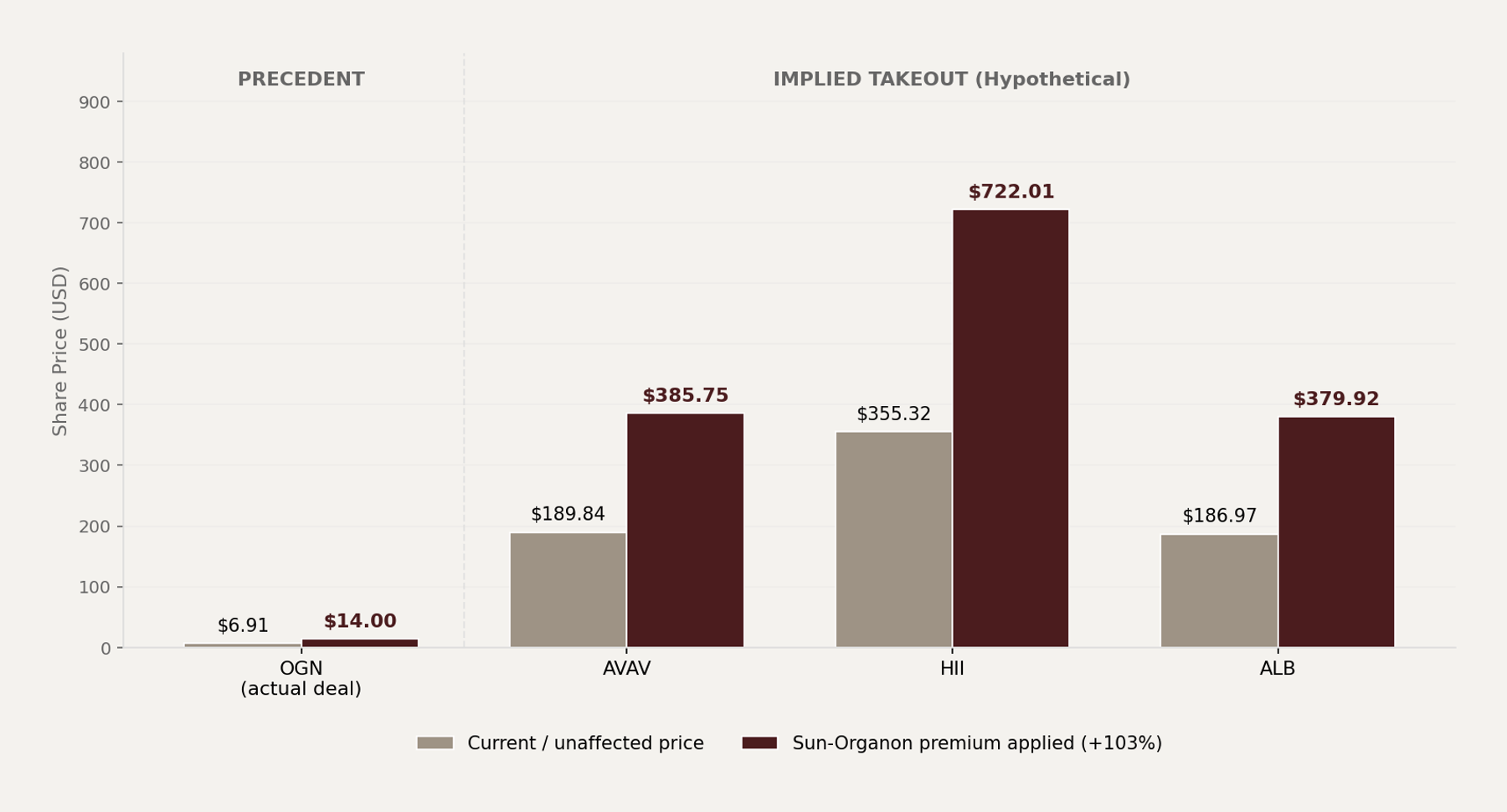
Apply Sun's 2.03x premium to AVAV, HII, and ALB and the implied takeouts run to $386, $722, and $380 at today's prices.
Sources: equity quotes per OpenBB / Yahoo Finance as of April 28, 2026 (endnotes 11, 15; ALB price from same source set). Premium calibration: $14.00 offer divided by $6.91 April 9, 2026 unaffected close per the Sun Pharma definitive agreement (endnotes 1, 16).
The chart is not a forecast. It is a calibration.
The Sun-Organon deal was struck at roughly 2.03x the pre-rumor unaffected price, equivalent to a roughly 103% premium.1,16
Apply that same arithmetic to AVAV, HII, and ALB and the implied takeouts run to roughly $386, $722, and $380 at today's prices.
None of those are price targets in the analytical sense. They are anchors that show what the asset would be worth to a contractor that has decided the IP is cheaper to buy than to license.
Even a 50% premium, half of what Sun paid for Organon on the pre-rumor reference, implies roughly $285 for AVAV, $533 for HII, and $280 for ALB. That is a 50 to 60% upside band on each name, on a thesis the market is not yet pricing. On the narrower 24% premium-to-April-24 framing that Reuters used, the math collapses by roughly 4x, and the right framing depends on whether the IP value or the unaffected market price is the correct anchor.
The Counter-Argument
The strongest case against this framework is CFIUS.
The Committee on Foreign Investment in the United States exists precisely to block foreign acquisitions of strategic US assets, and it held up Nippon Steel's $14.9B takeover of US Steel for roughly eighteen months (deal announced December 2023, blocked by President Biden January 3, 2025) before President Trump approved a structured compromise on June 13, 2025 that included a perpetual U.S. government "golden share" with veto authority over key corporate decisions and a Nippon commitment of $11B in new US Steel investments by 2028.
The deal closed June 18, 2025.28
The notion that Hanwha or HD Hyundai will be allowed to buy Huntington Ingalls outright is fantasy.
The notion that an Israeli or Korean defense prime will be allowed to buy AeroVironment outright is also fantasy. The Sun-Organon deal worked because pharma is not subject to CFIUS the way defense and critical infrastructure are.
This is real, and it sets the ceiling on the trade. But it does not break it.
The HII case is not a full takeout. The signed MOA with HD Hyundai contemplates joint investment, joint construction, and lifecycle support, though it does not, on its public face, name an outright acquisition of US shipyards.4 The economic value flows to HII through MRO contracts, JV margins, and the implicit floor on commercial-asset divestitures, not through a control premium, and that is enough to reprice the equity.
AVAV is a different story. US-allied acquirers of defense IP have well-documented precedent: Elbit Systems of America operates as a Fort Worth, Texas-headquartered subsidiary of Elbit Systems Ltd. with over 3,300 employees across 11 US sites, governed under a Special Security Arrangement;23 BAE Systems' US subsidiary acquired Lockheed Martin Aerospace Electronic Systems in 2000, United Defense in 2005 ($4.2B), Armor Holdings in 2007, and Ball Aerospace in 2024 ($5.5B), each cleared under CFIUS;24 and Hanwha Group's defense affiliates signed partnership and joint-development agreements with Northrop Grumman and Leidos Gibbs & Cox at Sea-Air-Space 2026 in April 2026.25 A 51% control deal for AVAV is unlikely, but a strategic partnership with a 19.9% stake, an exclusive supply agreement, or a divisional purchase of the unmanned ground systems business is plausible, and each unlocks a meaningful premium.
The second risk is sector-specific.
Lithium prices may stay weak through 2027, which would extend Albemarle's pain and delay any acquirer's urgency.20 Drone procurement may slow if the FY27 defense budget compresses, and shipbuilding capacity expansion may face Korean labor and political pushback.
Each of these breaks the timing of the trade without breaking the structure. The arc still completes, and the question is whether it completes in 2026, 2027, or 2028.
The third risk is execution at the acquirer.
Hanwha Ocean's five US-linked subsidiaries were sanctioned by China on October 14, 2025, and Beijing announced a one-year suspension of those countermeasures on November 10, 2025 following the Trump-Xi Busan summit. The sanctions are suspended, not permanently rescinded.21
If China-Korea tensions reignite, the Korean shipbuilders' US ambitions get squeezed. This affects timing more than direction. The structural mandate for a US-build solution does not disappear because Beijing is unhappy.
Key Data Table
| Company | Ticker | Role | Mkt Cap ($B) | Last Price | Off 52W High | Catalyst Window |
|---|---|---|---|---|---|---|
| Sun Pharma | SUN-IN | Precedent acquirer | ~$41 | n/a | n/a | Definitive agreement Apr 26, 2026, close expected early 2027 |
| Organon | OGN | Precedent target | $11.75 (EV) | $14.00 (offer) | n/a | Definitive agreement Apr 26, 2026, close expected early 2027 |
| Hanwha Ocean | 042660.KS | Emerging acquirer | ~$30 | KRW 133,500 | n/a | MASGA execution 2026 to 2027 |
| Huntington Ingalls | HII | US target, ships | $14.00 | $355.32 | -22.8% | HD Hyundai MOA, Q1 2026 earnings |
| AeroVironment | AVAV | US target, drones | $9.61 | $189.84 | -54.6% | Q4 FY26 print June 23, 2026 |
| Albemarle | ALB | US target, lithium | $22.04 | $186.97 | -13.3% | Q1 2026 print May 2026 |
Market data sourced via OpenBB / Yahoo Finance as of April 28, 2026; see endnotes for issuer-specific filings and contract documents.
Catalyst Map
AVAV reports Q4 FY26 on June 23, 2026 per the company's published earnings calendar (matching the June 24, 2025 prior-year cadence).
The BADGER/SCAR overhang clears, BlueHalo gross margins normalize toward the high 30s, and Switchblade order momentum compounds. This is the single largest near-term catalyst across the three names.
ALB reports Q1. Lithium spot pricing is the variable, and energy storage demand growth (Albemarle guided 15 to 40% for 2026) is the offset.22
Author projection, not a scheduled milestone: HD Hyundai and HII may formalize MOA terms during 2026, with specific shipyard JV structures (potential MRO expansion, auxiliary work, possible commercial-asset carve-out) plausibly announced. Neither company has published a binding deadline for definitive terms; the public MOA does not commit either party to a closing date.
Author projection, not a scheduled milestone: the $150B MASGA shipbuilding component of the Korea-US package may convert into named Korean investments and acquisitions during the second half of 2026 as Korean shipbuilders execute against the framework agreement. Konkrete commitments will trail the framework, and the timeline is contingent on US-Korea bilateral execution.
The Navy's stated procurement window for the first Trump-class battleship (BBG-1 Defiant) is the FY28 budget submission, with $17B in procurement funding planned and construction expected to begin in fiscal 2028. HII's role and any foreign-build component become explicit when the FY28 submission lands.
Section 232 drone investigation rulings continue. FCC Covered List enforcement against remaining DJI inventories proceeds in parallel.
The Bottom Line
The Sun-Organon deal is the proof point that the contractor-to-acquirer arc completes, and the roughly 103% pre-rumor premium is the calibration for what completion looks like in cash terms. CFIUS keeps the trade asymmetric rather than killing it, because partial deals, joint ventures, and divisional carve-outs each unlock the premium without requiring full takeouts. The risk that breaks the thesis is timing, since if the arc slips into 2028 the holding cost is two years of weak earnings on broken-cyclical equities like AVAV and HII.
Sources
Sources.