Silvia Insights · April 29, 2026
These 2 large-cap stocks have grown free cash flow while hyperscaler capex has exploded
Hyperscaler capex went from roughly $80 billion in 2020 to a projected $660 billion in 2026, and the FCF margins of Microsoft, Alphabet, Meta, and Oracle have each fallen 8 to 12 percentage points as a direct result. Two large-cap names ran the opposite way over the same four years.
What to Know
- Long MSCI at $591 (mean Street target $688, +16% upside) and Mastercard at $506 (mean target $664, +31% upside) as the two large-cap names with FCF margins that expanded 3.7 and 4.3 points from FY2021 to FY2025.1,2
- Hyperscaler capex now equals roughly 100% of operating cash flow versus a 10-year average of 40%, and sell-side analysts forecast Amazon's 2026 free cash flow at negative $17 billion at the consensus end and negative $28 billion at the most bearish.8,10
- The next confirmation arrives this week, with Microsoft, Alphabet, Meta, and Amazon all reporting after the close on April 29 and Mastercard reporting before the open on April 30.3
Mega-cap FCF margins are collapsing while two names quietly expanded over the same four years.
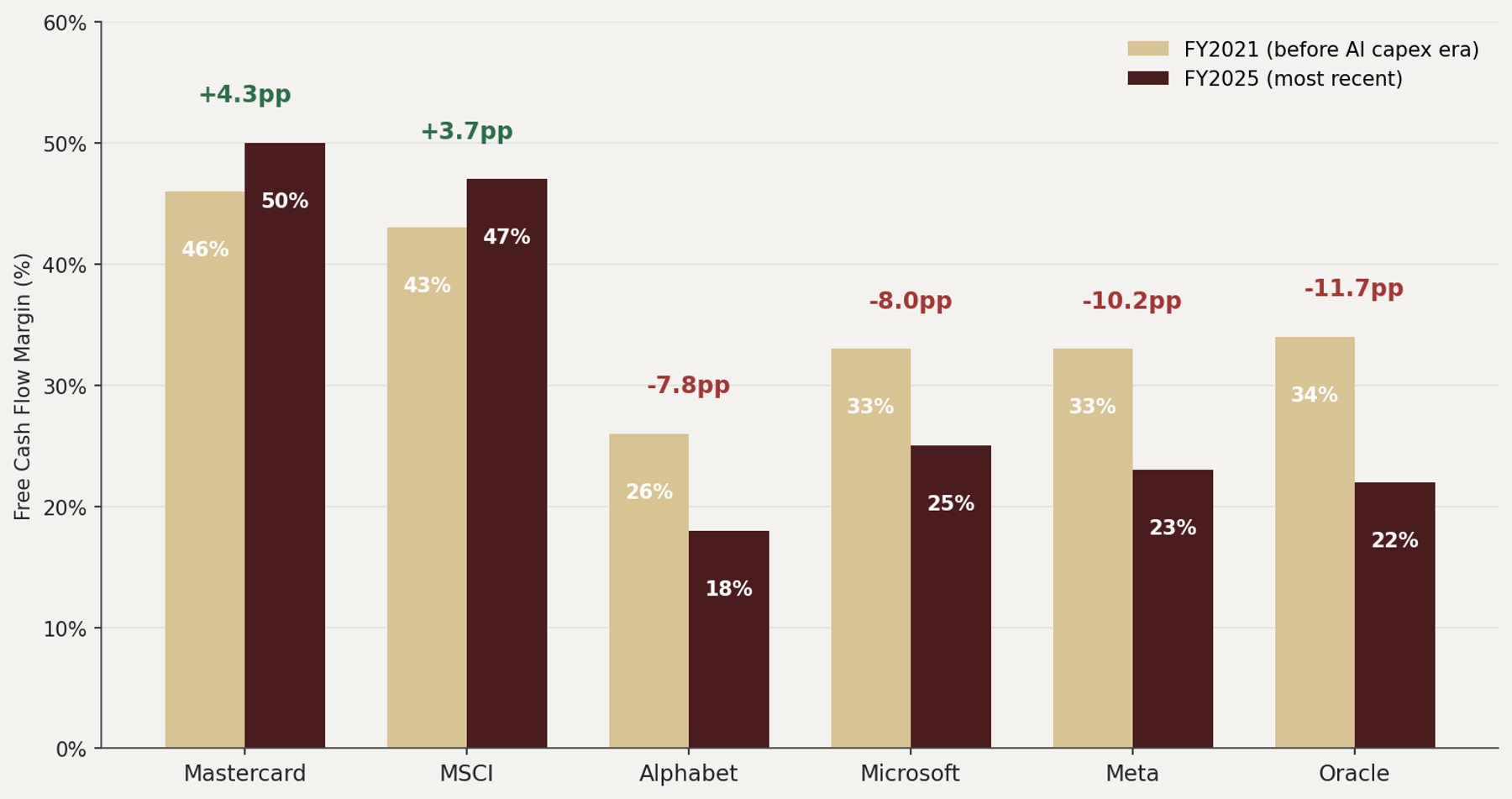
FY2021 versus the most recently reported fiscal year, percentage-point change shown above each pair.¹
The Analytical Framework
This list is built from one filter applied to a universe of 17 large-cap candidates. Free cash flow margin must have expanded between FY2021 and the most recently reported fiscal year, the absolute FCF margin must exceed 35%, and the most recent quarterly print must demonstrate the trend is still in motion.
The seven mega-cap hyperscalers (MSFT, GOOGL, META, AMZN, AAPL, NVDA, ORCL) failed the first criterion because every one of them has lost FCF margin over the four-year window.
Among the asset-light universe, MSCI, Mastercard, BKNG, MCO, and FICO passed all three thresholds.1
FICO was excluded after April 22, 2026, when the FHFA and HUD jointly approved VantageScore 4.0 (alongside FICO Score 10T) for FHA, Fannie Mae, and Freddie Mac mortgage underwriting, converting it from a high-conviction asset-light franchise into a contrarian special situation.
MCO and BKNG cleared the framework but rank below the two final picks on absolute margin level and end-market cyclicality.11
Free cash flow margin is computed as free cash flow divided by revenue on an annual basis. Margin change is the difference in percentage points between the most recent fiscal year and FY2021.
Forward P/E is current price divided by FY27 consensus EPS.1
The Watchlist
| Company | Ticker | Price | Mkt Cap | FCF Margin (FY25) | 4Y Margin Change | Mean PT (Upside) | Next Catalyst |
|---|---|---|---|---|---|---|---|
| MSCI Inc. | MSCI | $591.02 | ~$43B | 46.5% | +3.7pp | $688 (+16.4%) | Q2 2026 print, Jul 22 (est.) |
| Mastercard | MA | $506.43 | ~$455B | 50.1% | +4.3pp | $664 (+31.2%) | Q1 2026 print, Apr 30 BMO |
The Theme Behind The List
The companies that defined index returns from 2015 to 2023 were asset-light by design.
Software has near-zero marginal cost, so each new dollar of revenue scales while the cost base barely moves. That single property is the reason the Magnificent Seven trade where they trade.
AI broke the model.
Training and serving frontier models requires GPUs, networking, cooling, power agreements, and physical real estate. The four largest hyperscalers spent roughly $80 to $100 billion on capex in 2020, $230 billion in 2024, and will spend roughly $660 billion in 2026 (range $630 to $700 billion across syntheses).7,8
Amazon alone is on track for roughly $200 billion in 2026 capex.
Alphabet has guided to $175 to $185 billion.
Meta has guided as high as $135 billion. Microsoft is tracking toward $120 to $146 billion in fiscal 2026.7
This is a categorical change to the unit economics of these businesses. Hyperscaler capex now equals roughly 100% of operating cash flow versus a 10-year average of 40%.8
When capex equals cash flow, free cash flow goes to zero. Sell-side analysts now forecast Amazon's 2026 free cash flow at negative $17 billion at the consensus end and negative $28 billion at the most bearish.10
The market is starting to reprice. Microsoft just had its worst quarter for the stock since the 2008 financial crisis, with the stock down 23% in Q1 2026 alone, and Alphabet's reported return on invested capital has already compressed from roughly 45% at its 2021 peak to approximately 28% by year-end 2025, with sell-side paths assuming continued compression as AI capex flows through the denominator.9,14
The compounding machine is being capital-intensified into a different kind of business.
Capital-light tech is becoming capital-heavy industrial, and the multiples are following.
Hyperscaler capex went from roughly $80 billion to a projected $660 billion in six years.
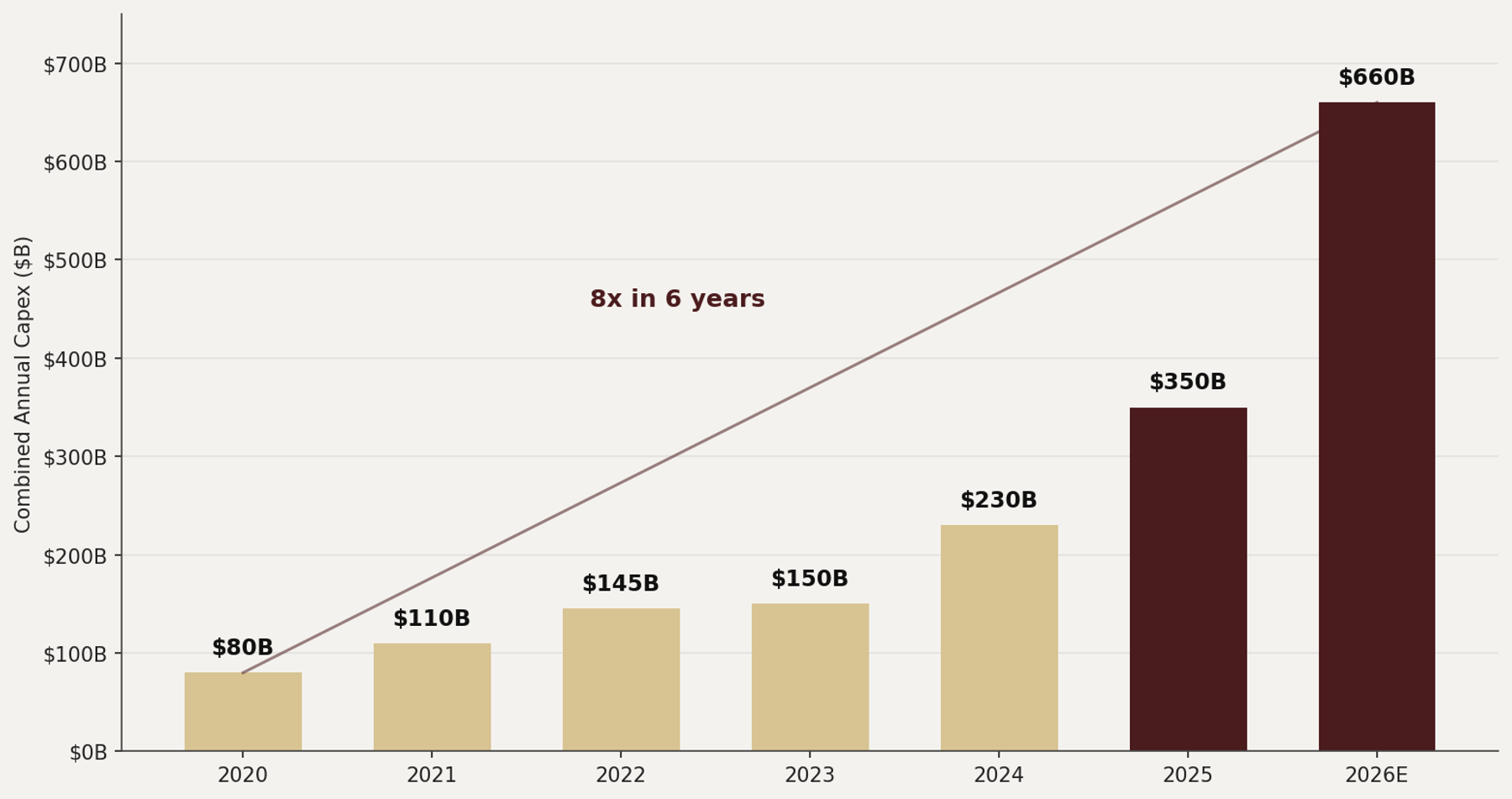
Combined annual capex of MSFT, GOOGL, META, and AMZN. 2020 through 2024 from company filings; 2025 reflects current run-rate disclosures; 2026E is the midpoint of analyst syntheses.⁷,⁸
Name-By-Name Analysis
Pick 1. MSCI, the index subscription toll booth
MSCI runs the second-largest index family in the world after S&P and the largest ESG and climate analytics franchise.
Every passive ETF that tracks the MSCI ACWI, MSCI EAFE, MSCI Emerging Markets, or any of the 250,000-plus MSCI indexes pays a recurring asset-based fee.4
The business has zero physical assets that need scaling. Operating margin is 53.7%, higher than Microsoft's. FCF margin is 46.5% and expanding.1,4
Subscription retention is 95.4%, with company-reported Total Run Rate growing approximately 13% year-over-year.
The April 21, 2026 Q1 print delivered operating revenue of $850.8 million, +14.1% reported and +13.3% organic, and adjusted EPS up 13.8% to $4.55.4
MSCI returned $464 million via share repurchases at an average price of $555.61 (covering Q1 2026 plus the first 20 days of Q2, the only buyback figure disclosed in the press release).
The Board declared a Q2 2026 dividend of $2.05 per share, +14% year-over-year, with approximately $150 million returned via dividend in Q1.4
The AI thesis for MSCI is the opposite of the AI thesis for Microsoft. AI does not replace MSCI because AI funds need MSCI benchmarks. Every quant strategy needs index data and every climate-aware allocator needs MSCI's ESG analytics.4
The product gets more valuable as AI accelerates the proliferation of systematic strategies, and none of that growth requires MSCI to spend a single additional dollar on data centers. The data is already owned and already licensed.
The risk to the thesis is fee compression at the index level. S&P and FTSE Russell compete aggressively on price. The counter is MSCI's dominance in international and ESG, where pricing power has been demonstrably stronger and where switching costs (rewriting reporting infrastructure, re-papering pension boards) are punishing.
Pick 2. Mastercard, the payment rail that outpaces Visa
Mastercard charges 0.5% to 3.0% on every transaction across its global network with effectively zero marginal cost on each incremental swipe. Operating margin is 57.6%. FCF margin is 50.1%, twice Microsoft's.1,5
Q4 2025 (reported January 29, 2026) delivered $4.76 adjusted EPS versus a consensus of approximately $4.22, a beat of roughly 12.8%. Net revenue rose 18% (15% currency-neutral) to $8.81 billion. Cross-border volume grew 14% and gross dollar volume grew 7% on a local-currency basis.5
Mastercard has consistently beaten consensus EPS over the trailing two-year window, with the Q4 2025 print marking the largest beat of that period.1
Mastercard outperforms Visa on every dimension that matters for this thesis. MA grew net revenue several hundred basis points faster than V last quarter, and MA's FCF margin expanded 4.3 points from FY2021 to FY2025 while Visa's contracted 6.3 points over the same period.1
That is not a stylistic difference. It is a structural one.
Mastercard has been more aggressive on cross-border (where take rates are highest), more aggressive on B2B and value-added services, and more disciplined on capital allocation.5
The 4% workforce reduction announced January 29, 2026 was framed as refocusing investment in higher-growth lines, not cost-cutting from weakness, and was paired with an approximately $200 million one-time Q1 restructuring charge.5
The AI thesis for Mastercard is rail economics. Every AI-driven commerce transaction (agentic shopping, embedded checkouts, micro-subscriptions, digital wallets) settles on a card rail or a network like Mastercard Send. AI accelerates the digitization of cash, which is bullish for whoever owns the rails.
Why not Visa, Adobe, ServiceNow, or Salesforce
Visa has flat-to-contracting FCF margins, slower revenue growth, and weaker cross-border momentum. Mastercard wins the same trade with better numbers.1
Adobe, Atlassian, ServiceNow, and Salesforce are getting hit by investor concern that AI agents replace seat-based software.
Adobe is down roughly 32% year-to-date, ServiceNow is down roughly 41% YTD, and Atlassian is down roughly 57% YTD.1
These businesses face the wrong AI exposure (substitute risk) and trade like it. MSCI and Mastercard have the right exposure (complement risk), where AI makes their core products more useful, not less.
FICO would be a third pick on the same thesis (37% FCF margin, monopolistic pricing) if not for the April 22, 2026 FHFA and HUD VantageScore announcement, which converted it from a high-conviction asset-light name into a contrarian special situation.
Worth watching, not worth committing to today.11
Both names beat the most recent quarter on margin, growth, and capital return at the same time.
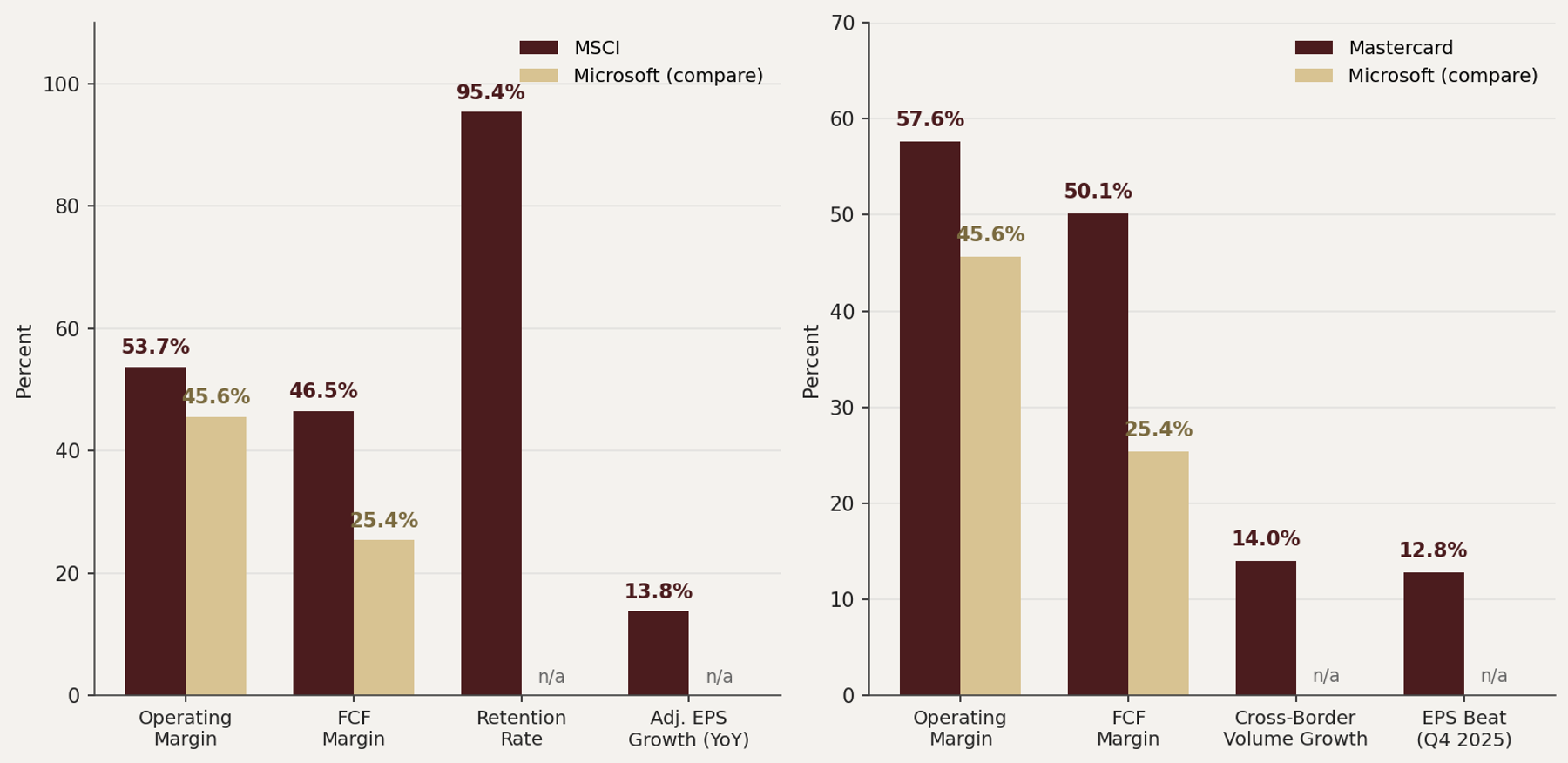
MSCI Q1 2026 release (April 21, 2026); Mastercard Q4 2025 release (January 29, 2026); Microsoft FY2025 financials shown for comparison.⁴,⁵,⁶
The Consensus And Where It Breaks
The dominant Wall Street narrative on hyperscaler capex has three components.
First, capex is investment, not expense, and will produce 3x ROIC by 2028.
Second, free cash flow contraction is temporary and reverses in 2027.9
Third, the capex creates a moat that protects the existing software cash flows. Three problems with that view, in increasing order of severity.
One. Depreciation is real. GPUs have a useful life of three to five years before they are technically obsolete. The depreciation expense from $660 billion in 2026 alone will compound through the income statement for the rest of the decade regardless of what AI revenue arrives.9
Two. The math on capex efficiency is getting worse, not better. The 100%-of-CFO ratio is an all-time high, and Alphabet's invested capital base nearly doubled between FY2021 and FY2025 while ROIC fell from roughly 45% to approximately 28%. Even if AI revenue arrives, the denominator is growing faster than the numerator.8,14
Three. The market is already repricing. Microsoft's forward multiple has compressed materially in 2026, and Amazon's is at the lowest since 2017.1
The repricing is not waiting for the FCF crater to materialize on the income statement. Investors are front-running it now.
The non-obvious dimension consensus is missing entirely is the second-derivative effect.
Every dollar of hyperscaler capex creates demand for another category of asset-light businesses, the data licensors, payment rails, ratings agencies, and exchanges that monetize the financial activity AI accelerates.
These businesses do not need to spend on GPUs because they sit one layer up the stack. They get paid every time financial data is queried, every time a transaction settles, every time a portfolio is benchmarked.
The Counter-Argument
The strongest case against this thesis is that AI capex actually pays off. If hyperscaler capex generates 3x ROIC by 2028, the bull case Microsoft and Alphabet management have publicly endorsed, then today's FCF crater reverses violently in 2027 and 2028.9
Mega-cap multiples re-rate higher and the relative outperformance of MSCI and Mastercard gets compressed back to the long-term mean. The hyperscalers stop being the trade you avoid and become the trade you over-weight.
There are three credible mechanisms for the bull case. First, AI inference revenue could scale faster than expected. OpenAI exited 2025 at over $20 billion in annualized revenue and was reported to be running above $25 billion annualized in early 2026.
Enterprise AI agents are a real revenue stream that did not exist two years ago.12
Second, GPU efficiency improves rapidly. Nvidia's Blackwell, then Rubin, generations claim 30x performance per dollar improvements that could collapse the cost-to-serve.9
Third, depreciation accounting could be adjusted. Alphabet already extended its server useful life from four years to six years in 2023, lifting reported earnings by approximately $3.0 billion in fiscal 2023 alone without changing economic reality.13
The counter to the counter is that even in the bull case, the math does not produce a return to 33% FCF margins.
Alphabet's ROIC has already compressed by roughly one-third over the four years through FY2025, and Microsoft's has compressed by more than half over the same window, on the strength of capex flowing through the invested-capital base before AI revenue arrives at scale.14
These businesses are becoming structurally more capital-intensive even if AI revenue scales. The relative trade (long asset-light, less aggressive on hyperscalers) works in any scenario other than a complete and immediate AI revenue explosion that only management has actually projected.
The other thesis-breaker is regulatory. The Credit Card Competition Act, EU PSR3, and the FHFA and HUD VantageScore announcement on April 22, 2026 demonstrate that government action can compress monopolistic pricing without warning.11
The counter is that Mastercard derives the majority of incremental growth from cross-border, value-added services, and Mastercard Send, all of which sit outside the domestic interchange regulation that CCCA and PSR3 target.
MSCI faces no analogous regulatory risk because index pricing has never been regulated and the underlying products sit outside any defined consumer protection regime.5
The asset-light thesis survives a regulatory shock to the payment networks. It does not survive a regulatory attack on data licensing, but no such attack exists or is being seriously discussed.
The third risk is valuation. MSCI trades at 26.3x forward FY27 EPS, and Mastercard trades at 22.3x. Neither is cheap on absolute terms.1
Microsoft, by comparison, currently trades at roughly 25x forward FY26 and 22x forward FY27 EPS, close to Mastercard on FY27 and below MSCI. MSCI and Mastercard are paying for that multiple with expanding margins, while Microsoft is paying for it while margins contract.1
The relative valuation argument is not that asset-light is cheaper. It is that asset-light is fairly priced for an expanding-margin business while asset-heavy is fairly priced for a contracting-margin business, and the latter is the riskier setup at any given multiple.
Catalyst Map
| Date | Event | Why It Matters |
|---|---|---|
| Apr 29, 2026 (AMC) | MSFT FY26 Q3, plus GOOGL, META, AMZN Q1 2026 | Capex guidance updates. Amazon FCF print is the single most important data release for this thesis. |
| Apr 30, 2026 (BMO) | Mastercard Q1 2026 release | Consensus expects continued ~13% cross-border volume growth. A beat confirms the thesis with fresh data. |
| Apr 30, 2026 (AMC) | Apple FY26 Q2 earnings | Read-through on Apple capex commentary for AI infrastructure exposure. |
| Jul 22, 2026 (est.) | MSCI Q2 2026 earnings | Test of subscription growth durability. Retention rate and Total Run Rate are the headline metrics. |
| 2H 2026 | EU PSR3 final implementation rules | Defines the regulatory ceiling on Mastercard's European interchange. Bear case test. |
| 2H 2026 | FHFA VantageScore mortgage rollout milestones | Read-through on how aggressive regulators are willing to go on monopolistic pricing of financial data. |
| Q1 2027 | Hyperscaler 2027 capex guidance | If MSFT, GOOGL, META guide capex higher again, the asset-heavy story extends another year. |
The Bottom Line
The 2010s mega-cap playbook is being unwound right now, and the businesses that genuinely retain those characteristics are an increasingly small list. MSCI and Mastercard are two of them, with expanding FCF margins of +3.7 and +4.3 points over the same four years that Microsoft, Alphabet, Meta, and Oracle each lost 8 to 12 points. The most important near-term catalysts are the avalanche of mega-cap prints on April 29 (MSFT, GOOGL, META, AMZN, all after-market) and the Mastercard Q1 2026 release on the morning of April 30.
Disclosures. ProCap Insights is a research division of ProCap Financial. This report is for informational and analytical purposes only. It does not constitute investment advice and does not make buy, sell, or hold recommendations on any security. Nothing in this report should be construed as a solicitation or recommendation to buy or sell any financial instrument. Readers should conduct their own due diligence and consult a qualified financial advisor before making any investment decision.
Sources
Sources
Finnhub company fundamentals API (FCF margin, operating margin, EPS estimates, forward P/E inputs, FY2021–FY2025 annuals for MSCI, MA, V, MSFT, GOOGL, META, ORCL, ADBE, NOW, TEAM, FICO, MCO, BKNG); cross-checked against OpenBB FMP equity fundamentals. Accessed April 28, 2026. Supports the FCF margin levels and 4-year changes (Watchlist table, hero chart, MSCI/MA name-by-name detail), forward P/E ratios, YTD price returns, and Visa contraction figure. https://finnhub.io/docs/api/company-basic-financials
Finnhub price target consensus, last updated within 30 days of April 28, 2026. Cross-checked against Yahoo Finance analyst consensus (MSCI mean $683.56 target, MA mean $652.69 target). Supports Watchlist mean PT and upside columns. https://finance.yahoo.com/quote/MSCI/analysis/ · https://finance.yahoo.com/quote/MA/analysis/
Finnhub earnings calendar, April 28 through May 2, 2026, accessed April 28, 2026. Cross-checked against Mastercard IR (April 30 Q1 release), Apple IR (April 30 Q2 release), and Mag 7 earnings previews (April 29 cluster). Supports Catalyst Map and "next confirmation" bullet. Mastercard IR · Apple Q2 release date · Mag 7 April 29 cluster
MSCI Q1 2026 earnings call and press release, April 21, 2026 (ir.msci.com). Supports MSCI Q1 print numbers: revenue +14.1% reported / +13.3% organic to $850.8M, adjusted EPS $4.55 (+13.8%), retention 95.4%, total run rate growth ~13%, $464M+ buyback at avg ~$556, $2.05 Q2 2026 dividend declared. https://ir.msci.com/news-releases · Q1 2026 call transcript
Mastercard Q4 2025 earnings release and conference call, January 29, 2026. Supports Q4 2025 EPS $4.76 (adjusted, +25%), net revenue $8.81B (+18%), cross-border volume +14%, GDV +7% local currency, 4% workforce reduction, $200M Q1 2026 restructuring charge. 4Q25 Earnings Release (PDF) · 4Q25 Earnings Presentation (PDF) · Workforce reduction (Yahoo / Reuters) · Investing.com Q4 recap (consensus EPS ~$4.22)
Microsoft FY2025 10-K and Q2 FY26 financial results, supporting the FY25 operating-margin (45.6%), FCF margin (25.4%), and revenue figures used for the comparison column in the scorecard chart. FY26 Q2 press release
CNBC, "Tech AI spending approaches $700 billion in 2026, cash taking big hit," February 6, 2026. Supports 2026 hyperscaler capex range ($630–$700B), individual 2026 capex guidance (AMZN $200B, GOOGL $175–$185B, META up to $135B, MSFT $120–$146B), and the Morgan Stanley / BofA Amazon FCF range. https://www.cnbc.com/2026/02/06/google-microsoft-meta-amazon-ai-cash.html
UBS Global Research publications on hyperscaler capex-to-CFO ratio, February to March 2026. Supports the 100%-of-operating-cash-flow claim and the 10-year-average 40% benchmark. (Subscription research; cited via the CNBC and Reuters Breakingviews summaries below.) CNBC summary
Reuters Breakingviews, "How Big Tech's $630 bln AI splurge will fall short," March 25, 2026. Supports the broader argument that hyperscaler capex efficiency is deteriorating despite the bull case for AI ROIC. https://boereport.com/2026/03/25/how-big-techs-630-bln-ai-splurge-will-fall-short/
Morgan Stanley equity research (Brian Nowak) and Bank of America equity research, Amazon 2026 FCF forecasts of negative $17 billion and negative $28 billion respectively, both cited in CNBC, February 6, 2026. https://www.cnbc.com/2026/02/06/google-microsoft-meta-amazon-ai-cash.html
FHFA, "Homebuying Advances into New Era of Credit Score Competition," April 22, 2026. FHFA and HUD jointly announced VantageScore 4.0 and FICO Score 10T as eligible credit-scoring models for FHA-insured mortgages and for Fannie Mae and Freddie Mac. Supports the regulatory-risk discussion and the FICO exclusion from the framework. https://www.fhfa.gov/news/news-release/homebuying-advances-into-new-era-of-credit-score-competition · Inman coverage
OpenAI annualized revenue trajectory. CFO Sarah Friar confirmed annualized revenue crossed $20 billion in 2025 (Reuters, January 2026). The Information later reported OpenAI topped $25 billion in annualized revenue in early 2026. Supports the bull-case AI revenue mechanism. Reuters via Yahoo (CFO statement) · The Information report ($25B+ annualized)
Alphabet Q4 2023 / FY 2023 earnings release, January 30, 2024. In January 2023 Alphabet adjusted the estimated useful life of servers from four to six years and certain network equipment from five to six years, reducing FY 2023 depreciation expense by approximately $3.9 billion and lifting net income by approximately $3.0 billion. Supports the depreciation-accounting bull-case mechanism. Q4 2023 release (SEC EDGAR)
Alphabet and Microsoft historical ROIC trajectory. Standard published ROIC calculations show Alphabet's ROIC peaking at approximately 45% in FY2021, registering 41% in FY2024, and falling to roughly 28% by year-end 2025, while Microsoft's ROIC peaked near 46% in FY2021 and fell to approximately 24% by FY2025. Invested capital at Microsoft rose from approximately $108 billion in FY2020 to approximately $431 billion in FY2025. Supports the ROIC-compression argument in the consensus and counter-argument sections. GuruFocus GOOG ROIC · Finance Charts GOOGL ROIC · GuruFocus MSFT ROIC · Stock Analysis on Net — Microsoft ROIC · Stock Analysis on Net — Alphabet ROIC