Silvia Insights · April 24, 2026
3 stocks to play the AI-fueled uranium squeeze
Wall Street is pricing the reactors but it's barely begun pricing the fuel. Goldman Sachs projects a 1.763 billion pound uranium supply deficit through 2045, and three uranium stocks have each returned more than 180% over the past year against 35% for the S&P 500.
What to Know
- The trade is long uranium producers that capture the AI-driven nuclear renaissance. Cameco (CCJ) at $126 is the blue-chip with Westinghouse leverage, Uranium Energy (UEC) at $15 is the unhedged domestic inflection play, and NexGen (NXE) at $13 holds the option on the largest new mine on Earth.
- Goldman's April 2026 reactor tracker quantifies a 1.763 billion pound uranium deficit through 2045, yet the U.S. still imports 95% of its uranium fuel, producing barely 1 million pounds domestically against 50 million consumed annually.
- NexGen begins construction on Rook I this summer after receiving final federal approval in March, adding 30 million pounds of annual capacity by 2030 into a market where new mines take 10 to 15 years from discovery to first production.
All Three Uranium Picks Have Returned 5x to 6x the S&P 500 Over the Past Year
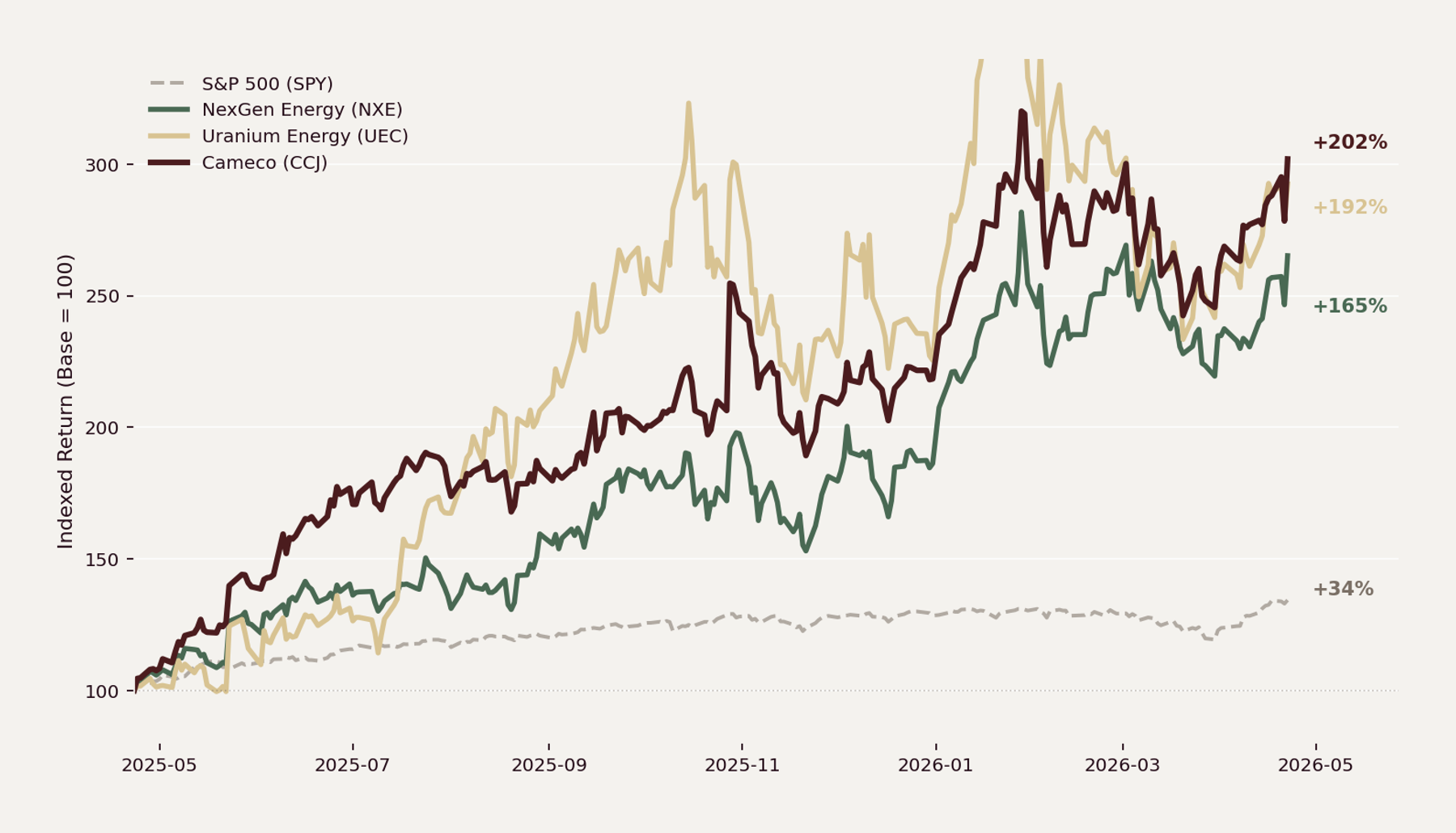
Yahoo Finance, Finnhub API, as of April 22, 2026. Indexed returns, base 100.
The Market Priced the Reactors and Forgot the Fuel
Everyone in markets understands that AI requires enormous amounts of electricity.
BloombergNEF projects U.S. data center power demand will rise from approximately 35 gigawatts in 2024 to 106 gigawatts by 2035 under its December 2025 forecast, a roughly tripling driven by hyperscale AI infrastructure buildout.5, 20
The IEA confirmed on April 21 that global data center electricity consumption will more than double to approximately 950 TWh by 2030.3
The market has priced this at the reactor level. Constellation Energy runs 21 nuclear reactors and trades at a premium. Small modular reactor offtake and partnership agreements have expanded rapidly, with Microsoft signing a 20-year power purchase agreement to restart Three Mile Island and Google striking the first-ever deal to buy nuclear energy from multiple SMRs via its Kairos Power agreement.
But here is what the market has not fully absorbed. Every one of those reactors, whether a legacy plant running at 90%+ capacity factor or a new SMR coming online by 2030, needs uranium fuel for its entire 40-to-60-year operating life.
IAEA Director General Rafael Grossi has consistently argued nuclear is uniquely positioned to deliver low-carbon, round-the-clock baseload with the grid stability and power density AI-scale data centers require.
The AI boom is not just a demand story for electricity.
It is a demand story for the physical commodity that makes carbon-free baseload power possible.
The supply side cannot keep up.
The Consensus and Where It Breaks
The consensus view on uranium is broadly correct on direction but dramatically wrong on magnitude.
Most institutional investors acknowledge the nuclear renaissance narrative. Uranium ETFs saw record inflows in late 2025, and sell-side analysts have upgraded price targets.
Where consensus breaks is on the supply response timeline. Goldman Sachs analyst Brian Lee's April 12 Global Nuclear Reactor Tracker quantifies the gap, projecting a cumulative global uranium supply shortfall of approximately 1.763 billion pounds from 2025 to 2045.1
This deficit persists even with improved supply assumptions because new mine development takes 10 to 15 years from discovery to production, and existing mines are reaching end-of-life.
The numbers underneath the headline are worse than they appear.
Kazakhstan's Kazatomprom, the world's largest producer, guided 2026 production at 27,500 to 29,000 tU, 12 to 16 percent below its original subsoil use contract capacity of roughly 32,800 tU. The United States operates 94 reactors across 54 plant sites but produces barely 1 million pounds of uranium domestically out of 50 million consumed each year.
That 95% import dependence has become a national security vulnerability, and policy is shifting fast.
The Structural Uranium Deficit Accelerates as AI Reactor Demand Ramps
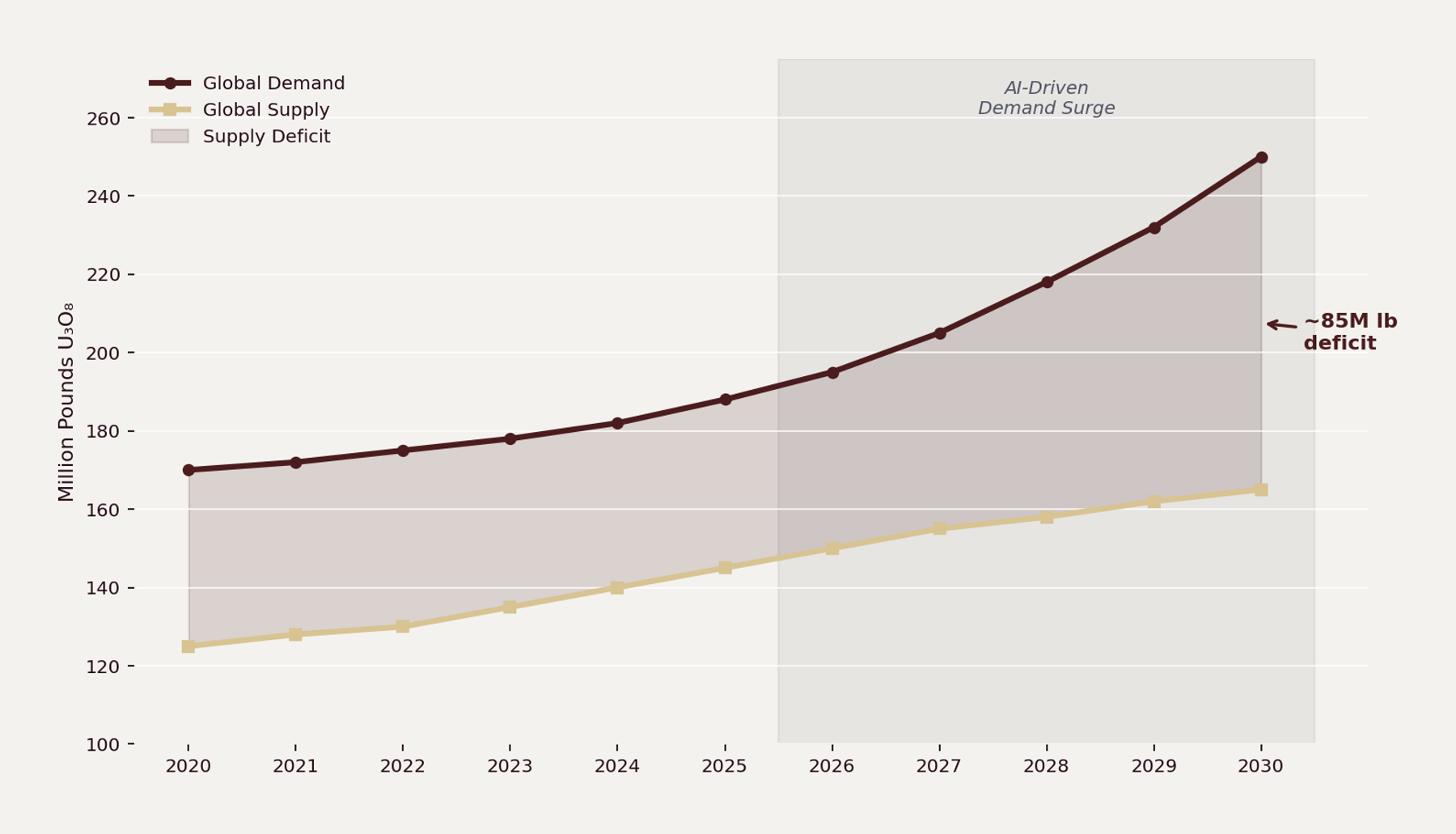
Goldman Sachs Global Nuclear Reactor Tracker (April 2026), World Nuclear Association, UxC¹
The spot market itself tells the story. Despite a pullback from January's $100-101/lb peak, uranium spot settled near $87/lb ($86.85 per TradingEconomics on April 21).11 Sprott Physical Uranium Trust re-entered the market that week, raising $71.9 million and purchasing 600,000 pounds, bringing trust holdings to 80.9 million pounds of U3O8 and $125.6 million in cash.12
Term contracts remain firm with mid-term pricing at $88/lb and long-term at $93/lb, with floor prices in the mid-$70s and ceiling prices stretching into the low $130s for longer-dated deliveries.16, 19 Citi analysts project spot prices reaching $100 to $125/lb this year.
UBS lifted its uranium price forecast to $100/lb, while Shaw and Partners projects even higher levels based on structural supply deficits exceeding 200 million pounds per year.12
Three Names That Express the Uranium Thesis
Cameco (CCJ). The Blue-Chip Integrated Producer.
Cameco is the institutional-grade way to play uranium.
The world's second-largest uranium producer reported CAD $3.5 billion in revenue for 2025, up 11% year-over-year, with adjusted EBITDA of $1.9 billion, up 26%.2
Adjusted net earnings hit $630 million, a 115% improvement over 2024.
The Westinghouse investment is the underappreciated catalyst. Each new reactor project built with Westinghouse technology contributes $400 to $600 million in EBITDA at the Westinghouse level, per COO Grant Isaac on the Q4 2025 earnings call.2 Cameco owns 49% of Westinghouse, translating to roughly $196 to $294 million in proportional EBITDA per project.
The U.S. government has committed at least $80 billion in planned investment to accelerate Westinghouse reactor deployment. Cameco guided 2026 Westinghouse EBITDA at $370 to $430 million, but potential long lead item orders this year could push that higher.
With 230 million pounds committed under long-term contracts and a disciplined supply strategy, Cameco is the closest thing to an annuity stream in the uranium space.
The 2026 guidance calls for 19.5 to 21.5 million pounds of uranium production and 29 to 32 million pounds of deliveries at an average realized price of CAD 85 to 89 per pound.2
That realized price is well below current spot, meaning every incremental contract signed at today's prices flows directly to margin expansion.
Uranium Energy Corp (UEC). The Unhedged Domestic Inflection.
UEC is the pure domestic U.S. play, and April 2026 is an inflection point. On April 8, UEC commenced production at Burke Hollow, the world's newest ISR uranium mine and the first new U.S. ISR operation in over a decade.6
Combined with expanded production at Christensen Ranch in Wyoming, UEC is the only U.S. uranium company with two active producing ISR hub-and-spoke platforms.
The cost structure is compelling. Cumulative production from Christensen Ranch totaled 244,321 pounds at a total cost of $37.28 per pound, including cash costs of $30.52.7 At $87 uranium, that is a 57% total cost margin on every pound produced, with cash margins even wider at approximately 65%.
The strategic differentiator is UEC's 100% unhedged uranium strategy. While Cameco sells forward under long-term contracts at below-spot prices, every pound UEC produces is sold at prevailing market prices.
In a rising uranium market, UEC captures the full upside.
The company is also pursuing domestic refining and conversion capabilities through its UR&C subsidiary, which received NRC docketing on March 18, 2026 for a planned U.S. conversion facility.7 UEC's licensed capacity across Wyoming and South Texas totals approximately 12 million pounds per year, providing enormous production optionality as prices rise.
The Ludeman ISR project is 80% through delineation drilling and targets startup in 2027, adding a third producing platform.
CCJ Dominates Revenue, UEC Inflects Into Production, NXE Holds the Largest Option
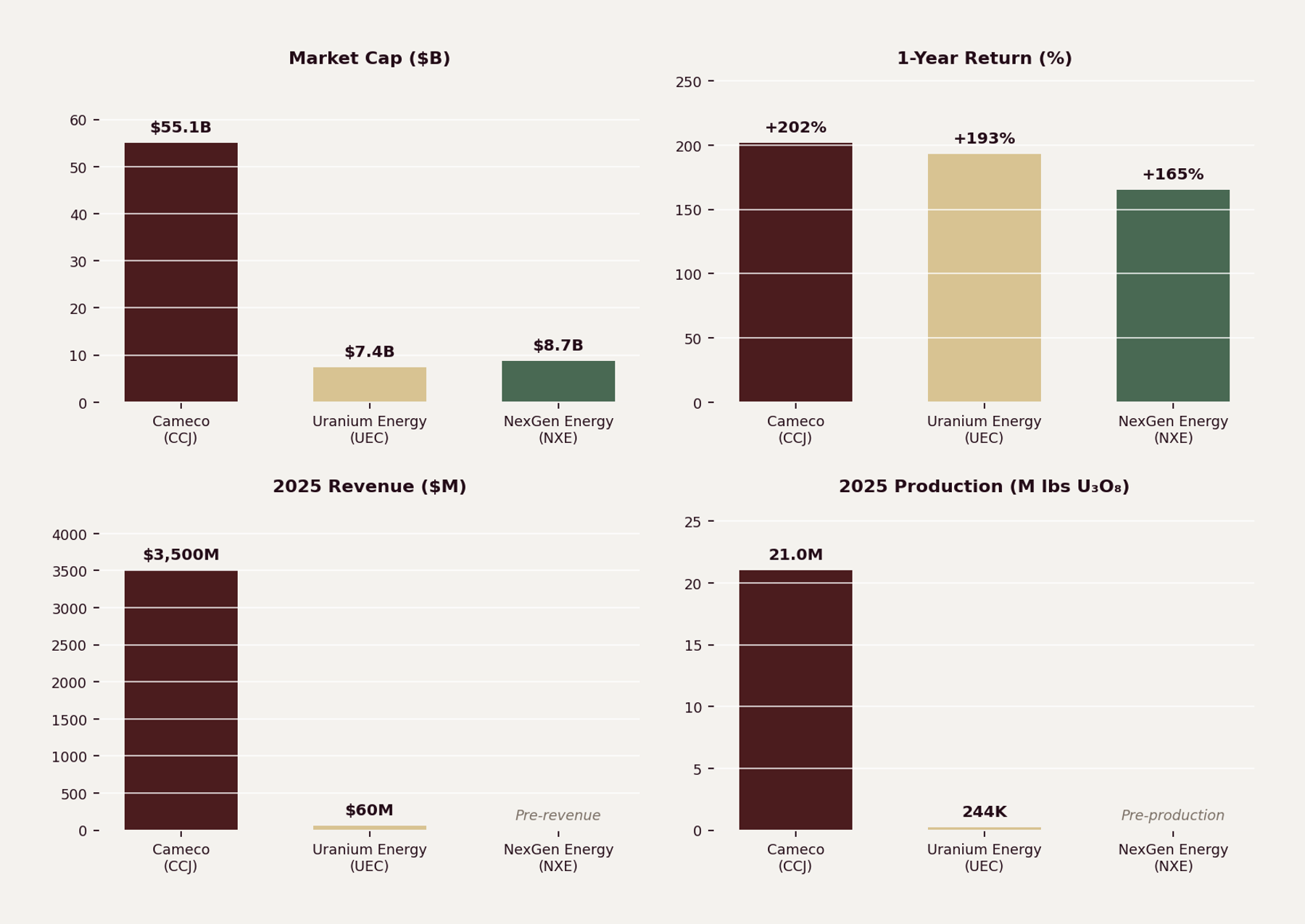
Company filings, Finnhub API, as of April 22, 2026², ⁶, ⁷, ⁸, ¹⁸
NexGen Energy (NXE) at $13.10. The Highest-Upside, Highest-Risk Name.
NexGen is the highest-upside name in the trio, and its critical regulatory risk just disappeared. On March 5, 2026, the Canadian Nuclear Safety Commission approved NexGen's Environmental Assessment and issued the Licence to Prepare Site and Construct for the Rook I Project.8
This was the final regulatory approval required for full construction.
When operational, Rook I will be the single largest uranium mine on Earth, capable of producing up to 30 million pounds annually. That represents over 20% of current global uranium fuel supply and over 50% of western world supply. The Arrow deposit in Saskatchewan's Athabasca Basin is the world's highest-grade large-scale uranium deposit.
NexGen made its Final Investment Decision and will commence construction this summer, with a 4-year timeline to production by 2030.
The company holds over CAD 1.1 billion in cash, providing strategic independence without dilutive financing.8 Market-related pricing in offtake contracts preserves full upside to rising uranium prices.
The Patterson Corridor East discovery adds a free option on a second Arrow-scale deposit. Since discovery in March 2024, 115 drill holes have been completed with 79 mineralized, including 54 intersecting high-grade and 21 hitting off-scale readings.9
The winter 2026 drilling program extended the high-grade subdomain vertically by 33%, and a 29,200-meter summer drilling program begins the week of May 25, 2026.
The Data Center Demand Accelerant
The IEA's April 21, 2026 report confirmed what uranium investors have been positioning for. Data center electricity demand reached approximately 485 TWh in 2025, a 17% surge from 415 TWh in 2024, far outpacing the 3% growth in overall global power demand.3 AI-specific data center demand is set to triple by 2030.
The five largest tech companies made substantial capital investments in 2025 with spending expected to rise by a further 75% in 2026, driven almost entirely by hyperscale data center development.
Microsoft is exploring nuclear-powered data centers. NVIDIA is working with reactor developers to optimize AI-driven design and approval processes for nuclear plants.
Data Center Power Demand Is Projected to Nearly Triple by 2035
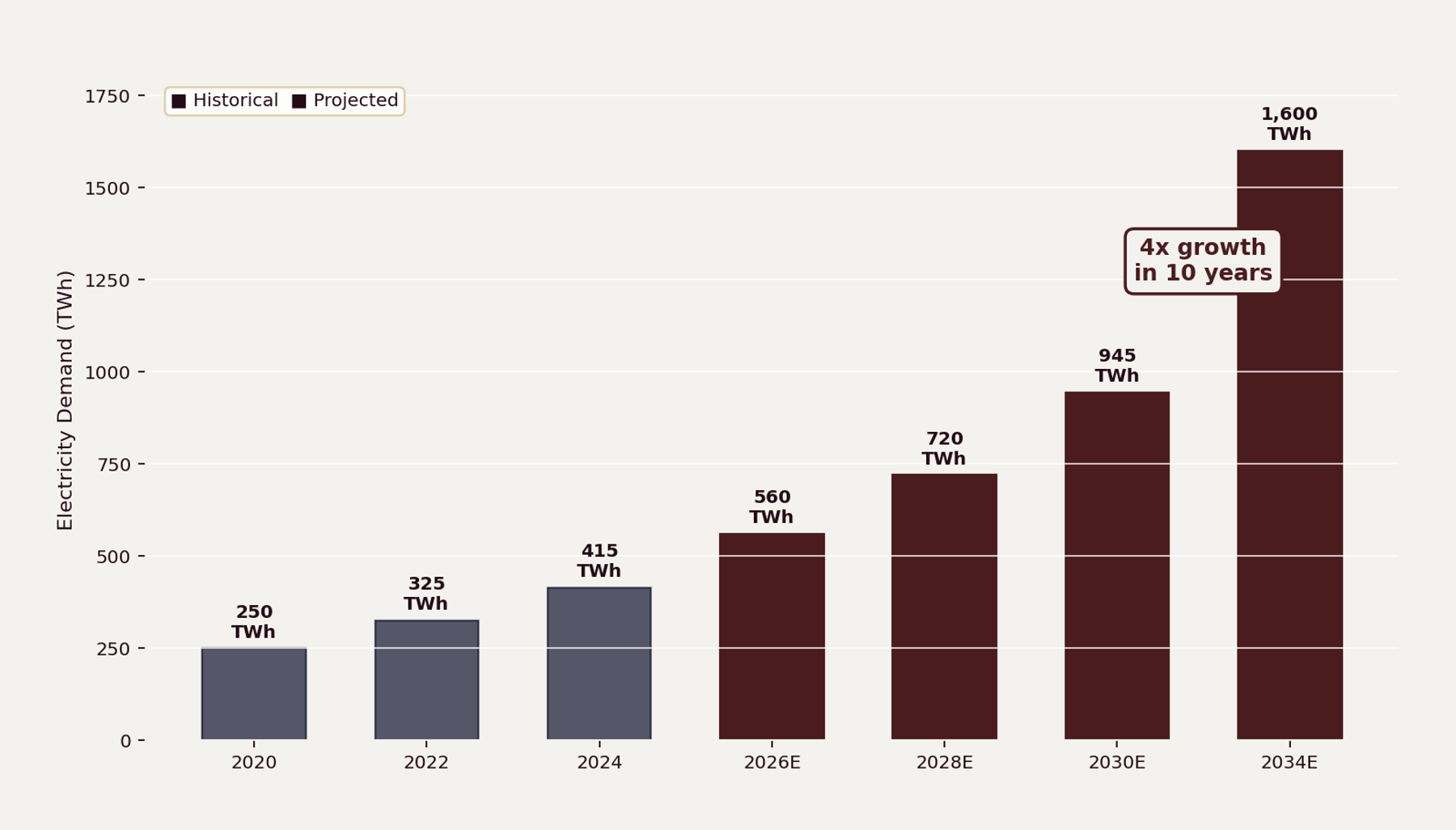
IEA "Key Questions on Energy and AI" (April 2026), Precedence Research, BloombergNEF³, ⁴, ⁵
Nuclear is the only energy source that simultaneously delivers 24/7 reliability, carbon-free baseload, and the power density AI data centers demand. A typical AI-focused data center consumes electricity equivalent to 100,000 households.
That is baseload nuclear territory, not intermittent solar or wind.
The uranium demand from this buildout is a decade-long locked-in commitment per reactor. When a utility signs a 20-year power purchase agreement with Microsoft to run a nuclear plant for an AI data center campus, that utility needs uranium fuel for 20 years minimum. The contracts being signed today are creating uranium demand through 2050 and beyond.
The Spot Market Is Telling the Same Story
Uranium spot near $87/lb in mid-April 2026 sits well above the $70-80 range needed to incentivize new mine development, but well below the $100+ levels reached in late January and the structural deficit math implies longer term.11, 14 Term contracts, which reflect longer-dated utility purchasing, already price at $88 to $93/lb depending on tenor, with ceilings stretching past $130.16, 19
The spot market is notably thin. Fifteen transactions in the week ending April 21 were enough to move prices $1.50 higher.12
The Sprott Physical Uranium Trust's episodic purchasing adds demand jolts to an illiquid market. Utility buying remains active, with engagement across uranium, conversion, and enriched uranium product.
Long-Term Contracts at $93/lb and Citi Targeting $100-125 Suggest Spot Has Room to Run
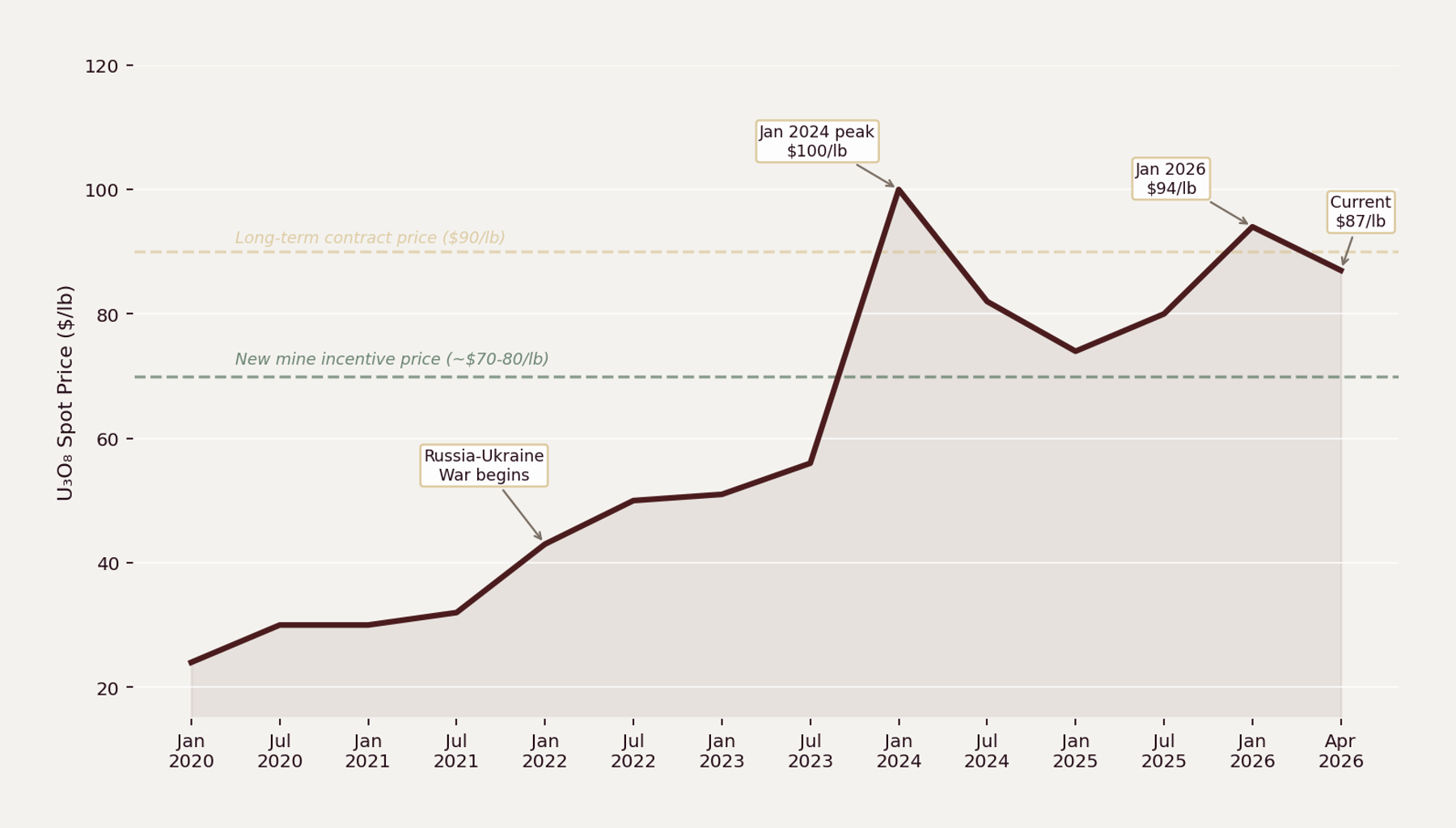
Cameco, TradeTech, UxC¹¹, ¹⁴, ¹⁶
Three price drivers converge from here. Kazatomprom's production guidance below contracted levels tightens physical supply. The Russian uranium import ban forces western utilities to compete for a shrinking pool of non-Russian supply.
Every new reactor announced, every SMR offtake agreement signed, and every data center PPA executed adds multi-decade demand to the forward curve.
Key Data Table
| Metric | Cameco (CCJ) | Uranium Energy (UEC) | NexGen Energy (NXE) |
|---|---|---|---|
| Stock Price | $126.47 | $15.15 | $13.10 |
| Market Cap | ~$55.1B | $7.4B | ~$8.7B |
| 1-Year Return | +215% | +213% | +185% |
| 52-Week Range | $42.10 – $135.24 | $5.03 – $20.34 | $4.95 – $13.96 |
| 2025 Revenue | CAD $3.5B | ~$60M (est.) | Pre-revenue |
| 2025 Production | 21M lbs | 244K lbs cumulative | Pre-production |
| Licensed / Target Capacity | 21.5M lbs (2026 guide) | 12M lbs/yr (U.S.) | 30M lbs/yr (Rook I) |
| Cost per Pound | CAD 85-89 (contracted) | $37.28 total / $30.52 cash | TBD (high-grade = low cost) |
| Hedging Strategy | Long-term contracts (230M lbs) | 100% unhedged | Market-related pricing |
| Key 2026 Catalyst | Westinghouse orders, $80B gov't partnership | Burke Hollow ramp + Christensen expansion | Construction begins summer 2026 |
| Analyst Consensus | Buy, mean PT $136 (9 analysts) | Strong Buy, mean PT $19 (9 analysts) | Buy-rated; coverage concentrated in Canada |
| Risk Profile | Low (blue-chip producer) | Medium (production ramp) | High (4-year construction) |
Data as of April 22-23, 2026. Prices, market caps, 52-week ranges, and analyst consensus from OpenBB (yfinance). Sources listed in endnotes.2, 6, 7, 8, 17, 18, 21
Catalyst Map
Q2 2026 (Now through June)
- UEC Burke Hollow production ramp and first revenue from the new mine (production commenced April 8)
- NexGen Rook I construction commencement (summer 2026, exact date pending)
- Cameco Q1 2026 earnings and potential Westinghouse long lead item order announcements
- NexGen 29,200m summer drilling program at Patterson Corridor East begins May 25
Q3-Q4 2026
- UEC Christensen Ranch additional header houses come online as regulatory approvals clear
- Kazatomprom interim production reports (watch for any further guidance cuts)
- U.S. Department of Energy HALEU production milestones impacting downstream fuel demand
- Potential new reactor announcements from Microsoft, Google, and Amazon
2027
- UEC Ludeman ISR project startup, adding a third producing platform
- NexGen Rook I shaft sinking and underground development progress
- Global uranium contracting cycle intensification as secondary supplies thin further
2028-2030
- First SMRs come online from Google/NuScale and DOE-backed projects
- NexGen Rook I approaches production with 30M lbs/yr capacity
- Uranium deficit acceleration as new reactor demand ramps with insufficient mine supply response
The Counter-Argument
The bull case for uranium is not without genuine risks, and three specific threats deserve direct engagement rather than hand-waving.
The first is price cyclicality.
Uranium has a history of violent boom-bust cycles. The last major peak hit $136/lb in 2007, followed by a multi-year decline to around $70/lb before the Fukushima disaster in 2011 accelerated the downturn further.
Prices bottomed at $18/lb in late 2016. Bears argue the current cycle mirrors that pattern, with speculative capital from Sprott and ETFs inflating prices beyond physical fundamentals. The recent pullback from January's $100+ peak to $87 in less than three months, a decline of roughly 13%, lends some credibility to this concern.
If financial demand retreats or a global recession dampens electricity growth, uranium could revisit the $60-70 range. That would compress margins for producers and devastate pre-production developers like NexGen.
The second threat is Kazatomprom's production flexibility.
Kazakhstan controls approximately 45% of global uranium production, and if Kazatomprom reversed its production discipline and ramped to full contracted capacity, it could flood an additional 5 to 10 million pounds onto the market annually. The company has a history of doing exactly this during previous cycles, choosing volume over price.
Its 2026 guidance came in below contracted levels, but this could shift quickly if Astana's fiscal needs change or if geopolitical realignment with Russia incentivizes higher output.
The third and most underestimated risk is technology substitution. Advanced reactor designs are exploring thorium fuel cycles and fusion technology timelines that, while distant, could shift long-run demand expectations. More immediately, energy efficiency gains in AI hardware could slow the electricity demand growth curve.
The IEA notes that each AI task is becoming more energy-efficient even as aggregate demand rises.3 If hardware efficiency outpaces data center buildout, the approximately 950 TWh 2030 figure could prove too aggressive, weakening the nuclear demand catalyst.
For UEC specifically, execution risk is real.
The company is transitioning from a development-stage company to a multi-platform producer simultaneously. Regulatory delays at the state level could slow the ramp, and UEC's 100% unhedged strategy offers zero downside protection if prices reverse.
For NexGen, the 4-year construction timeline means no revenue until 2030 at the earliest, and capital markets conditions could deteriorate. Construction cost overruns are endemic in mining. A single deposit, no matter how extraordinary, concentrates geological and operational risk.
These are not theoretical risks. They are the specific variables that separate a thesis from a trade.
The Bottom Line
Goldman Sachs projects a 1.763 billion pound uranium deficit through 2045, AI data centers are locking in nuclear power demand through mid-century, and the supply pipeline cannot fill the gap for a decade. Cameco is the diversified base case with Westinghouse leverage, UEC is the unhedged domestic play inflecting into production right now, and NexGen holds the option on the largest new mine on Earth with construction starting this summer. The thesis breaks if Kazatomprom floods the market or AI efficiency gains crush electricity demand growth, but the weight of evidence favors the fuel trade over the next 3 to 5 years.
Sources
- Goldman Sachs, "Global Nuclear Reactor Tracker (April)," Brian Lee et al., April 12, 2026
- Cameco Corp (CCJ) Q4 2025 Earnings Call Transcript, February 13, 2026
- IEA, "Key Questions on Energy and AI," April 21, 2026
- Precedence Research, "Growing Energy Demand from Data Centres," February 10, 2026
- BloombergNEF, "AI and the Power Grid," December 1, 2025 (106 GW by 2035 forecast)
- Uranium Energy Corp, "Commences Production at Burke Hollow," April 8, 2026
- Uranium Energy Corp, Q2 Fiscal 2026 Earnings Release, March 10, 2026
- NexGen Energy, "Receives Final Federal Approval for Rook I," March 5, 2026
- NexGen Energy, Winter 2026 Drilling Results, April 22, 2026
- Centrus Energy, "$900M DOE HALEU Contract Award," January 6, 2026
- Purepoint Uranium, "Uranium Spotlight," April 7, 2026 (spot price data)
- FNArena, "Uranium Week, Sprott Joins Risk On Rally," April 21, 2026
- MarketChameleon, "Uranium Supply Gap Drives UEC and Peers," April 17, 2026
- TradeTech via EINPresswire, "Uranium Spot Price Surges to $100.25," January 28, 2026
- Energy Intelligence, "Uranium Spot Price Surges Over $100 Per Pound," January 30, 2026
- TradeTech via EINPresswire, "Long-Term Uranium Price Climbs on Historically High Forecast," April 14, 2026
- Finnhub API, candle data trailing one year through April 22, 2026 (52-week ranges for CCJ, UEC, NXE)
- Finnhub API, company profiles and financial metrics, accessed April 23, 2026
- FNArena, "Uranium Week, Buyers Turn To Term Market," April 14, 2026 (mid-term $88/lb, long-term $93/lb)
- BloombergNEF, "Power for AI, Easier Said Than Built," April 15, 2025 (~35 GW 2024 baseline)
- Finnhub API, analyst recommendation trends and price targets for CCJ, UEC, NXE, accessed April 23, 2026
- OpenBB Platform via yfinance — equity quotes, 52-week ranges, historical prices, market caps, and analyst consensus for CCJ, UEC, NXE, and SPY, accessed April 23, 2026
- OpenBB Platform via Financial Modeling Prep — Cameco FY2025 income statement (CAD 3.479B revenue) and analyst price targets cross-check, accessed April 23, 2026