Silvia Insights · April 10, 2026
These 2 stocks can rally big with stagflation signals flashing
Thursday's PCE report confirmed core inflation at 3.0% in February, 100 basis points above the Fed's target, before a single war-driven energy dollar hit the data. The selloff in oil stocks has suddenly opened up new opportunities.
What to Know
- Diamondback Energy (FANG) at $187 trades at 11.9x forward earnings with a $37/bbl breakeven, generating a $57/bbl cash margin at current WTI. EOG Resources (EOG) at $140 trades at 10.8x forward earnings with a $50/bbl breakeven and $44/bbl margin.
- The ceasefire is a two-week pause, not a permanent deal, and the IEA says full Strait of Hormuz supply restoration will take three to six months. Gas prices at $4.16/gallon and diesel at $5.57 will flow directly into the March CPI print releasing tomorrow.
- Thursday's Commerce Department release confirmed core PCE at 3.0% in February, 100 basis points above the Fed's 2% target, before a single war-driven energy dollar hit the data. Q4 2025 GDP was revised down to just 0.5% annualized, and personal income fell 0.1%, painting a stagflation picture that the ceasefire does not fix.
Oil at $94 Post-Ceasefire Generates a $57/bbl Margin for FANG in a Stagflation Economy
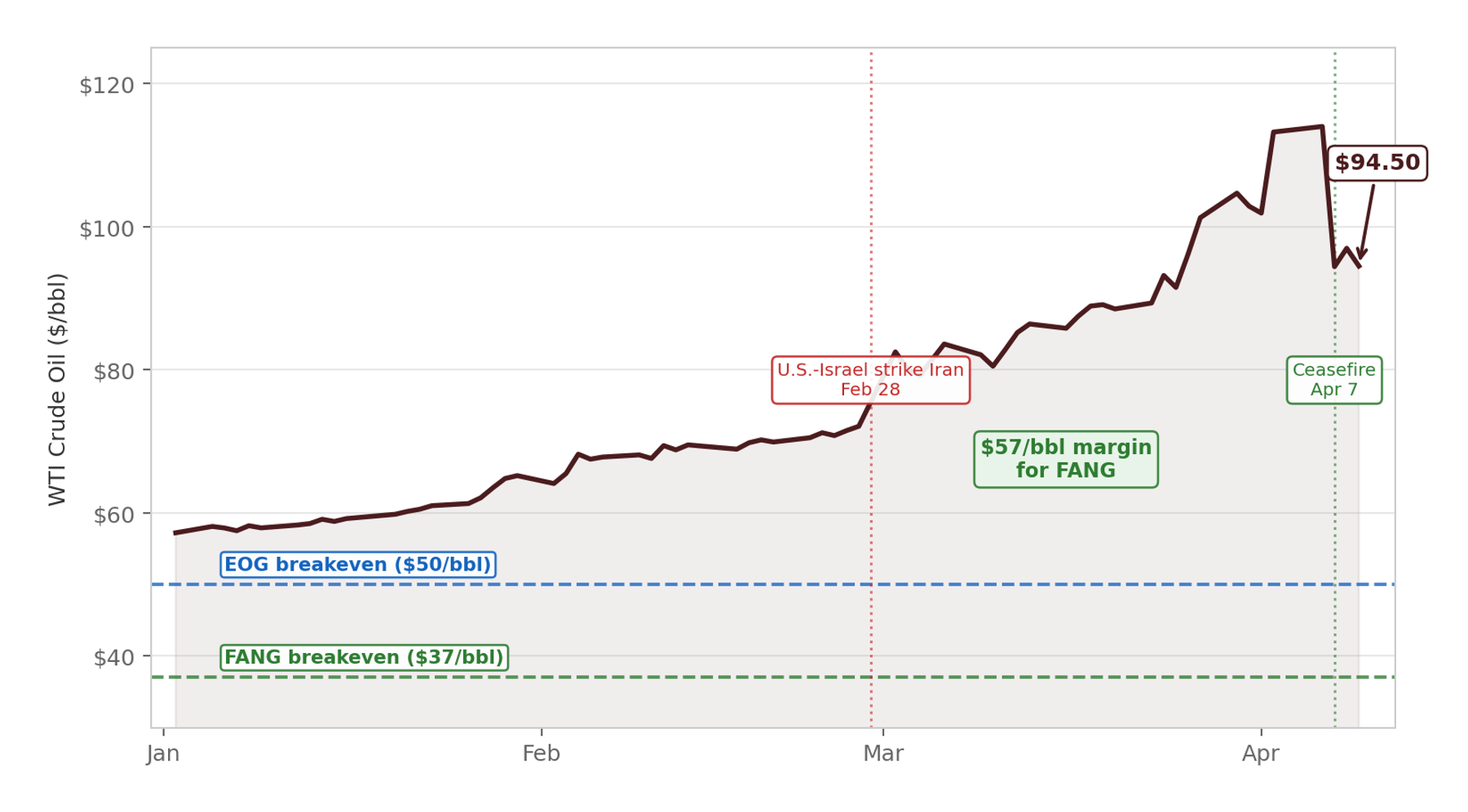
Source: FRED via OpenBB (DCOILWTICO). Breakeven estimates from Diamondback Energy Q4 2025 investor presentation and EOG Resources guidance. Data as of April 9, 2026.
What Happened
The Commerce Department reported Thursday that the core personal consumption expenditures price index rose 3.0% year-over-year in February, with headline PCE at 2.8%.1 Both readings matched consensus. Monthly core and headline each increased 0.4%.
The same release showed consumer spending up 0.5% but personal income falling 0.1%, badly missing the 0.4% estimate.1 Separately, Q4 2025 GDP was revised down to 0.5% annualized from 0.7%, with real final sales to private domestic purchasers cut to 1.8% growth. The stagflation setup was in place before the first missile left the ground.
The Atlanta Fed's GDPNow model, updated April 7, projects Q1 2026 growth at just 1.3%, down from 3.1% in mid-February.11 That is the trajectory into which the ceasefire arrived.
The April 7 ceasefire between the U.S. and Iran triggered a 16-18% single-day crash in WTI crude and a 5-7.5% selloff in energy producers.2 The Dow surged 1,300 points. Equity price action suggested markets were treating inflation as largely solved.
The Market's Ceasefire Trade Ignores Three Hard Numbers
The first number is $94. That is where WTI settled after the ceasefire panic subsided. Pre-war WTI averaged $57-72 in January and February.3 Even after the largest single-day oil decline since April 2020, crude remains 35% above the price environment that produced 3.0% core PCE in Thursday's release.
The second number is $4.16, the national average gasoline price, up 71 cents in a single month.4 Diesel hit $5.57, up from $4.60 thirty days prior. These costs do not reverse overnight.
They flow through trucking, shipping, and manufacturing with a four-to-eight-week lag. Consensus expects roughly a 0.9% monthly CPI print pushing headline inflation toward 3.3%, capturing much of the initial war-driven energy spike.
The third number is 0.5%. That is the revised Q4 2025 GDP growth rate, cut from the initial 1.4% estimate, alongside personal income that fell 0.1% in February against a consensus expectation of 0.4% growth.1 Inflation running at 3.0% while growth collapses to 0.5% is a classic stagflation mix. The Fed is likely to hold at 4.25-4.50%, with CME FedWatch implying a 94.8% probability of no change at the April meeting.5
FANG and EOG Have Crushed the S&P 500 in 2026, and the Ceasefire Dip Widens the Gap
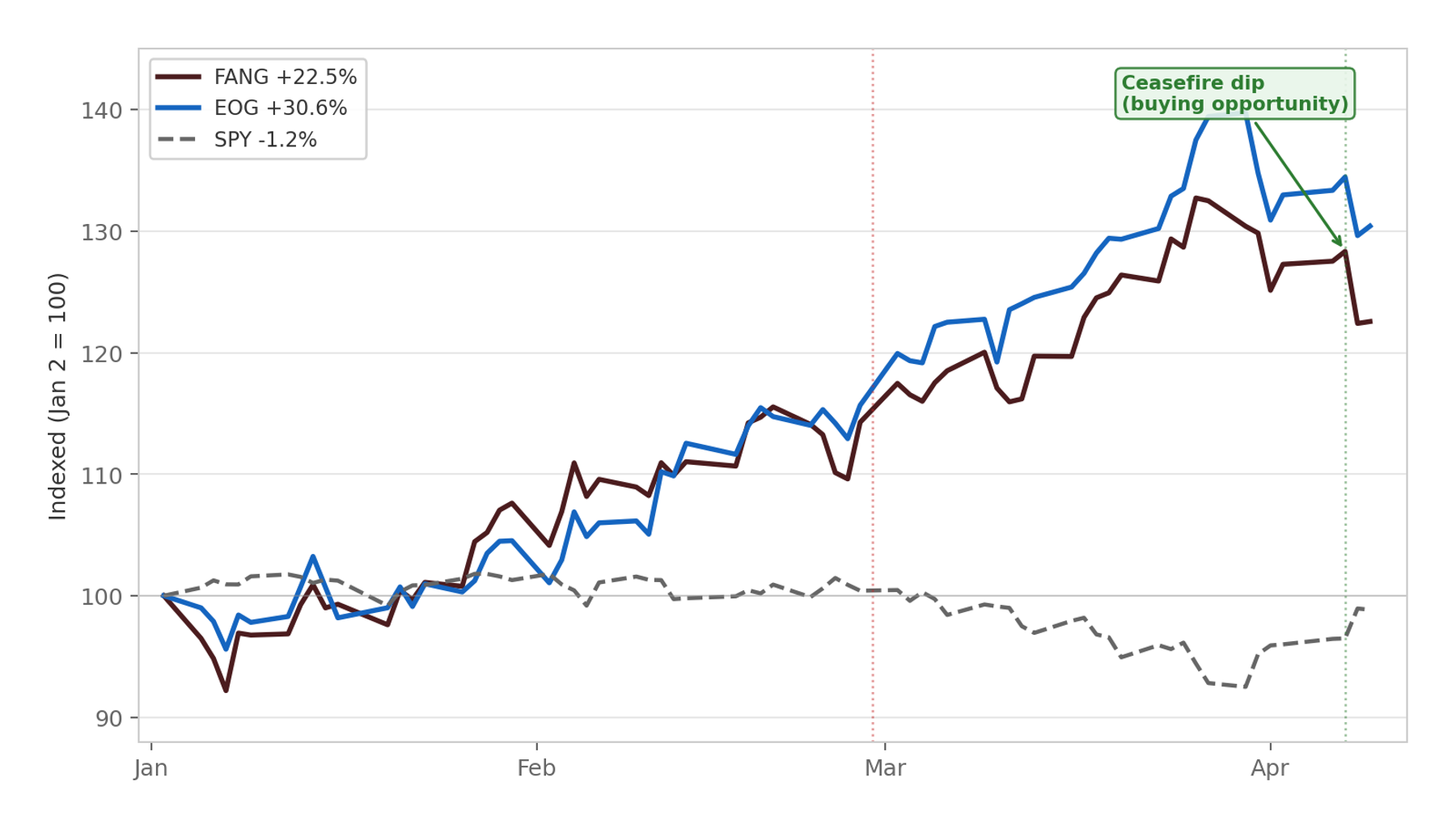
Source: Yahoo Finance via OpenBB. Indexed to 100 on January 2, 2026. Data as of April 9, 2026.
The Real Investor Implication
Diamondback Energy (FANG) dropped from $195 to $186 on the ceasefire. That pullback created an entry into a pure-play Permian Basin producer pumping 500,000-510,000 barrels of oil per day at a $37/bbl breakeven cost.6 At $94 WTI, every barrel generates $57 in cash margin. FANG produced $5.2 billion in free cash flow in 2025 when oil averaged roughly $65-70 and returned $3.2 billion to shareholders through dividends and buybacks.
At current oil prices, FANG's cash generation accelerates dramatically. The stock trades at 11.9x forward earnings, over a 40% discount to the S&P 500's roughly 21x multiple.7 Raymond James has a $240 price target, representing 28% upside from current levels. Mizuho targets $205 and Piper Sandler targets $218.
One caution on FANG that warrants sizing discipline. SEC Form 4 filings show every insider transaction in the past six months has been a sale, zero purchases.12 Director Charles Meloy sold 30,000+ shares at $177-198, COO Daniel Wesson sold 5,000 at $192, and CAO Teresa Dick sold 10,000 at $190-193.
The largest block was a 12.65 million share disposition by SGF FANG Holdings (a 10% owner) at $170.19 on March 12. The complete absence of any buying is a yellow flag that argues for a smaller position size in FANG relative to EOG.
EOG Resources (EOG) fell from $144 to $139 on the same ceasefire headline. EOG's breakeven sits at $50/bbl, generating $44 in per-barrel margin at current WTI.8 The balance sheet is the cleanest in large-cap E&P, with a 1.9x current ratio, 7.1x EV/EBITDA, and a 6.6% earnings yield. EOG trades at 10.8x forward earnings.
EOG's insider activity is notably cleaner than FANG's.12 CEO Ezra Yacob's only recent transactions were tax-withholding dispositions on vesting stock, the most routine form of insider activity. No executive made open-market sales at elevated prices. For a risk-adjusted pair, EOG deserves the larger allocation.
The setup is asymmetric, and actual cash flow data proves it. Using annual filings, FANG generates roughly $5.4 billion in free cash flow at $70 WTI and $9.0 billion at $100.13 EOG generates $3.8 billion at $70 and $7.2 billion at $100.
At $94 WTI, FANG's implied FCF yield exceeds 15% and EOG's exceeds 8%. Even the bear case of $70 oil still produces a double-digit FCF yield for FANG and roughly 5% for EOG, multiples of what the S&P 500 offers.
Both Stocks Print Cash Even if Oil Falls to $70, and Current Prices Imply Double-Digit FCF Yields
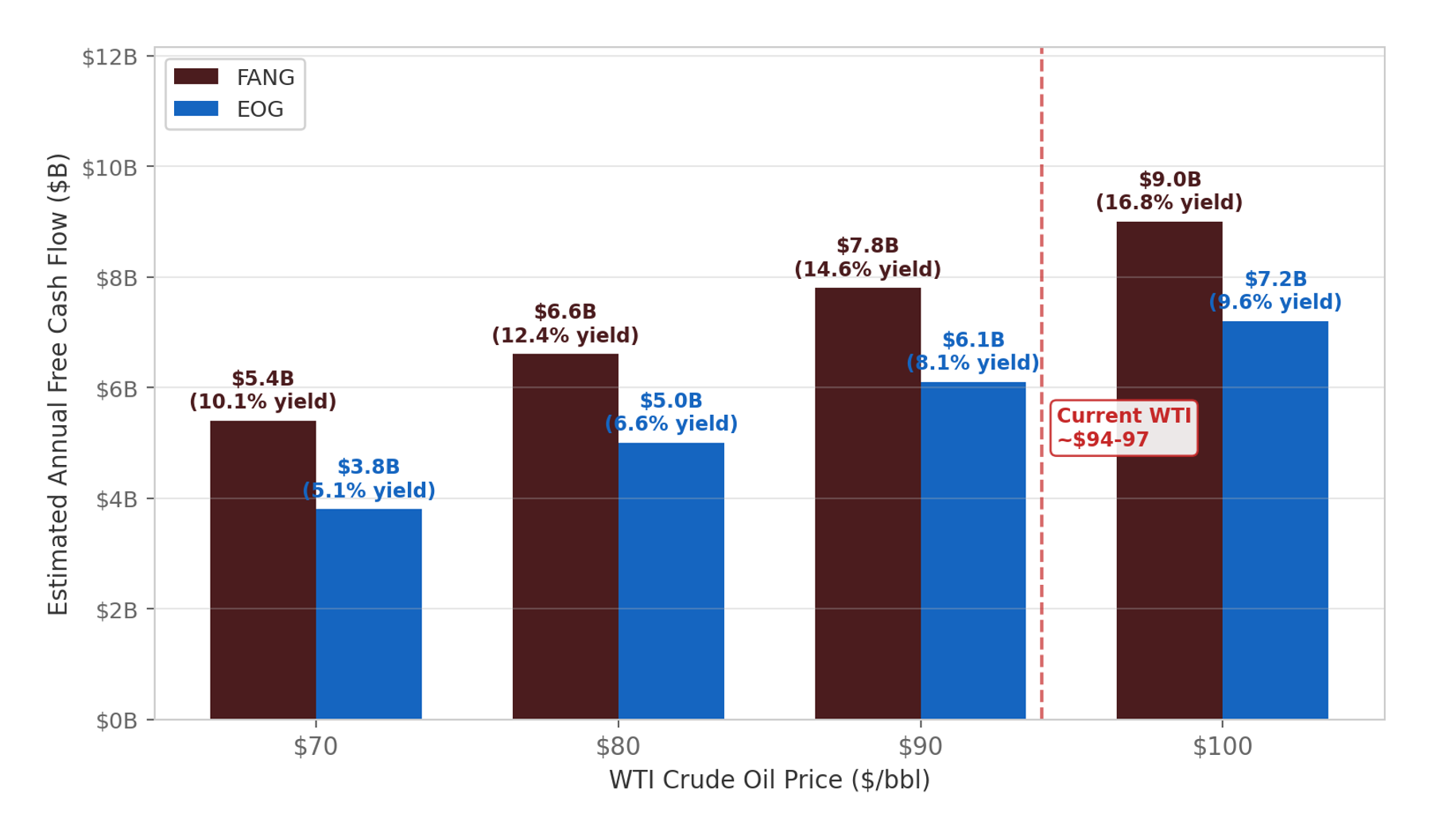
Source: FANG and EOG quarterly cash flow statements via OpenBB (FY2025). Sensitivity model assumes 65% after-tax/royalty revenue capture rate on incremental production. FCF yield based on current market capitalization. Data as of April 9, 2026.
Both Stocks Trade at Half the Market Multiple While Earning $50+ Per Barrel Above Breakeven
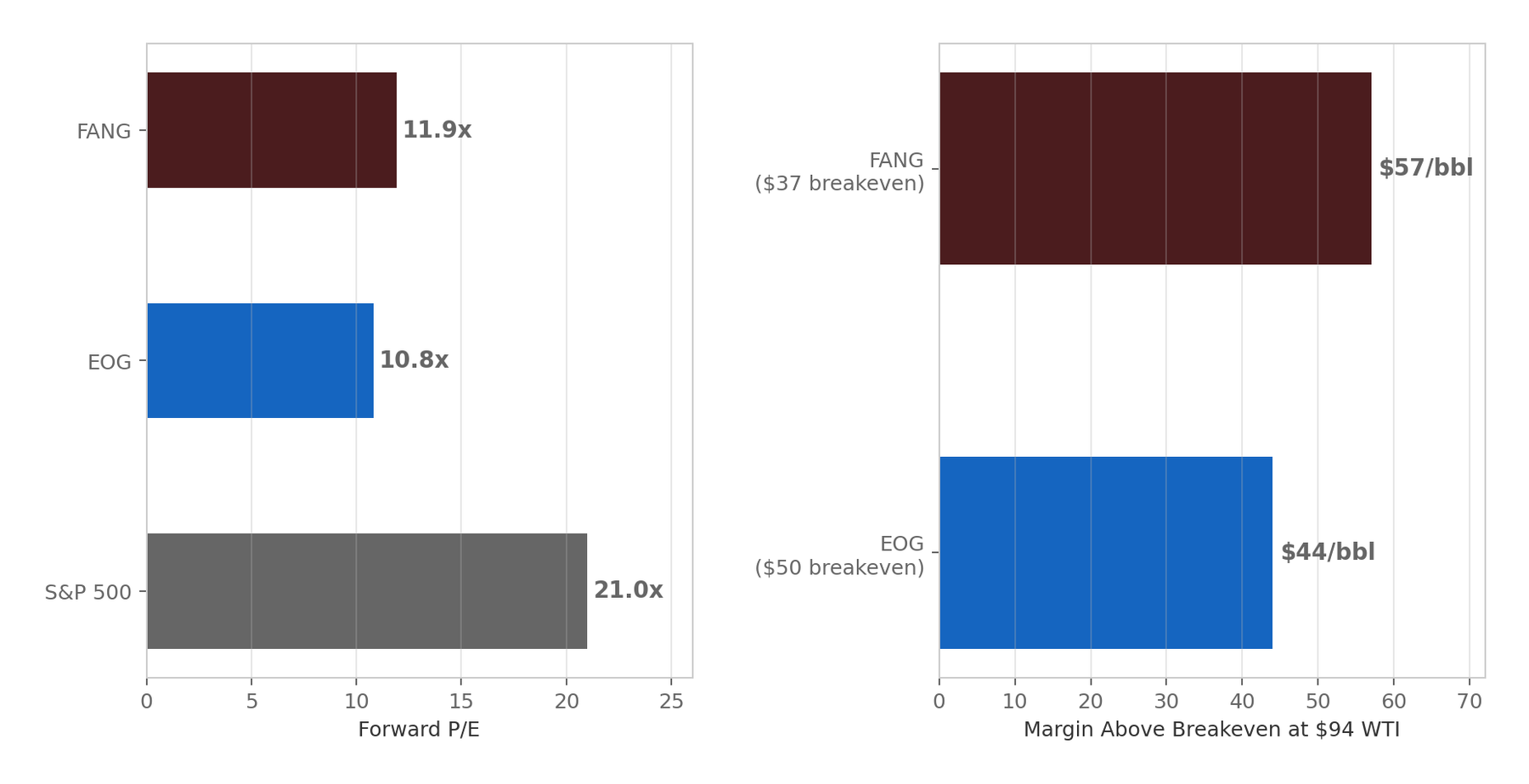
Source: FMP via OpenBB (forward EPS consensus estimates), Diamondback Energy and EOG Resources investor presentations. Data as of April 9, 2026.
The Counter-Argument
The bear case rests on a rapid normalization of oil markets. Bob McNally of Rapidan Energy Group has noted that Washington and Tehran appear to be "talking past each other" on Strait of Hormuz access, but if full shipping lanes reopen within weeks rather than months, Brent could fall below $80 and WTI could approach $70.9 In that scenario, the energy trade gives back its war premium and FANG and EOG shares decline toward pre-war levels.
Thursday's GDP revision to 0.5% annualized growth complicates the energy bull case. If the economy tips into recession, oil demand drops and crude prices fall regardless of supply dynamics. The OECD's 4.2% inflation projection assumes sustained oil disruption; if ceasefire terms hold and energy costs normalize, rate-sensitive sectors like homebuilders and regional banks outperform energy.
The structural bull case for energy also faces a demand risk. The World Economic Forum flagged recession as a consequence of the conflict, and Goldman Sachs has modeled scenarios where global demand destruction from $100+ oil offsets supply-side bullishness.10 If the U.S. enters a technical recession in Q3 2026, energy demand falls and so do crude prices, regardless of Strait of Hormuz dynamics.
FANG's insider selling pattern adds a company-specific risk. Every Form 4 filing in the past six months is a sale, including a 12.65 million share block from a 10% holder in March.12 FANG's 2026 capex guidance of $3.6-3.9 billion is the highest in its history, meaning if oil prices fall while spending stays elevated, free cash flow compresses faster than revenue.
What to Watch
Friday's March CPI print (April 10, 8:30 AM ET) is the single most important data point in the next 30 days. Consensus expects a 0.9% monthly surge pushing headline CPI to 3.3%, nearly a full point above February's 2.4%. If the actual print exceeds 3.5%, the "ceasefire solves inflation" narrative collapses in real time and energy reprices higher.
The two-week ceasefire deadline determines whether this is a pause or a settlement. Any breakdown in Strait of Hormuz negotiations sends Brent back above $110 within days.
The April 29-30 FOMC statement will reveal whether the Fed acknowledges the oil supply shock as a persistent inflation driver or treats it as transitory. The word "transitory" applied to a war-driven oil shock would be a policy error that energy investors would profit from.
Watch FANG's Q1 2026 earnings (expected late April/early May) for updated free cash flow guidance at current oil prices. Any upward revision to shareholder returns would be a direct catalyst for re-rating.
Track FANG Form 4 filings for any insider purchase. The current pattern is 100% selling over six months. A single open-market buy from a named executive would flip the signal from cautionary to confirmatory and justify increasing position size.
The Bottom Line
The ceasefire removed the tail risk of $150 oil, but Thursday's data confirmed stagflation was already here with core PCE at 3.0%, GDP at 0.5%, and GDPNow tracking just 1.3% for Q1. EOG is the cleaner play given FANG's wall of insider selling, and both stocks print cash even if oil falls to $70. The ceasefire selloff just put the best stagflation hedge on sale.
Sources
1. U.S. Commerce Department / Bureau of Economic Analysis, Personal Income and Outlays report (February 2026 data), released April 9, 2026. GDP revision from BEA third estimate, Q4 2025.
2. CNBC, "Oil prices plunge after Trump agrees to Iran ceasefire," April 7, 2026; Deseret News, ceasefire market impact, April 8, 2026.
3. FRED via OpenBB (DCOILWTICO), WTI Crude Oil Spot Price, January-April 2026.
4. Deseret News/AAA, national gasoline price average, April 8, 2026.
5. CME FedWatch Tool, April FOMC meeting probability, accessed April 9, 2026; MEXC News reporting.
6. Diamondback Energy Q4 2025 Investor Presentation, February 2026; StockTitan earnings release.
7. FMP via OpenBB, forward EPS consensus estimates for FANG (FY2026: $15.70), accessed April 9, 2026.
8. FMP via OpenBB, EOG Resources forward EPS (FY2026: $12.91) and fundamental metrics, accessed April 9, 2026. EOG breakeven ($50 WTI) per Q4 2025 earnings release (capex + regular dividend).
9. Bob McNally, Rapidan Energy Group, quoted in Deseret News, April 8, 2026.
10. World Economic Forum, "The global price tag of war in the Middle East," March 2026.
11. Federal Reserve Bank of Atlanta, GDPNow model estimate, Q1 2026, updated April 7, 2026.
12. SEC Form 4 filings via OpenBB (equity_ownership_insider_trading), FANG and EOG, October 2025-April 2026. SGF FANG Holdings 12.65M share disposition filed March 12, 2026.
13. FANG and EOG quarterly cash flow statements via OpenBB (equity_fundamental_cash). Sensitivity model uses 65% after-tax/royalty capture rate on incremental production. FANG 2026 capex guidance: $3.6-3.9B (Diamondback Energy investor presentation).