Silvia Insights · April 8, 2026
These 25 founder-led stocks carry the entire S&P 500
Strip the founder-led companies from the S&P 500 and the last three years shrink from a 60% gain to a 46% grind. Twenty-five CEOs who built their own companies from scratch now account for $9.2 trillion in market value.
What to Know
- An equal-weighted basket of 25 founder-led S&P 500 stocks returned 172% over three years versus 60% for the full index and 46% for the S&P 500 with those names removed (author calculations from Yahoo Finance price data). The trade is long the founders, not the index.
- These 25 companies represent only 5% of S&P 500 constituents by count but 16.7% by market cap, and they delivered a 1.48 Sharpe ratio versus 0.86 for the benchmark (using the 3-year average federal funds rate as the risk-free rate). Risk-adjusted, the gap is even wider than the raw returns suggest.
- The annualized return of the S&P 500 excluding founder-led names is 13.5%, respectable in isolation but less than a third of the founder basket's 39.6%. If even two or three founders step down, the index's return engine loses serious horsepower.
Founder-Led Stocks Tripled the S&P 500 Return Over Three Years, Leaving the Rest of the Index Behind
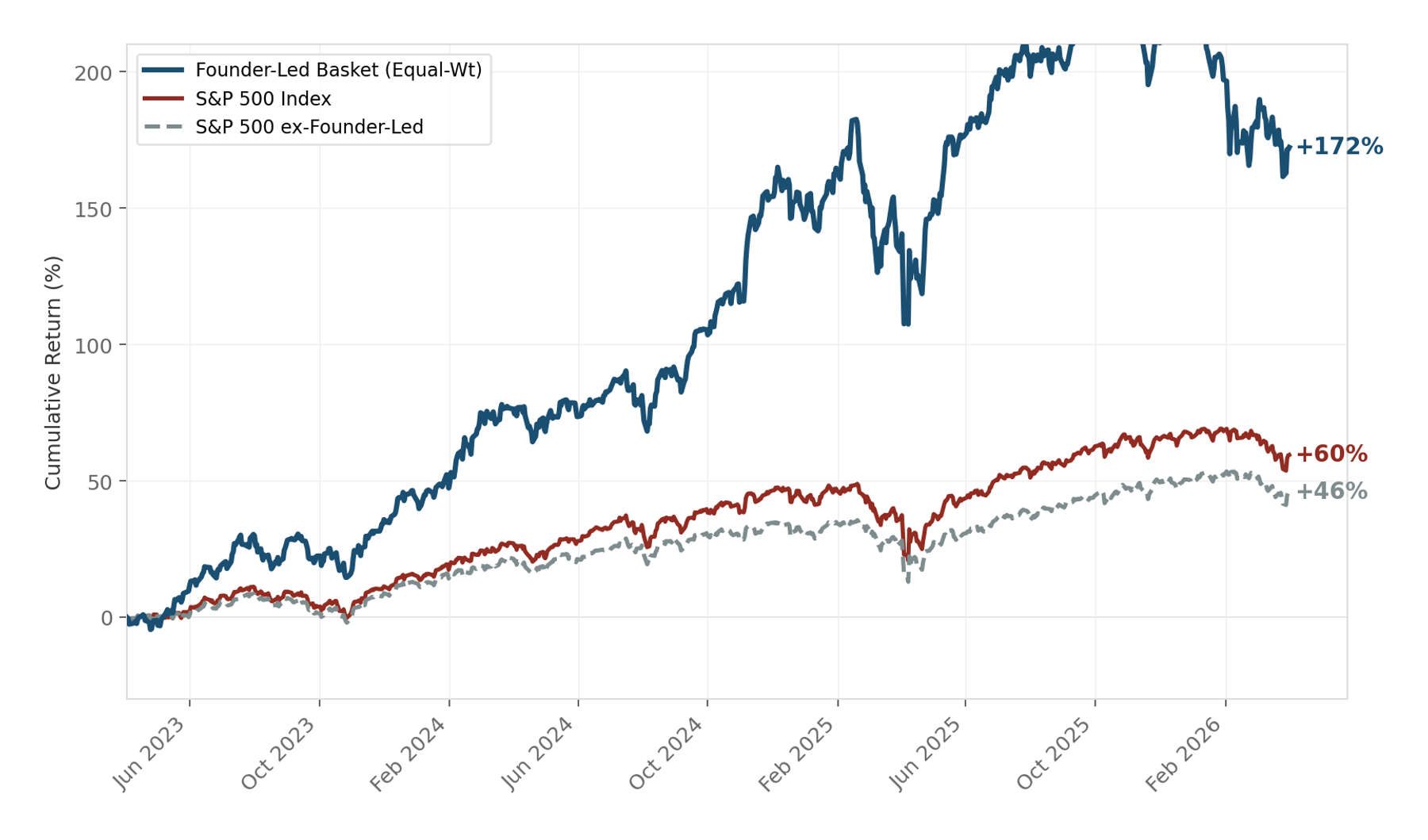
Source: Yahoo Finance, ProCap Insights analysis. Equal-weighted basket of 25 S&P 500 companies where a founder or co-founder serves as CEO, April 2023 to April 2026.
The Founder Premium Is Real, and the Market Just Proved It
The academic case for founder-led outperformance is well-documented. Bain found that founder-led companies beat non-founder peers by 2.1x in total shareholder returns since 2015.1 The Credit Suisse Family 1000 study showed a 4.5% annualized edge over broad equity markets.2 Bessemer measured 10.1% annualized returns for founder-led Russell 3000 firms versus 7.2% for the rest between 1998 and 2018.3
But those studies measured averages over long periods. The three years ending April 2026 turned that historical edge into a chasm.
An equal-weighted basket of the 25 S&P 500 companies still run by their founders returned 172.3%, annualizing at 39.6%. The S&P 500 itself returned 59.6%, annualizing at 16.9%.
The real number is what happens when you remove those 25 names. The implied S&P 500 ex-founder-led return drops to 46% cumulative, or 13.5% annualized. That is a respectable figure in isolation, but it is less than a third of the founder basket's annualized return and trails the full index by over 3 percentage points per year.4
The Consensus and Where It Breaks
Wall Street's consensus on founder-led companies is lukewarm agreement. Most institutional investors nod along to the thesis but treat it as a qualitative observation, not a portfolio construction principle. The standard line is that founder-CEOs have better long-term vision but higher governance risk.
That framing misses the magnitude of what the data shows. This is not a 2-3% annual edge that smooths out over decades.
Over the last three years, the founder basket's equal-weighted Sharpe ratio of 1.48 doubled the S&P 500's 0.86. Even accounting for higher volatility (24.1% annualized versus 14.9% for the index), the risk-adjusted returns demolished the benchmark.
The consensus also fails to grapple with concentration risk running in reverse. Passive investors think they own 500 diversified names.
In reality, they own a concentrated bet on 25 founder-operators and a 475-stock index that returned 13.5% annualized. The diversification is an illusion; the outperformance is consistent with founder conviction, though sector concentration (particularly in AI and tech) is a contributing factor.
Founder-Led Companies Delivered Triple the Annualized Return of the Rest of the S&P 500
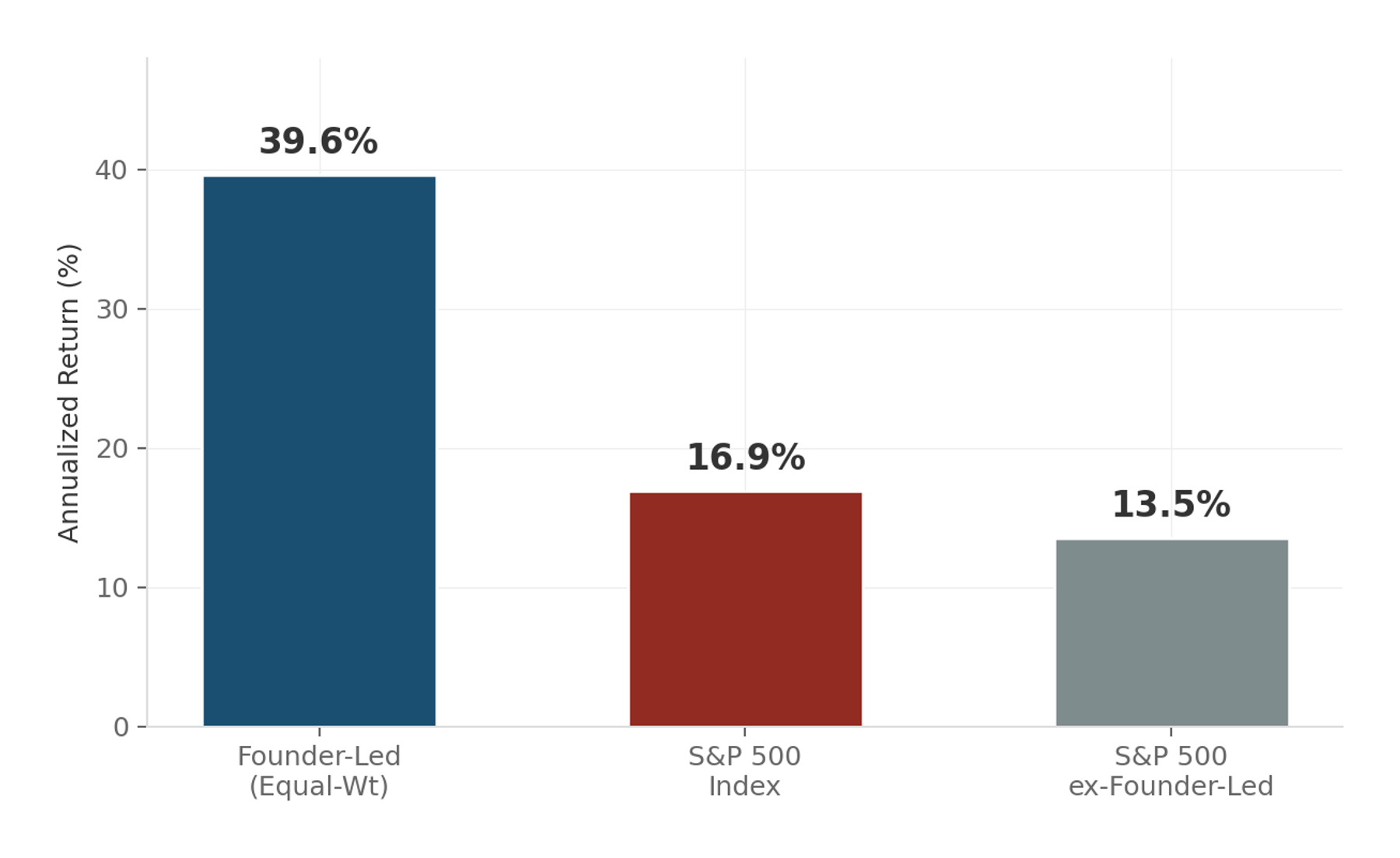
Source: Yahoo Finance, ProCap Insights analysis. Annualized returns from April 2023 to April 2026. S&P 500 ex-Founder-Led is the implied return of the index after removing the market-cap-weighted contribution of 25 founder-led companies.
The Names That Prove It and the Ones That Challenge the Thesis
The top of the founder-led leaderboard reads like a Silicon Valley hall of fame. AppLovin (APP), run by co-founder Adam Foroughi, returned 2,341% over three years. That is not a typo.
Palantir (PLTR) under Alex Karp returned 1,672%. Robinhood (HOOD) under Vladimir Tenev returned 606%. Jensen Huang's Nvidia (NVDA) returned 535%.5
These four names alone turned every $10,000 invested in April 2023 into an average of $133,000. But the apparent founder premium extends beyond the mega-winners.
Fourteen of the 25 founder-led companies beat the S&P 500's 59.6% return. The median founder-led return was 70.3%, beating the index even after stripping out the extreme right-tail performers.
The failures are worth examining too. Salesforce under Marc Benioff returned negative 3.6%. Regeneron under Leonard Schleifer lost 7.2%.
Block under Jack Dorsey lost 11.9%. These are not bad founders. They are founders navigating mature business cycles where the original growth thesis has faded.
14 of 25 Founder-Led Stocks Beat the S&P 500 Over Three Years
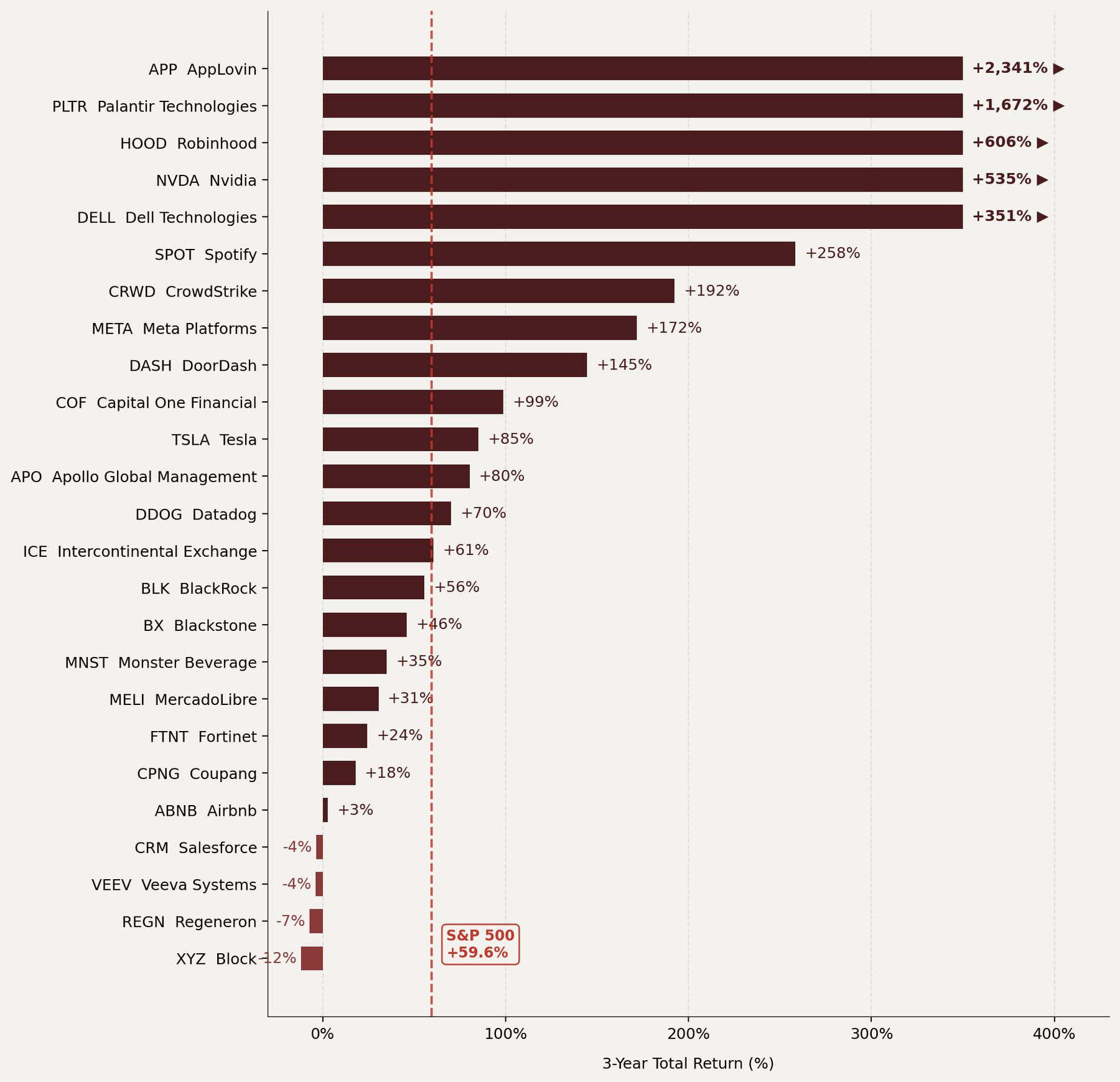
Source: Yahoo Finance. Total returns from April 3, 2023 to April 2, 2026. Extreme outliers (APP, PLTR, HOOD) are truncated at the chart boundary for readability. Dashed red line indicates S&P 500 total return of +59.6%.
The distinction matters. Early-stage founders building category-defining businesses (Huang at Nvidia, Foroughi at AppLovin, Karp at Palantir) delivered exponential returns, though this cohort also had heavy AI exposure. Late-stage founders maintaining mature franchises (Benioff at Salesforce, Dorsey at Block) delivered single-digit or negative returns.
The observed founder premium is not a blanket guarantee. The pattern is consistent with companies where the founder is still in the building phase, not the maintenance phase.
Definition of "founder-led." A company qualifies if its original founder (or co-founder) serves as CEO or executive chairman as of April 2, 2026. Companies where the founder holds a board seat but not an executive role are excluded.
Universe. S&P 500 constituents as of April 2, 2026 (static membership). Companies added to or removed from the index during the measurement period are included or excluded based on current membership, not historical. This introduces mild survivorship bias, which is addressed in the Counter-Argument section.
Return calculations. All returns are total returns (price appreciation only, dividends not included) from April 3, 2023 to April 2, 2026, sourced from Yahoo Finance historical price data. The founder basket uses equal weighting with no rebalancing (buy-and-hold). The S&P 500 ex-founder return is computed using daily market-cap-weighted rebalancing based on historical shares outstanding and daily prices. All return and Sharpe ratio figures are author calculations.
Sharpe ratio. Computed as (annualized portfolio return minus risk-free rate) divided by annualized portfolio standard deviation. The risk-free rate used is the 3-year average of the effective federal funds rate over the measurement period (approximately 5.1%), sourced from the Federal Reserve (FRED). Daily returns are used for volatility computation, then annualized using the square root of 252 trading days.
The Founder-Led S&P 500 at a Glance
| Ticker | Company | Founder-CEO | Market Cap ($B) | 3-Yr Return |
|---|---|---|---|---|
| NVDA | Nvidia | Jensen Huang | $4,269 | +535% |
| META | Meta Platforms | Mark Zuckerberg | $1,440 | +172% |
| TSLA | Tesla | Elon Musk | $1,283 | +85% |
| PLTR | Palantir Technologies | Alex Karp | $356 | +1,672% |
| CRM | Salesforce | Marc Benioff | $173 | -4% |
| BLK | BlackRock | Larry Fink | $149 | +56% |
| APP | AppLovin | Adam Foroughi | $139 | +2,341% |
| BX | Blackstone | Stephen Schwarzman | $138 | +46% |
| DELL | Dell Technologies | Michael Dell | $117 | +351% |
| COF | Capital One Financial | Richard Fairbank | $114 | +99% |
| CRWD | CrowdStrike | George Kurtz | $102 | +192% |
| SPOT | Spotify | Daniel Ek | $100 | +258% |
| ICE | Intercontinental Exchange | Jeffrey Sprecher | $95 | +61% |
| MELI | MercadoLibre | Marcos Galperin | $87 | +31% |
| REGN | Regeneron | Leonard Schleifer | $80 | -7% |
| ABNB | Airbnb | Brian Chesky | $75 | +3% |
| MNST | Monster Beverage | Rodney Sacks | $71 | +35% |
| DASH | DoorDash | Tony Xu | $68 | +145% |
| FTNT | Fortinet | Ken Xie | $62 | +25% |
| APO | Apollo Global Management | Marc Rowan | $62 | +80% |
| HOOD | Robinhood | Vladimir Tenev | $62 | +606% |
| DDOG | Datadog | Olivier Pomel | $41 | +70% |
| XYZ | Block | Jack Dorsey | $37 | -12% |
| CPNG | Coupang | Bom Kim | $35 | +18% |
| VEEV | Veeva Systems | Peter Gassner | $28 | -4% |
Sources listed in endnotes. Market cap as of April 2, 2026. Returns from April 3, 2023 to April 2, 2026.
The Counter-Argument
The survivorship bias problem is real and the most serious objection to this analysis. The 25 founder-led companies in the S&P 500 today are there precisely because they succeeded.
Founder-led companies that failed, got acquired, or never reached index-level market caps are invisible in this dataset. The index automatically culls losers and promotes winners, which inflates the apparent founder premium.
The concentration within the basket deserves scrutiny. Remove Nvidia alone and the market-cap-weighted return drops dramatically.
Add AppLovin and Palantir to the removal list and the basket's outperformance narrows materially. Three stocks drove an outsized share of the total return, which means the "founder premium" may be more accurately described as a "three-founder premium."
Governance risk is the structural vulnerability. Founders who control their companies through dual-class share structures (Zuckerberg at Meta, Musk at Tesla, Karp at Palantir) can make decisions that a professional board would block. When those decisions work, shareholders benefit enormously.
When they misfire, there is no institutional check. Meta's $10 billion Reality Labs losses between 2021-2023 happened because Zuckerberg could not be overruled. Tesla's Elon Musk has repeatedly made decisions that a conventional board would have challenged.
The AI tailwind complicates the thesis. Many of the top-performing founder-led companies (Nvidia, Palantir, AppLovin, CrowdStrike) are direct beneficiaries of the artificial intelligence spending cycle.
A large portion of the founder-led outperformance may reflect AI exposure rather than founder quality. If the AI investment cycle decelerates, the founder basket's returns may revert toward the index.
Succession is the ticking clock. Warren Buffett's retirement from Berkshire Hathaway on January 1, 2026 removed one of the most iconic founder-operators from the S&P 500 founder list.6 Jensen Huang is 63.
Larry Fink is 73. Leonard Schleifer has led Regeneron for 37 years.
When these founders leave, their companies historically underperform. A 2024 Motley Fool analysis found that companies where a founder-CEO departed within the prior decade underperformed both the S&P 500 and their founder-led peers over five and ten-year windows.7
Catalyst Map
- Nvidia GTC and earnings (May 2026). Jensen Huang's forward guidance on data center AI spending will set the tone for the single largest market-cap contributor to the founder basket.
- Meta Q2 2026 earnings. Zuckerberg's AI assistant reaching 1 billion users would validate the most expensive founder bet in the index. Any guidance cut on Reality Labs spending would signal discipline.
- Palantir government contract renewals (Q2-Q3 2026). DOGE-related government efficiency cuts could threaten or expand Palantir's federal book. This is the highest-beta founder stock in the basket.
- Founder succession announcements. Any retirement or CEO transition from the current 25 would immediately test whether the premium survives the person who created it.
- AI spending cycle inflection. If hyperscaler capex guidance declines in the next two earnings cycles, the AI-driven portion of founder outperformance faces a correction. Watch Nvidia, AppLovin, Palantir, and CrowdStrike as the four most exposed names.
The Bottom Line
The S&P 500 is not 500 stocks; it is 25 founders and 475 caretakers, and the last three years show the performance gap between them is enormous. Survivorship bias and AI tailwinds are valid objections, but the median founder-led stock still beat the index and the risk-adjusted Sharpe ratio (1.48 vs 0.86) held through higher volatility. The biggest risk is not a market correction but a wave of founder departures, which would test whether the premium belongs to the person or the culture they built.