Silvia Insights · April 16, 2026
Robinhood looks set to outperform Schwab as it rerates to America's default brokerage
Robinhood (HOOD) at $87.32 commands roughly 37–38x forward earnings after rallying 25% on the Trump Accounts contract win. The sell-side has not modeled the lifetime compounding value of 4 million government-funded accounts landing on HOOD's platform starting July 4. The demographic moat that Schwab cannot replicate starts compounding in 80 days.
What to Know
- The setup favors HOOD at $87.32 over SCHW at $100.27 on a generational thesis. HOOD's 27 million funded accounts generate $166 in annual revenue per user versus Schwab's $621, and that nearly 4x gap narrows as 75% of HOOD's user base ages into peak earning years.1,2
- The Trump Accounts program delivers approximately 4 million children into tax-advantaged investment accounts on July 4, 2026, with Robinhood and BNY Mellon as platform partners. That is a federally funded customer acquisition channel at zero marginal cost to HOOD.8
- Schwab launched its Teen Investor account on March 26, a tacit admission that the generational pipeline matters, but HOOD's 75% under-40 user base and 58% Gold subscriber growth give it a structural lead the incumbents are racing to close.2,3
HOOD Generates $166 Per Account Versus Schwab's $621, and That Gap Is the Entire Thesis
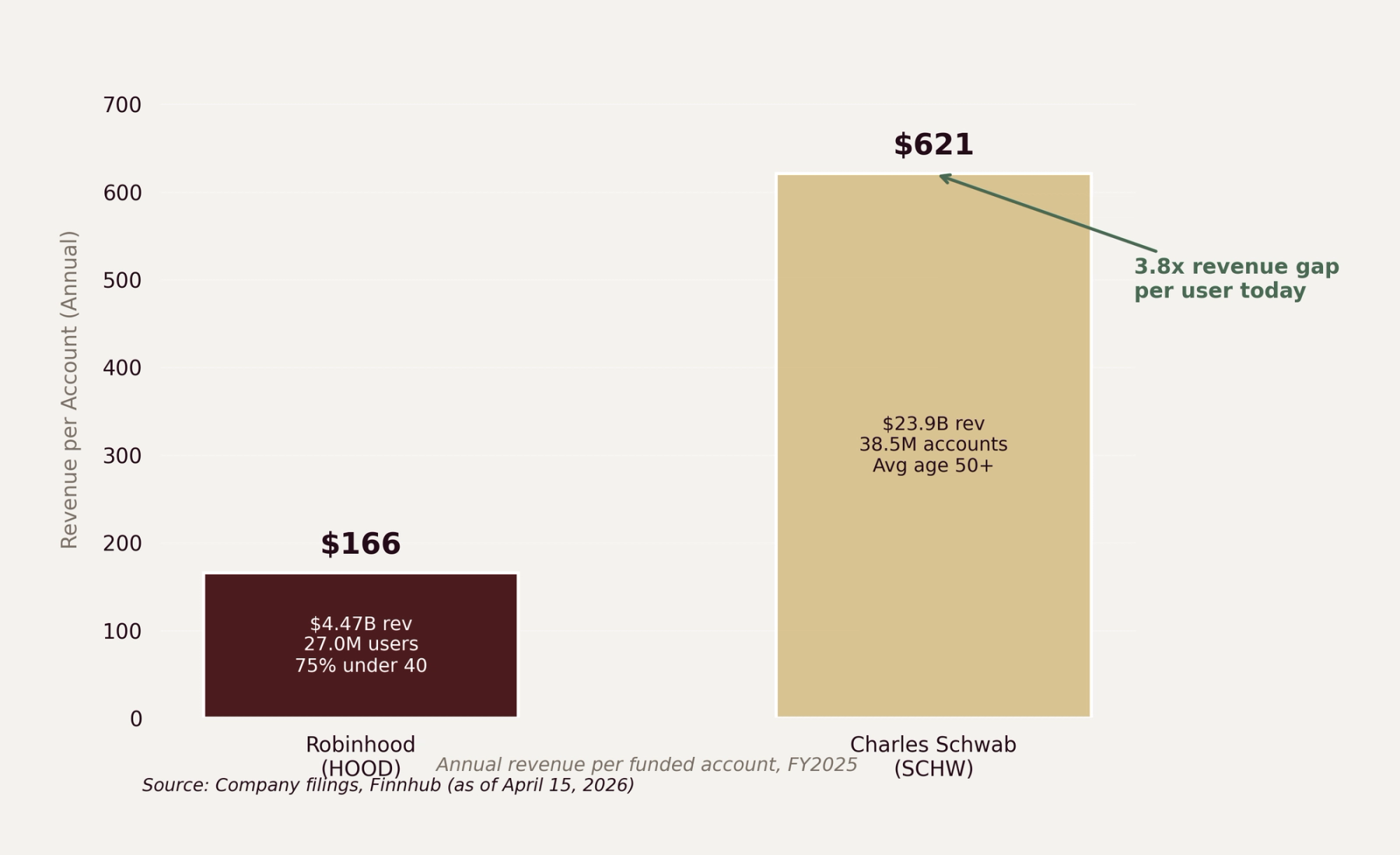
Robinhood Q4/FY2025 Earnings Release¹; Charles Schwab FY2025 10-K³
The Knockout Punch
The brokerage industry's next decade will not be decided by fee schedules, platform features, or investment returns. Demographics will decide it.
Robinhood owns the youngest investor cohort in the market. Approximately 75% of its 27 million funded accounts belong to investors under 40.1 Schwab's installed base skews overwhelmingly Boomer and Gen X, with an average client age well above 50, even though roughly 33% of new accounts come from younger investors.3
The revenue-per-account gap tells the story. HOOD generates $166 annually per funded account versus Schwab's $621.1,3 That nearly 4x difference reflects where HOOD's users stand in their financial lifecycle, not where they are headed.
As Gen Z and millennial account holders enter peak earning years, accumulate assets, and demand more sophisticated financial products, the revenue-per-user curve bends sharply upward. Gold subscriptions already demonstrate the path, growing 58% year-over-year to 4.2 million subscribers.1
The Trump Accounts program accelerates this dynamic to its logical endpoint. Starting July 4, approximately 4 million children receive tax-advantaged investment accounts with Robinhood and BNY Mellon as platform partners.8 A child enrolled at birth who remains on-platform through adulthood represents 60+ years of compounding account value.
If even 20% of those 4 million accounts remain active through age 25, HOOD adds 800,000 investors at zero marginal acquisition cost who arrive at peak ARPU potential just as the current Gen Z cohort enters its 30s.
The Consensus and Where It Breaks
The consensus on HOOD is split between momentum bulls who see a fintech platform story and valuation bears who see roughly 37–38x forward earnings on a brokerage that still depends on crypto revenue cycles. Both sides are looking at the wrong variable.
The momentum camp points to HOOD's 52% revenue growth, 68% asset growth, and expanding margins.1 The bear camp points to the premium multiple, the 12.8% year-over-year decline in monthly active users to 13 million in Q4 2025, and the structural cyclicality of crypto trading revenue.1
Neither camp has modeled the lifetime value of the generational pipeline. Current consensus estimates project $5.44 billion in 2026 revenue, a 21.7% increase, with EPS ranging from $2.26 to $2.35 depending on the aggregator.12 Those estimates capture the existing trajectory.
They do not capture the compounding effect of a federally backed top-of-funnel that delivers lifetime customers before those customers are old enough to choose a competitor.
The average Gen Z investor made their first investment at age 19, according to Schwab's 2024 Modern Wealth Survey.6 Millennials started at 25, Gen X at 32, and Boomers at 35. Each generation enters the market earlier than the last, and the Trump Accounts program pushes that starting age to zero.
Each Generation Starts Investing Earlier, and Trump Accounts Push the Starting Age to Zero
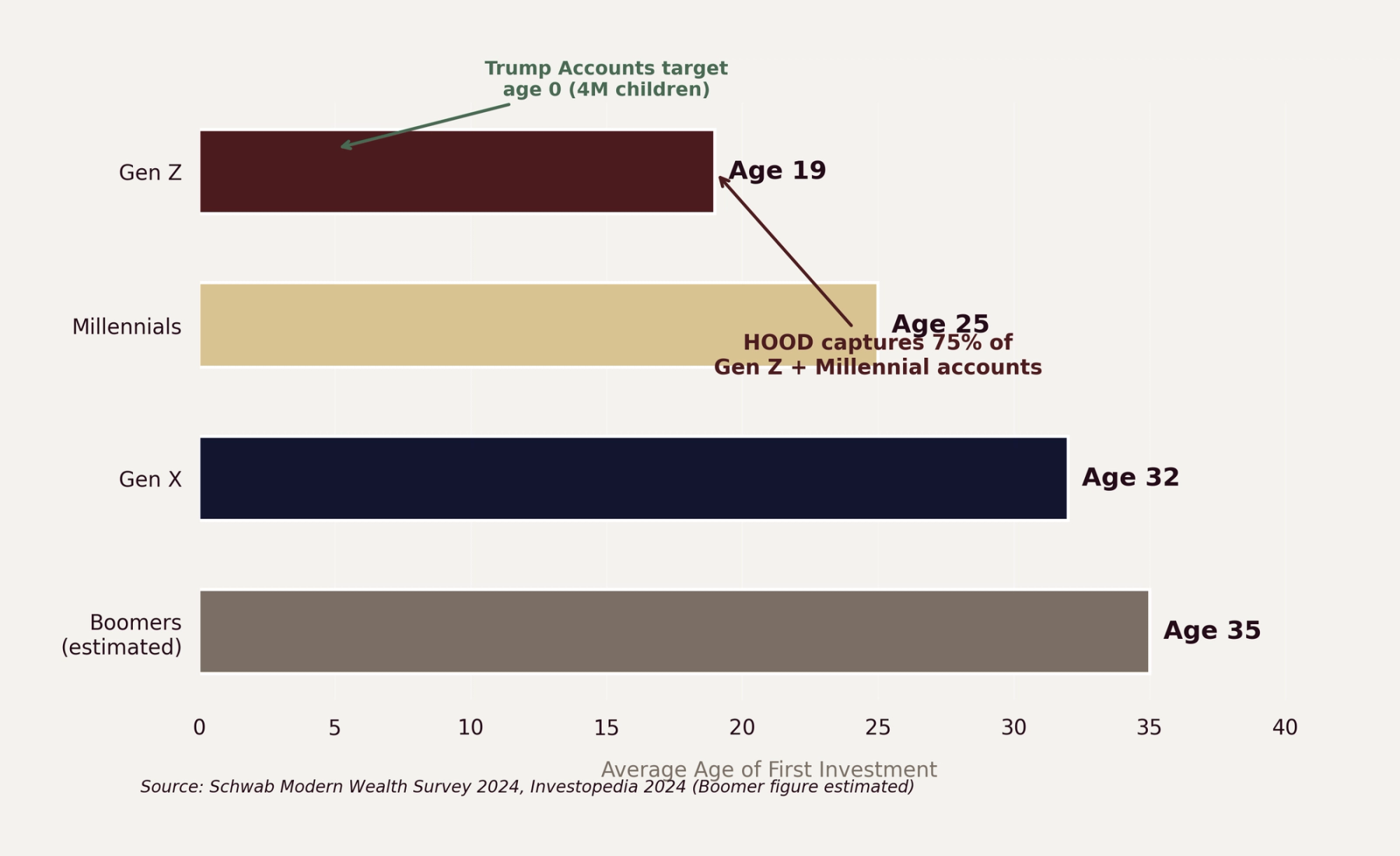
Schwab Modern Wealth Survey 2024⁶; Investopedia Financial Literacy Survey 2024⁷
Schwab launched its Teen Investor account on March 26, 2026, and Fidelity's Youth Account has reportedly grown over 200% since 2022.3,9 The incumbents see the demographic shift. They are responding late, and HOOD's 75% under-40 user base gives it a structural lead that a teen account product cannot close overnight.
The $11.90 Trillion Moat and Its Cracks
Schwab's scale commands respect. The firm manages $11.90 trillion in client assets across 38.5 million active brokerage accounts as of December 31, 2025.3 FY2025 revenue reached $23.9 billion, up 22% year-over-year, with pre-tax margins of 47.9% and net income of $8.85 billion.2
Schwab generated $11.8 billion in net interest revenue in FY2025, up 28% year-over-year, representing roughly half of total net revenues.3 That interest income stream alone exceeds Robinhood's entire $4.5 billion revenue base by a factor of 2.6x. In a stable-rate or rising-rate environment, Schwab's NII advantage compounds further.
Net new assets for 2025 totaled $519.4 billion, a 42% increase over the prior year.3 Schwab is not a dinosaur. It is a fortress.
But fortresses have blind spots. Schwab's revenue-per-account of roughly $621 reflects a mature client base already generating near-peak revenue.3 HOOD's $166 reflects a young client base at the beginning of its accumulation phase. The upside convexity sits entirely with HOOD.
Robinhood Outpaces Schwab on Every Growth Metric That Matters for the Next Decade
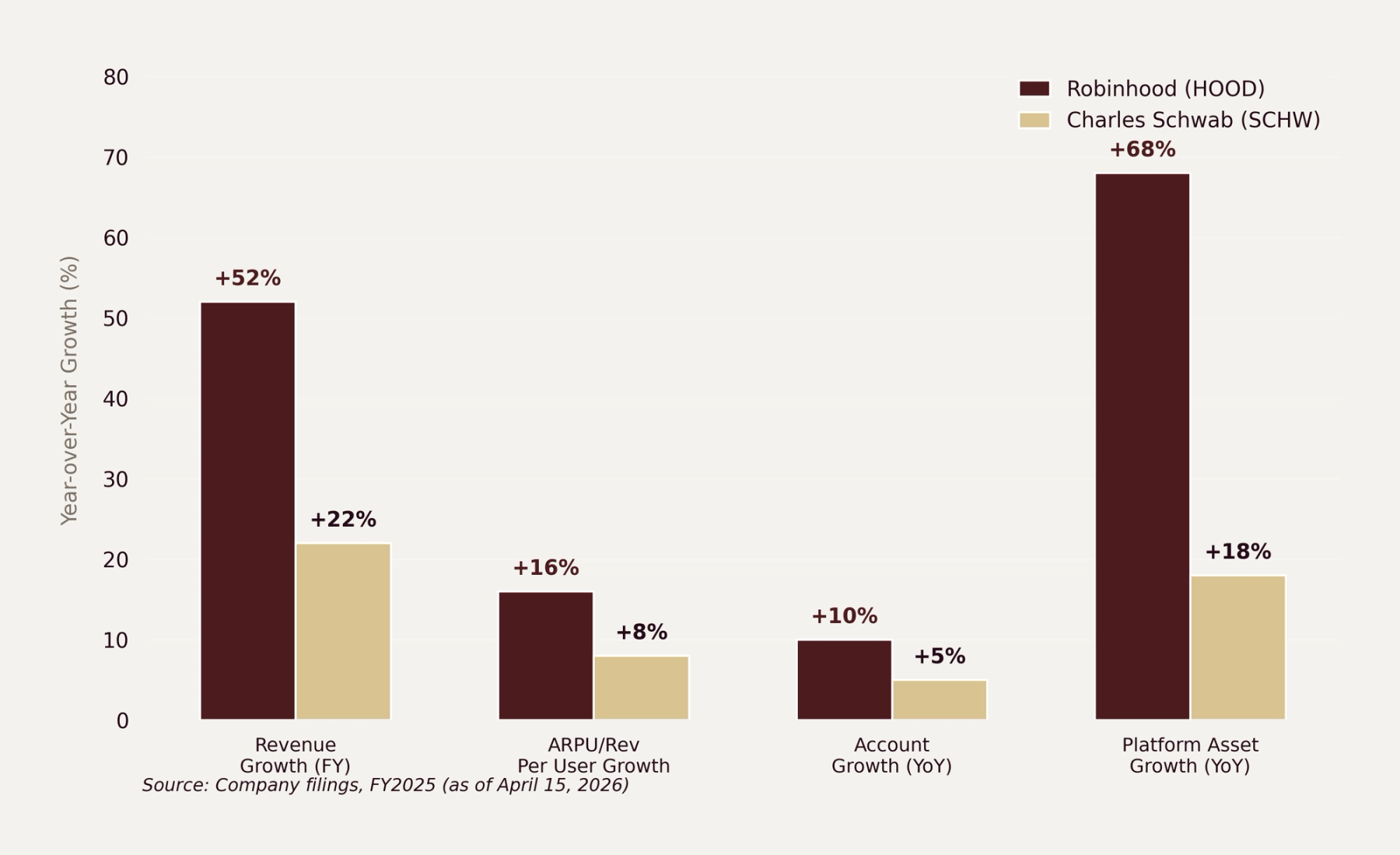
Robinhood Q4/FY2025 Earnings Release¹; Charles Schwab FY2025 10-K³
Trump Accounts Change the Math
The Trump Accounts program, launching July 4, 2026, enrolls approximately 4 million children in tax-advantaged investment accounts.8 Robinhood, alongside BNY Mellon, won the implementation contract. This is not a marketing partnership.
It is a government-funded customer acquisition channel. The lifetime value calculation matters most. A child enrolled at birth who remains on-platform through adulthood represents 60+ years of compounding account value.
If even 20% of those 4 million accounts remain active through age 25, HOOD adds 800,000 investors at zero marginal acquisition cost. Those investors arrive at peak ARPU potential just as the current Gen Z cohort enters its 30s.
Current consensus estimates capture the existing revenue trajectory.12 They do not capture the second-order effects of a federally backed top-of-funnel that delivers lifetime customers before they are old enough to choose a competitor. The sell-side models the next four quarters, but the Trump Accounts thesis operates on a 20-year compounding curve.
HOOD's Quarterly ARPU of $191 Keeps Climbing While the User Base Expands Simultaneously
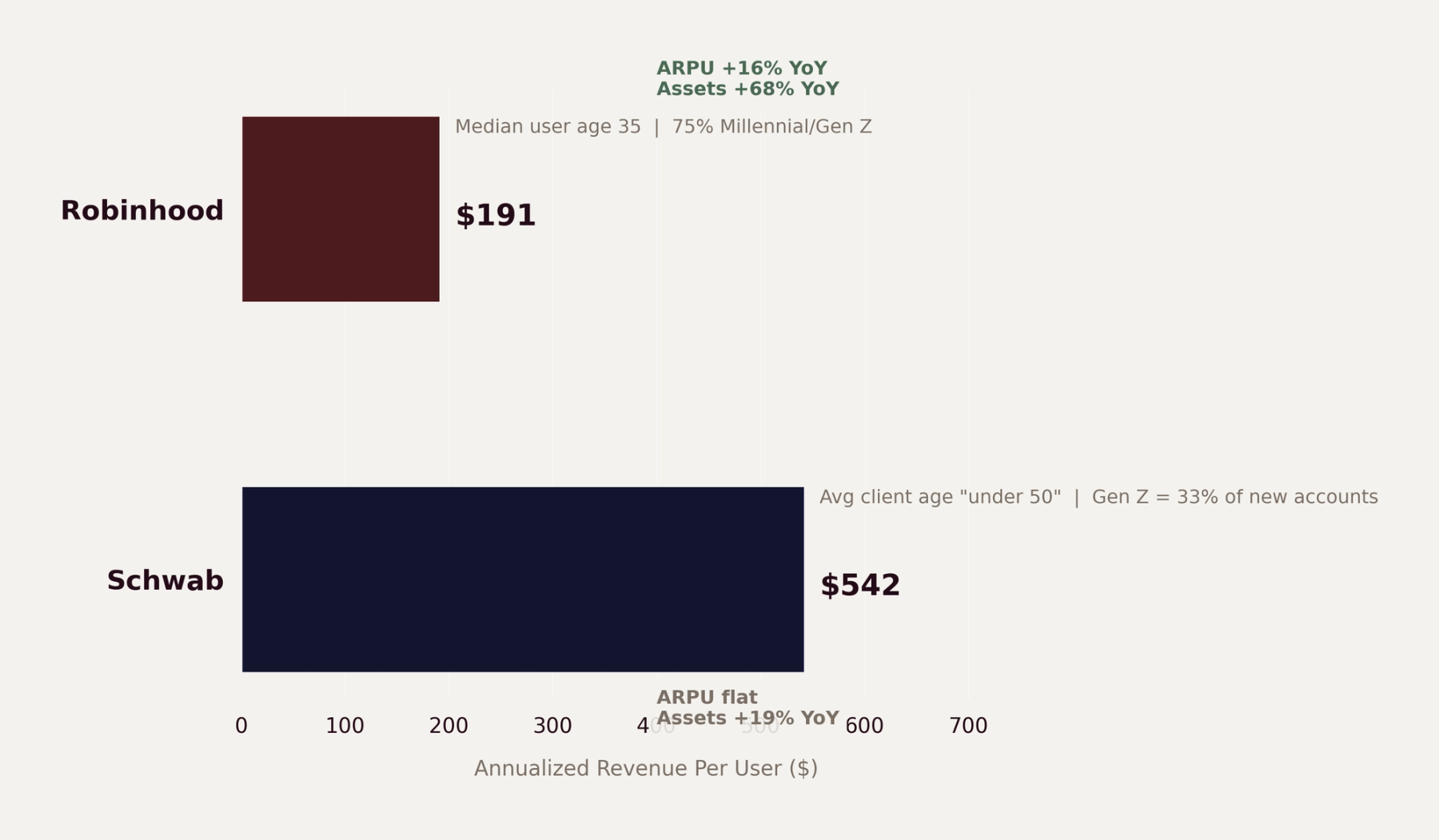
Robinhood Q4/FY2025 Earnings Release¹
The Counter-Argument
The bear case against Robinhood at approximately 37–38x forward earnings is straightforward and serious. The premium reflects a growth story that depends on unproven assumptions about user monetization, customer retention over decades, and the successful execution of a government program that has never been attempted before.
Crypto revenue, which powered much of HOOD's 2024-2025 growth, remains structurally cyclical. A sustained crypto winter would compress both revenue and the multiple the market assigns to HOOD's earnings. Monthly active users already declined 12.8% year-over-year in Q4 2025 to 13 million, suggesting that engagement is fragile even as funded accounts grow.1
Schwab's balance sheet advantage is durable. At $11.8 billion in annual net interest revenue for FY2025, Schwab's interest income alone exceeds Robinhood's entire $4.5 billion revenue base by a factor of 2.6x.3 In a rising-rate or stable-rate environment, Schwab's NII advantage compounds further.
Schwab also has the advisory and institutional channels that generate stickier, higher-margin relationships. The pre-tax margin of 47.9% on $23.9 billion in revenue represents an operating model that Robinhood has not proven it can replicate at scale.2 Schwab's fortress is not cracking.
The Trump Accounts program itself carries execution risk. Congressional opposition could delay or defund the program. Implementation challenges with custodial infrastructure for millions of minor accounts could create operational and reputational costs.
Even if the program launches successfully, the revenue contribution from accounts holding small government-funded balances may prove minimal for years. The 38x forward multiple leaves zero room for execution stumbles on this front.
Competitive response is inevitable. Schwab, Fidelity, and Vanguard all launched or expanded youth investing products in the past 12 months.3,9 The demographic advantage HOOD enjoys today narrows as incumbents invest in younger client acquisition. A 38x forward multiple leaves no room for execution stumbles, and the generational thesis requires a patience most growth investors do not possess.
Key Data
| Metric | Robinhood (HOOD) | Charles Schwab (SCHW) |
|---|---|---|
| Price | $87.32 | $100.27 |
| Market Cap | ~$78B | ~$176B |
| YTD Performance | ~-23% | Roughly flat |
| FY2025 Revenue | ~$4.5B (+52% YoY) | $23.9B (+22% YoY) |
| Revenue Per Account (Annual) | ~$166 | ~$621 |
| Funded / Active Accounts | 27.0M | 38.5M |
| Platform Assets | $322B | $11.90T |
| EBITDA / Pre-Tax Margin | ~56% (adj. EBITDA) | ~48% (pre-tax GAAP) |
| Gold Subscribers | 4.2M (+58% YoY) | N/A |
| ARPU (Quarterly) | $191 (+16% YoY) | N/A |
| % Millennial / Gen Z | 75% | ~33% new accounts |
| Asset Growth (YoY) | +68% | +18% |
| Forward Valuation | ~37–38x forward earnings | ~17x forward earnings |
| Teen Account Status | Trump Accounts (Jul 4 launch) | Teen Investor (Mar 26 launch) |
Data as of April 15, 2026. Sources listed in endnotes.1,2,3,5,12
Catalyst Map
| Timeframe | Event | Significance |
|---|---|---|
| Near-term (Q2 2026) | HOOD Q1 2026 Earnings (late April) | First quarter reflecting Trump Accounts announcement rally; watch for updated user growth and ARPU metrics |
| Near-term (Jul 4, 2026) | Trump Accounts Program Launch | Federally funded accounts go live on HOOD and BNY Mellon platforms; first test of enrollment scale |
| Mid-term (Q3-Q4 2026) | First Trump Accounts Cohort Data | Initial enrollment numbers, activation rates, and early retention data reveal whether the pipeline converts |
| Mid-term (H2 2026) | Crypto Market Cycle | A sustained crypto drawdown compresses HOOD's transaction revenue and tests the durability of the growth multiple |
| Wildcard | Congressional Action on Trump Accounts | Opposition party could attempt to defund or restructure the program; legislative risk persists through 2026 midterm cycle |
| Wildcard | Schwab / Fidelity Youth Product Acceleration | Aggressive incumbent response narrows HOOD's demographic advantage; watch for partnership announcements |
The Bottom Line
HOOD at $87.32 commands approximately 37–38x forward earnings based on 2026E EPS consensus of $2.26 to $2.35 (varying by aggregator), reflecting initial repricing of the generational optionality after the Trump Accounts contract win, but the lifetime compounding value of a government-funded top-of-funnel serving 4 million children has not been fully modeled by sell-side consensus.12 The bear case is real. Schwab's $11.8 billion NII advantage and the program's execution risk mean the premium leaves no room for stumbles.3 The thesis hinges on whether HOOD's demographic moat compounds faster than Schwab's balance sheet advantage erodes, and the July 4 launch date is the first live test of that proposition.
Sources
1. Robinhood Markets Q4 and Full Year 2025 Earnings Release, February 10, 2026
2. Charles Schwab Corporation Q4 and Full Year 2025 Earnings Press Release, BusinessWire, January 21, 2026
3. Charles Schwab Corporation 10-K Annual Report, FY2025
4. Charles Schwab Monthly Activity Report, January 31, 2026
5. Finnhub Financial Data API, live quotes retrieved April 15, 2026
6. Schwab Modern Wealth Survey 2024
7. Investopedia Financial Literacy Survey 2024
8. Executive Order establishing Trump Accounts program, 2026
9. Fidelity Youth Account growth statistics, Fidelity Investments press materials
10. Seeking Alpha, "Robinhood Markets Q4 Earnings Analysis," February 20, 2026
11. Yahoo Finance historical price data
12. Consensus earnings estimates aggregated from Zacks Investment Research, StockAnalysis.com (33 analysts), and FMP. 2026E EPS ranges from $2.12 to $2.35 depending on aggregator; revenue consensus $5.44B. Data as of April 6–15, 2026