Silvia Insights · April 13, 2026
Record gas prices alone have never caused a bear market
The national average for a gallon of regular gasoline just crossed $4 for only the third time in US history. Wall Street strategists are citing the two previous episodes as evidence that a bear market is imminent, but the data tells a different story.
What to Know
- Our analysis of prior episodes suggests energy exposure (XLE, up 24.7% YTD) during the elevated-price phase, followed by a rotation into beaten-down consumer discretionary (XLY, down 4.6% YTD) once prices peak. The 29-point YTD sector spread is historically extreme and has mean-reverted within 6-12 months of prior supply shock resolutions.
- According to our analysis, pure standalone supply shocks (1990, 2005) produced average S&P 500 returns of +18.9% twelve months after the gas price peak, and even headwind-muddied episodes (2011, 2022) still averaged +7.5%. The "$4 gas equals bear market" stat derives from two episodes where structural crises, not gasoline prices, were the primary driver of equity losses.
- WTI futures in steep backwardation, from $95.72 (May) to $74.40 (December 2026), signal the market prices a return to mid-$70s crude by Q4. The rotation trigger fires when WTI front-month settles below $80 for five consecutive sessions, the level our analysis identifies as the threshold that pulls gas under $3.50 and accelerates the shift from energy into discretionary names.
Standalone Supply Shocks Produce Positive 12-Month Forward Returns. Structural Crises Do Not.
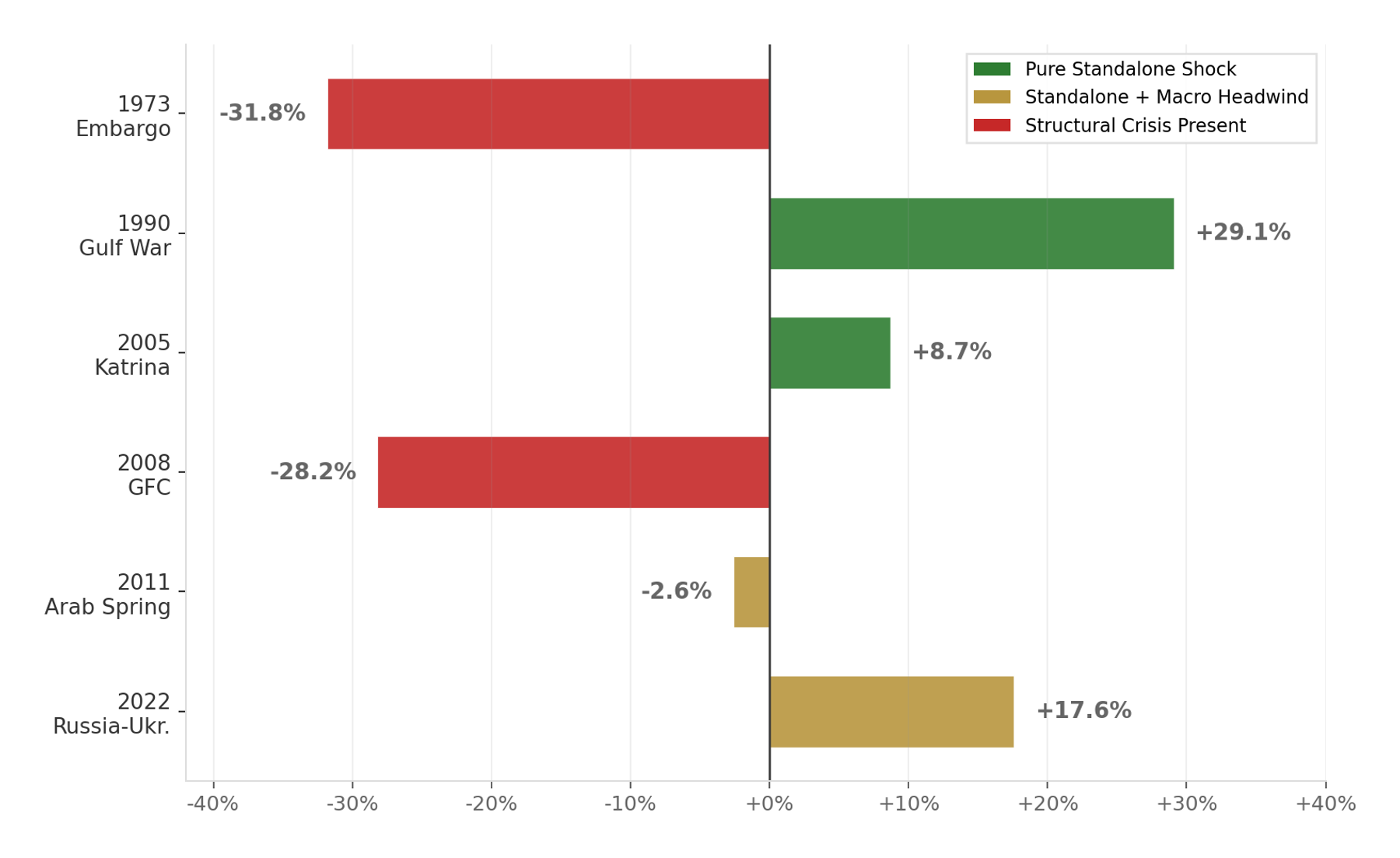
S&P 500 total return measured 12 months from the month of peak gasoline/oil prices in each episode. "Standalone" defined as oil supply shock without concurrent banking, credit, or monetary policy crisis. Source: S&P Dow Jones Indices via Yahoo Finance, EIA, ProCap analysis.
Gas at $4 per gallon functions as a media alarm bell. The national average crossed that line on April 6, 2026, driven by the Strait of Hormuz closure and the Iran conflict that has removed roughly 10 million barrels per day from global supply since early March.8 Prices surged from $2.94 in late February to $4.12 as of April 6, a 40% spike in barely six weeks.1
The immediate Wall Street reaction has been to reach for the only two historical comparisons available. Gas exceeded $4 in summer 2008 (peaking at $4.06 per gallon in July) and again in spring 2022 (peaking at $4.93 in June).2 In both cases, the S&P 500 entered a bear market, declining an average of 41% from peak to trough.3
Goldman Sachs used this framework to warn clients that the index could fall to 5,400, a 22% decline from the January high of 6,979.4 That number has become the bear case anchor for the entire sell-side.
The problem with this analysis is that it confuses correlation with causation on a sample size of two. In 2008, the financial system was collapsing under the weight of subprime mortgages and overleveraged banks. In 2022, the Federal Reserve was executing its most aggressive tightening cycle in four decades, raising rates from near-zero to 5.25% in 16 months.
Gas prices were a symptom in both cases, not the disease.
Six major oil and gas price spikes have hit the U.S. economy since 1973, and the forward return profiles split into three tiers based on the macro backdrop. Two episodes coincided with structural financial crises (1973, 2008), two were pure standalone supply shocks (1990, 2005), and two fell in the middle with the oil shock compounded by concurrent but non-systemic headwinds (2011 EU debt, 2022 Fed tightening).
In the 1973 Arab oil embargo, which coincided with stagflation, the collapse of Bretton Woods, and the Nixon resignation, the S&P 500 lost 31.8% over the following twelve months. In 2008, compounded by the banking crisis, it lost 28.2%. Average twelve-month forward return for crisis-contaminated spikes was negative 30.0%.5
The standalone supply shocks tell the opposite story. After the 1990 Gulf War, the S&P 500 gained 29.0% over twelve months. After Hurricane Katrina disrupted Gulf Coast refining in 2005, the index gained 8.7%.6
The two intermediate cases tell an instructive story. After the 2011 Arab Spring, the European sovereign debt crisis created a concurrent headwind, and twelve-month returns were -2.6%. After the 2022 Russia-Ukraine invasion, the most aggressive Fed tightening cycle in decades created a similar headwind, yet twelve-month returns were still +17.6%.
In our analysis, pure standalone supply shocks averaged +18.9% over twelve months. Even the headwind-muddied episodes averaged +7.5%, suggesting the oil shock itself was not the primary return driver in any of the four non-crisis episodes.
Six-Month and Twelve-Month Forward Returns Diverge Sharply Based on Whether a Structural Crisis Accompanied the Oil Shock
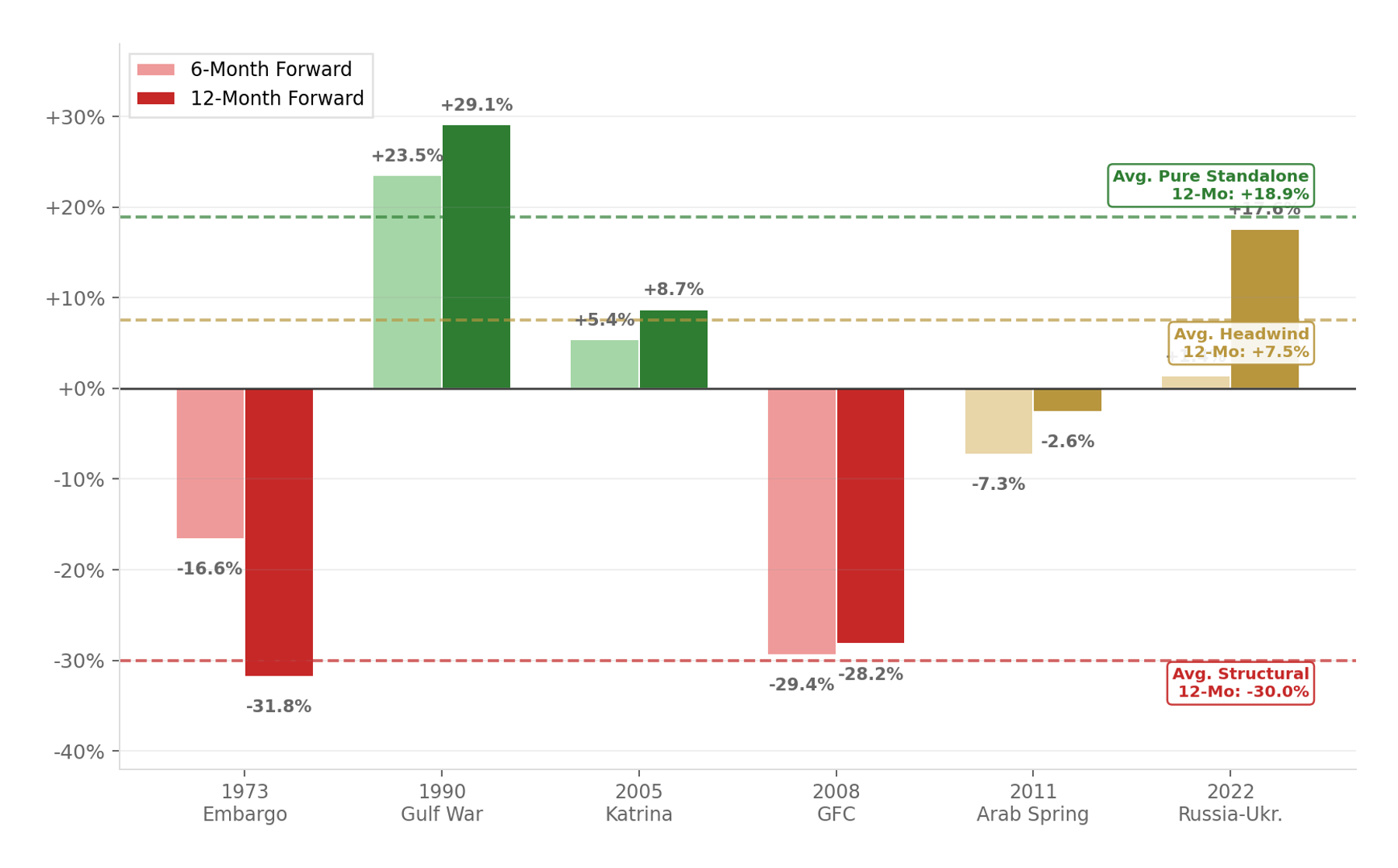
S&P 500 forward returns measured from the month of peak gasoline or oil prices in each episode. Green bars indicate pure standalone supply shocks. Amber bars indicate standalone shocks with concurrent macro headwinds. Red bars indicate supply shocks concurrent with structural financial crises. Dashed lines show group averages for 12-month forward returns. Source: S&P Dow Jones Indices via Yahoo Finance, EIA, ProCap analysis.
The six-month data reinforces the pattern. In our framework, pure standalone shocks averaged +14.4% at the six-month mark while structural crises averaged -23.0%.7 The directional split is consistent across both time horizons, and the magnitude gap is large.
The current gas spike is driven by a specific geopolitical event with a definable resolution path. Iran closed the Strait of Hormuz on March 4, removing roughly 20% of global oil supply from transit.8 WTI crude hit $114 per barrel on April 6 and Brent touched $128 on April 2 before both pulled back sharply to the mid-$90s on April 9 after ceasefire talks produced a temporary pause in hostilities.9
The critical distinction is what is not happening. The U.S. banking system is not under stress. Consumer balance sheets entered this shock in reasonable shape, with retail sales growing 0.6% in February, the last pre-war reading.10 The Federal Reserve has already cut three times since December 2024, bringing the target range to 3.50-3.75%, and markets price additional cuts in the second half of 2026.11
This profile matches the 1990 Gulf War template. That shock produced a sharp but contained 20% S&P 500 drawdown, followed by a V-shaped recovery once oil supply normalized. The S&P gained 23.5% over the six months following peak oil prices and 29.1% over twelve months.12
One cautionary note from 2011 is worth highlighting. The Arab Spring oil spike coincided with the European sovereign debt crisis, and while the S&P 500 still avoided a full bear market, it experienced a 19% peak-to-trough correction and delivered slightly negative twelve-month forward returns of -2.6%.13 If the Iran conflict escalates into a broader regional war or the consumer weakens faster than expected, the 2011 template is the downside scenario, not the 2008 one.
The historical pattern suggests a two-phase setup, and the sector performance year-to-date already reveals the divergence. Energy (XLE) is up 24.7% while consumer discretionary (XLY) is down 4.6%, a 29.3-percentage-point spread that is among the widest on record for a single quarter.14
The Energy-Discretionary Spread Has Blown Out to 29 Points YTD, a Gap That Has Historically Mean-Reverted After Supply Shocks
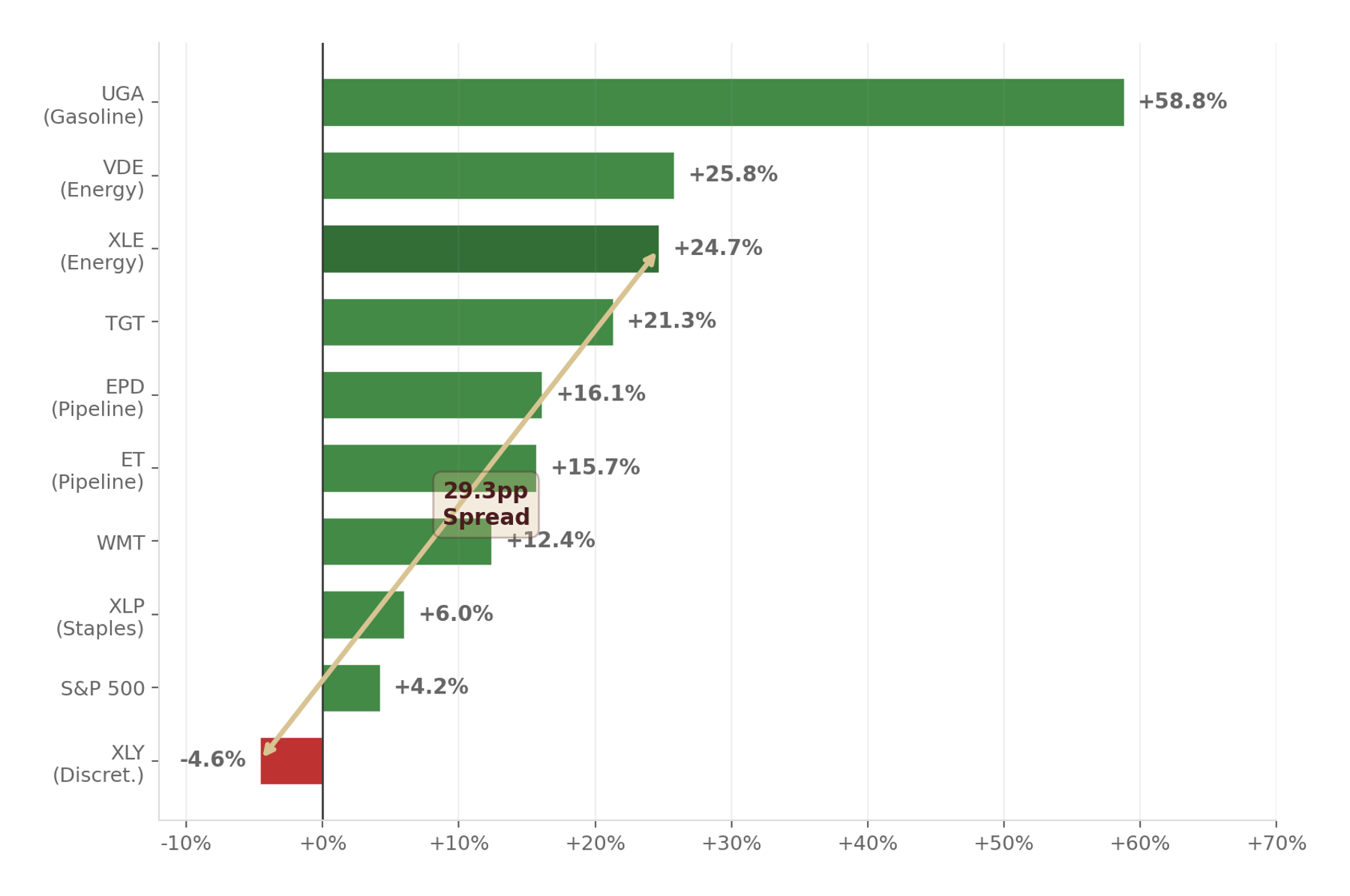
YTD returns as of April 11, 2026. Source: FMP via OpenBB, Yahoo Finance, ProCap analysis.
The first phase favors energy exposure. The Energy Select Sector SPDR (XLE) at $57 has returned 43.8% over the past twelve months, and the Strait of Hormuz remains partially disrupted.15 Enterprise Products Partners (EPD) at $37.35 represents a different angle on the same theme, operating a fee-based pipeline model that generates income from volume throughput regardless of commodity price.
EPD has delivered 16.1% YTD and pays a distribution yield above 6%.16
Our analysis of prior episodes suggests the second phase favors discretionary recovery. The Consumer Discretionary Select Sector SPDR (XLY) at $113 is down 4.6% YTD and sits below its 200-day moving average of $116.17 In the standalone supply shocks we examined, discretionary names snapped back as the "energy tax" on consumer spending lifted.
Real retail sales already dropped 0.7% in March as consumers cut back, and Target (TGT) warned of $1 billion in additional logistics costs.18 That damage is priced in. The recovery is not.
Walmart (WMT) at $127 sits at the intersection of both phases as a "trade-down" beneficiary that historically gains market share when gas costs squeeze household budgets. It is up 12.4% YTD and 33.8% over the past year, and management has reported surging trade-down behavior from higher-income households migrating to save on essentials.19
The strongest bear case against this thesis is that the current environment contains more structural risk than the 1990 or 2005 analogs suggest. The S&P 500 entered this oil shock at a Shiller CAPE ratio in the highest historical decile, and Shiller's own research implies forward annual returns of just 2% at these valuation levels.20 A high starting valuation compresses the margin for error. Any economic deterioration from elevated gas prices hits harder when stocks are priced for perfection.
Consumer resilience is not guaranteed. Real retail sales dropped 0.7% in March, the first month that captured the full gas price shock, and the decline was sharper than economists projected.21 BEA data shows Americans spent $440 billion on gasoline and motor fuel in 2024 at an average price near $3.40 per gallon. At the current $4.12, that scales to roughly $533 billion, an incremental $93 billion annual drag on discretionary purchasing power, or approximately $710 per household per year.22
The Iran conflict has no clear resolution timeline. Unlike the 1990 Gulf War, which lasted 42 days, the Strait of Hormuz disruption is now in its sixth week with ceasefire negotiations producing only temporary pauses.23 Goldman Sachs estimates that if Hormuz remains mostly shut for another month, Brent crude will average above $100 for all of 2026 and could reach $120 in Q3.24 A sustained $100+ oil environment would transform this from a temporary supply shock into a persistent inflation driver. March CPI already spiked to 3.3% year-over-year from 2.4% in February, and another month of elevated gas prices could push the April reading above 3.5%, potentially forcing the Fed to pause its cutting cycle at 3.50-3.75% rather than delivering the additional easing markets expect.
The 2011 analog also carries an embedded warning. While the S&P 500 avoided a full bear market, the 19% correction from April to October was painful, and the twelve-month forward return was marginally negative at -2.6%. If the European banking system or another unexpected vulnerability surfaces alongside the oil shock, the 2011 playbook is the realistic downside, and it does not deliver the robust recovery the 1990 analog promises.
The two-phase rotation trade also carries execution risk. Timing the pivot from energy to discretionary requires correctly calling the gas price peak, and the history of calling commodity tops is littered with early and expensive mistakes. The Strait of Hormuz could remain disrupted far longer than markets currently expect, keeping the energy-discretionary spread wide or pushing it wider before it mean-reverts.
| Episode | Peak Gas Price | Classification | 6-Mo Forward | 12-Mo Forward |
|---|---|---|---|---|
| 1973 Arab Embargo | N/A (oil from $3 to $12) | Structural crisis (stagflation) | -16.6% | -31.8% |
| 1990 Gulf War | ~$1.35 | Pure standalone | +23.5% | +29.1% |
| 2005 Katrina | $2.90 | Pure standalone | +5.4% | +8.7% |
| 2008 Financial Crisis | $4.06 | Structural crisis (GFC) | -29.4% | -28.2% |
| 2011 Arab Spring | $3.96 | Standalone + headwind (EU debt) | -7.3% | -2.6% |
| 2022 Russia-Ukraine | $4.93 | Standalone + headwind (Fed tightening) | +1.4% | +17.6% |
| Avg. Pure Standalone | +14.4% | +18.9% | ||
| Avg. Standalone + Headwind | -3.0% | +7.5% | ||
| Avg. Structural | -23.0% | -30.0% |
Sources listed in endnotes. S&P 500 returns measured from month of peak gasoline/oil price in each episode.
| Trade Expression | Ticker | Price | YTD Return | 1-Yr Return | Role |
|---|---|---|---|---|---|
| Energy Select Sector SPDR | XLE | $57.00 | +24.7% | +43.8% | Elevated-price phase exposure |
| Enterprise Products Partners | EPD | $37.35 | +16.1% | +23.2% | Volume-based yield exposure |
| Consumer Discret. SPDR | XLY | $113.00 | -4.6% | +18.7% | Post-normalization recovery |
| Walmart | WMT | $126.77 | +12.4% | +33.8% | Trade-down beneficiary |
Sources listed in endnotes. Prices as of April 11, 2026.
Iran ceasefire negotiations remain the single most important variable. A durable ceasefire reopening the Strait of Hormuz would send WTI below $80 within weeks, triggering the rotation signal (WTI front-month below $80 for five consecutive sessions) and accelerating the discretionary recovery. A breakdown in talks keeps crude above $95 and extends the energy-accumulation phase.25
April CPI (releasing May 13) will determine whether the March inflation spike was a one-month event or the start of a new trend. March CPI already jumped to 3.3% year-over-year from 2.4% in February, the largest monthly acceleration in four years.26 A second consecutive acceleration above 3.5% could shift Fed expectations from further cuts to an indefinite hold, which would undermine the recovery thesis.
Q1 earnings season, which begins this week, will reveal the first wave of management commentary on how the gas spike is affecting margins, guidance, and consumer behavior. Watch for downward revisions in consumer-facing names and upward revisions in energy and industrials exposed to elevated commodity prices.
Fed meeting on April 29-30 carries a 94.8% probability of a hold at 3.50-3.75%.27 The statement language on inflation versus growth will signal whether the Fed sees the oil shock as transitory (bullish for the recovery trade) or persistent (bearish).
The Bottom Line
The "$4 gas equals bear market" narrative is built on two data points where structural crises, not gasoline alone, drove equity losses, while our analysis finds pure standalone shocks averaged +18.9% and even headwind-muddied episodes averaged +7.5% at twelve months. The current Iran-driven spike carries the hallmarks of a 1990-style geopolitical event, not a 2008-style systemic collapse. The rotation trigger to watch is WTI front-month closing below $80 for five consecutive sessions, a level our framework identifies as the threshold that shifts leadership from energy to discretionary names.
Sources
1. FRED series GASREGW (U.S. Regular All Formulations Gas Price), weekly data through April 6, 2026. Pre-war baseline from January-February 2026 weekly readings.
2. FRED series GASREGM (U.S. Regular Gasoline Monthly Average), July 2008 = $4.062/gal, June 2022 = $4.929/gal.
3. IndexBox, "Gasoline Surpasses $4, Echoing Historical Bear Market Triggers," 2026.
4. Goldman Sachs equity strategy note, cited in The Motley Fool, April 6, 2026.
5. S&P 500 daily close data via Yahoo Finance (^GSPC); all forward returns computed from fixed 6-month and 12-month windows starting from the month-end close of the peak oil/gas price month. 1973 from Oct 1973 close (108.29), 2008 from Jun 2008 close (1280.00).
6. S&P 500 monthly close data via Yahoo Finance; returns computed from peak gas/oil price months in each episode.
7. ProCap analysis of S&P 500 monthly close data; six-month forward returns computed from same peak months.
8. CNBC, "Iran war-hit oil prices will soon rise if Hormuz stays shut," March 28, 2026.
9. FRED series DCOILWTICO (WTI spot, $114.01 on April 6) and DCOILBRENTEU (Brent spot, $127.61 on April 2); CNBC, "Oil rally loses steam," April 9, 2026 (post-ceasefire settlement ~$97-98 WTI).
10. Fortune, "Retail sales tick up 0.6% in February before Iran war, gas price spike," April 1, 2026.
11. FRED series DFEDTARU/DFEDTARL (Fed Funds Target Range), current 3.50-3.75% effective Dec 11, 2025. Three cuts from 4.50-4.75% since Dec 2024. CME FedWatch Tool via MEXC News, April 2026.
12. S&P 500 monthly data; 1990 Gulf War returns computed from October 1990 peak oil month.
13. S&P 500 monthly data; 2011 Arab Spring returns computed from May 2011.
14. FMP price performance data via OpenBB, accessed April 12, 2026.
15. Yahoo Finance equity price data for XLE, accessed April 11, 2026.
16. Yahoo Finance equity price and distribution data for EPD, accessed April 11, 2026.
17. Yahoo Finance equity data for XLY including 200-day moving average, accessed April 11, 2026.
18. FinancialContent, "The Great Pullback," March 6, 2026; FinancialContent, "The Energy Tax," March 10, 2026.
19. Modern Retail, "Rising gas prices could be the straw that breaks consumer spending," 2026.
20. The Motley Fool, "The Last Time the Stock Market Was This Expensive," April 6, 2026.
21. FinancialContent, "The Great Pullback: American Consumers Retreat," March 6, 2026.
22. Bureau of Economic Analysis, Personal Consumption Expenditures: Nondurable Goods: Gasoline and Other Energy Goods (FRED series DGOERC1Q027SBEA, USPCEGAS). 2024 annual PCE gasoline $440.5B. Scaled to current $4.12/gal using ratio method. 131M U.S. households per Census Bureau.
23. Euronews, "Iran ceasefire effect: Oil plunges as European markets surge," April 8, 2026; CNBC timeline.
24. OilPrice.com, "Goldman: Another Month of Hormuz Closure Means Over $100 Brent Throughout 2026."
25. CNBC, "Oil rally loses steam after Israel agrees to negotiate with Lebanon," April 9, 2026.
26. PBS News, "Soaring gas prices leads to biggest monthly inflation spike in four years in March," 2026.
27. CME FedWatch Tool, accessed April 12, 2026; MEXC News, "Fed Rate Hold Probability Reaches 94.8%."