Silvia Insights · April 29, 2026
2 non-crowded stocks that win from Nvidia's dominance
Nvidia's earnings dominance is real, but the trade is crowded. The cleaner expression of the same earnings flow is two third-order suppliers that report earnings before NVDA does and trade with a fraction of the consensus crowd.
What to Know
- The trade is long IES Holdings (IESC) at 33.9x forward earnings and Advanced Energy Industries (AEIS) at 43.5x, both with direct AI capex exposure and fewer than 20 sell-side analysts each.1
- AEIS data center revenue grew 101% year over year in Q4 2025 and management guides over 30% data center growth in 2026, while only 18 analysts model the name.2
- Both companies report earnings before NVDA's May 20 print, with IESC on May 1 and AEIS on May 4, giving readers a clean read-through and a tight catalyst window.3
The market has already discovered NVDA. It hasn't discovered the value chain.
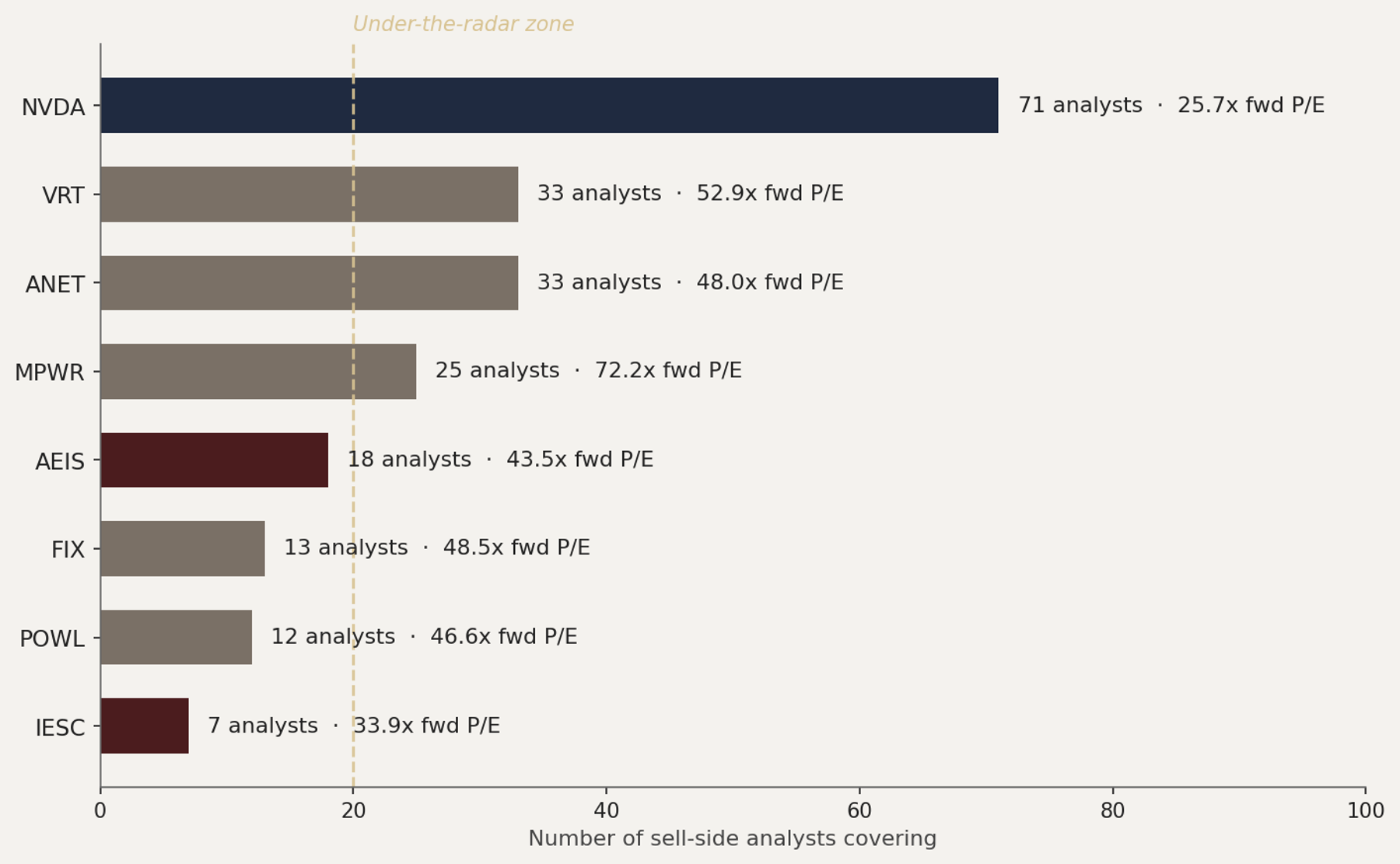
Source. Finnhub recommendation_trends and company_eps_estimates as of April 28, 2026. Forward P/E computed as price divided by FY+1 consensus EPS.¹
The Analytical Framework
The list comes from a data sweep of the AI infrastructure value chain.
We started with fifteen candidate suppliers across optical, networking, power, cooling, MEP construction, semicap equipment, and ODMs.
We then required four conditions for inclusion.
The first filter was sell-side coverage of fewer than twenty analysts as of April 1, 2026.1 The second was forward EPS growth of at least 25% over the next twelve months, computed from consensus earnings estimates.1 The third was a published earnings date inside the next six weeks.3
The fourth and most important filter was measurable AI revenue exposure.
We required either a disclosed data center segment growing above 50% year over year, or a tooling-supply business whose direct customers are the semiconductor capital equipment makers (Applied Materials, Lam Research, KLA, ASML) whose tools build the chips at TSMC and Samsung.
Two names cleared every filter, and they are the entire pick list, shown highlighted in the watchlist table below alongside the consensus peer cohort for context.
This methodology produced a small list deliberately. Wider lists dilute the read-through into NVDA's May 20 print, and the entire premise of the framework is asymmetric exposure to a single dominant capex cycle.
The Watchlist
The cohort below is the consensus AI infrastructure peer group plus our two picks. The point of the table is the gap between coverage and price. The two highlighted rows are the trade.
| Ticker | Analysts | Price | YTD Return | Fwd P/E | FY+1 EPS Growth | Earnings Date |
|---|---|---|---|---|---|---|
| NVDA | 71 | $216.61 | +14.7% | 25.7x | n/a | May 20, 2026 |
| VRT | 33 | $322.43 | +83.6% | 52.9x | +46.3% | reported |
| ANET | 33 | $172.47 | +29.1% | 48.0x | +22.8% | May 5, 2026 |
| MPWR | 25 | $1,587.57 | +69.6% | 72.2x | +21.9% | April 30, 2026 |
| AEIS | 18 | $385.68 | +73.7% | 43.5x | +39.8% | May 4, 2026 |
| FIX | 13 | $1,794.04 | +78.8% | 48.5x | +39.4% | reported |
| POWL | 12 | $260.52 | +121.7% | 46.6x | +14.2% | May 4, 2026 |
| IESC | 7 | $606.97 | +49.2% | 33.9x | +31.1% | May 1, 2026 |
Data as of April 28, 2026. Source. Finnhub quote, recommendation_trends, company_eps_estimates, and earnings_calendar. Forward P/E equals current price divided by FY+1 consensus EPS. YTD baseline is January 2, 2026 close.1
Pick One. IES Holdings (IESC)
What the Business Actually Is
IES Holdings is a Houston-based specialty contractor with four operating segments.
The one that matters is Communications, which builds the electrical and tech infrastructure inside data centers. That includes power distribution, fiber, networking cabinets, and the literal wiring that carries electrons to and from NVDA GPUs.4
Communications was 40% of revenue in Q1 FY26, at $351.9M of $871M total. That share was 34% in FY25, when Communications generated $1,140.6M out of $3,371.5M. The mix shift toward AI data-center build-out is happening in real time.4
Q1 FY26 (the December 2025 quarter) showed Communications revenue up 51% year over year with a 16.3% operating margin.
That is a hyperscaler-grade growth rate at hyperscaler-grade margins. The total company grew revenue 16% to $871M with operating income up 31%.4
The Knockout Number
Three sell-side analysts publish forward EPS estimates on IESC. Total recommendation count is seven. By comparison, NVDA has 71.1
Comfort Systems (FIX) is the larger MEP contractor that runs the same data center playbook. FIX has 13 analysts and trades at 48.5x forward P/E. IESC trades at 33.9x, which is a discount that reflects coverage rather than earnings quality.1
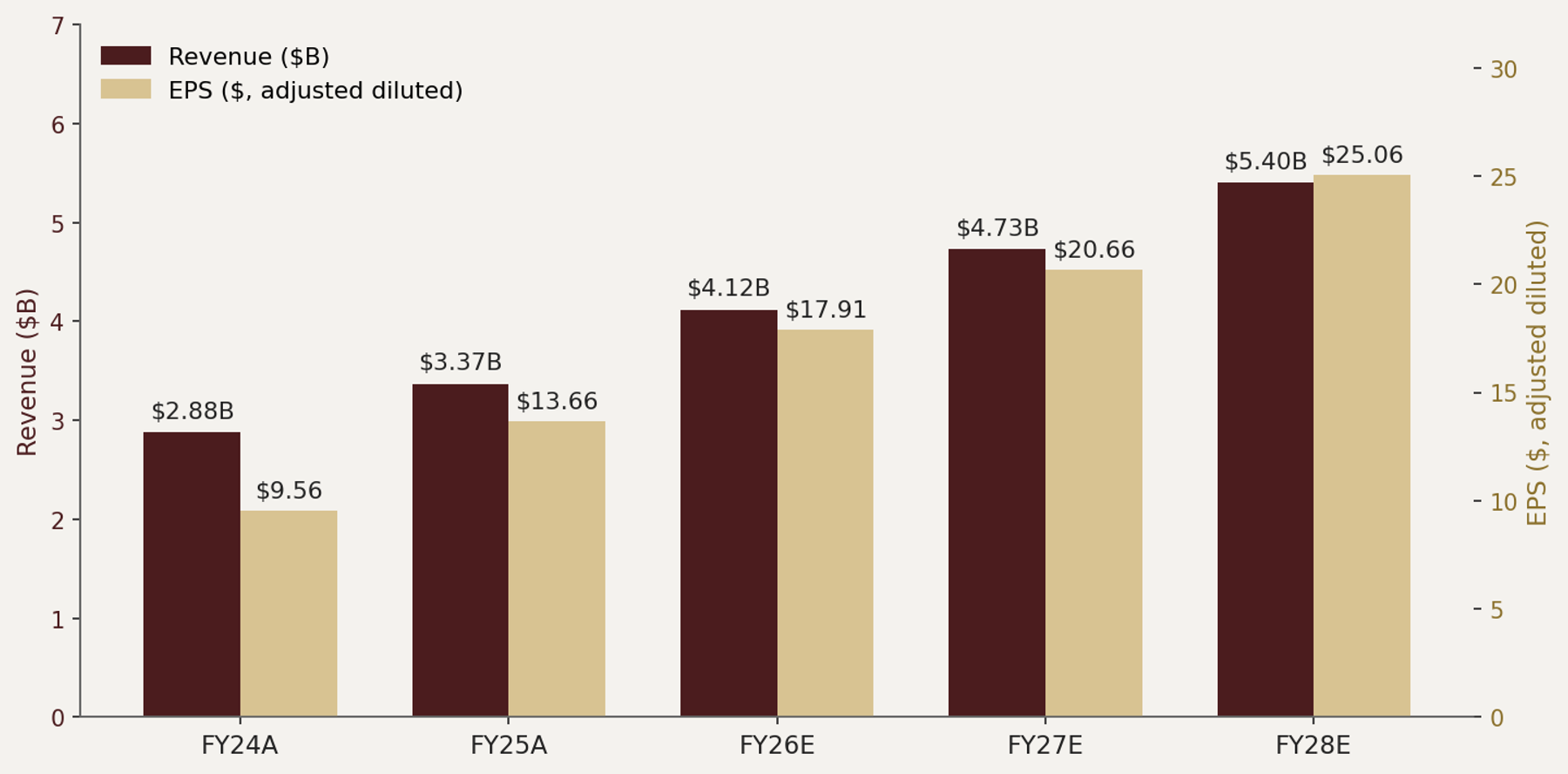
Source. FY24A and FY25A adjusted diluted EPS from IES Holdings press releases; revenue actuals from company filings. FY26E–FY28E consensus revenue and EPS from Finnhub company_revenue_estimates and company_eps_estimates.1
The Catalyst Window
IESC reports Q2 FY26 on May 1, 2026, which is nineteen calendar days before NVDA's May 20 print and three days before the AEIS report.
Consensus expects $4.03 EPS.3
One disclosure on the most recent quarter is required. Q1 FY26 was an EPS miss of 4.78% versus the $3.90 Finnhub consensus, even though revenue grew 16% year over year and operating income rose 31%.5
That mismatch between operating reality and the EPS line is the inefficiency that creates the asymmetric setup. If Q2 Communications continues to print growth above 50%, the read-through into NVDA's hyperscaler demand becomes unambiguous, and broker initiations are likely to follow.
Another EPS miss alongside continued segment strength would be a buying opportunity at a still-modest forward multiple.
The Single Biggest Risk
Residential and Commercial & Industrial together accounted for 44% of Q1 FY26 revenue ($284M and $95M of $871M, respectively) and are housing- and construction-sensitive. A genuine housing downturn would mute the AI signal. The bull case requires Communications growth to swamp the cyclical drag, which it has done for six consecutive quarters but is not guaranteed in a recession.4
Pick Two. Advanced Energy Industries (AEIS)
What the Business Actually Is
AEIS makes specialized power conversion products across four end markets. Semiconductor Equipment is roughly 42% of revenue and supplies plasma RF power generators into the etch and deposition tools sold by Applied Materials, Lam Research, KLA, and ASML.
AEIS is one of a small number of qualified RF plasma power suppliers (alongside MKS Instruments, Comet Group, and Trumpf), and these power systems are critical inputs to the etch and deposition steps that produce advanced-node chips at TSMC and Samsung.2
Data Center Computing was 37% of revenue in Q3 2025 and 36% in Q4 2025, and the segment supplies power conversion solutions directly to hyperscalers for AI rack architectures. Industrial & Medical (16% of Q4 2025 revenue) and Telecom & Networking (5%) together provide the cyclical ballast.2
The Knockout Number
Data center revenue grew 101% year over year in Q4 2025 and 107% for full-year 2025, reaching roughly $587M.2 Management guided to over 30% data center growth in 2026 on top of that base.2
The CFO highlighted total revenue growth in the high teens for 2026, with data center as the lead engine. Semiconductor Equipment grew 6% in 2025 to $840M, which CEO Steve Kelley described as the second-strongest year on record after the 2022 peak.
Industrial & Medical was the segment that bottomed in Q1 2025 and has posted three consecutive quarters of sequential growth since.2
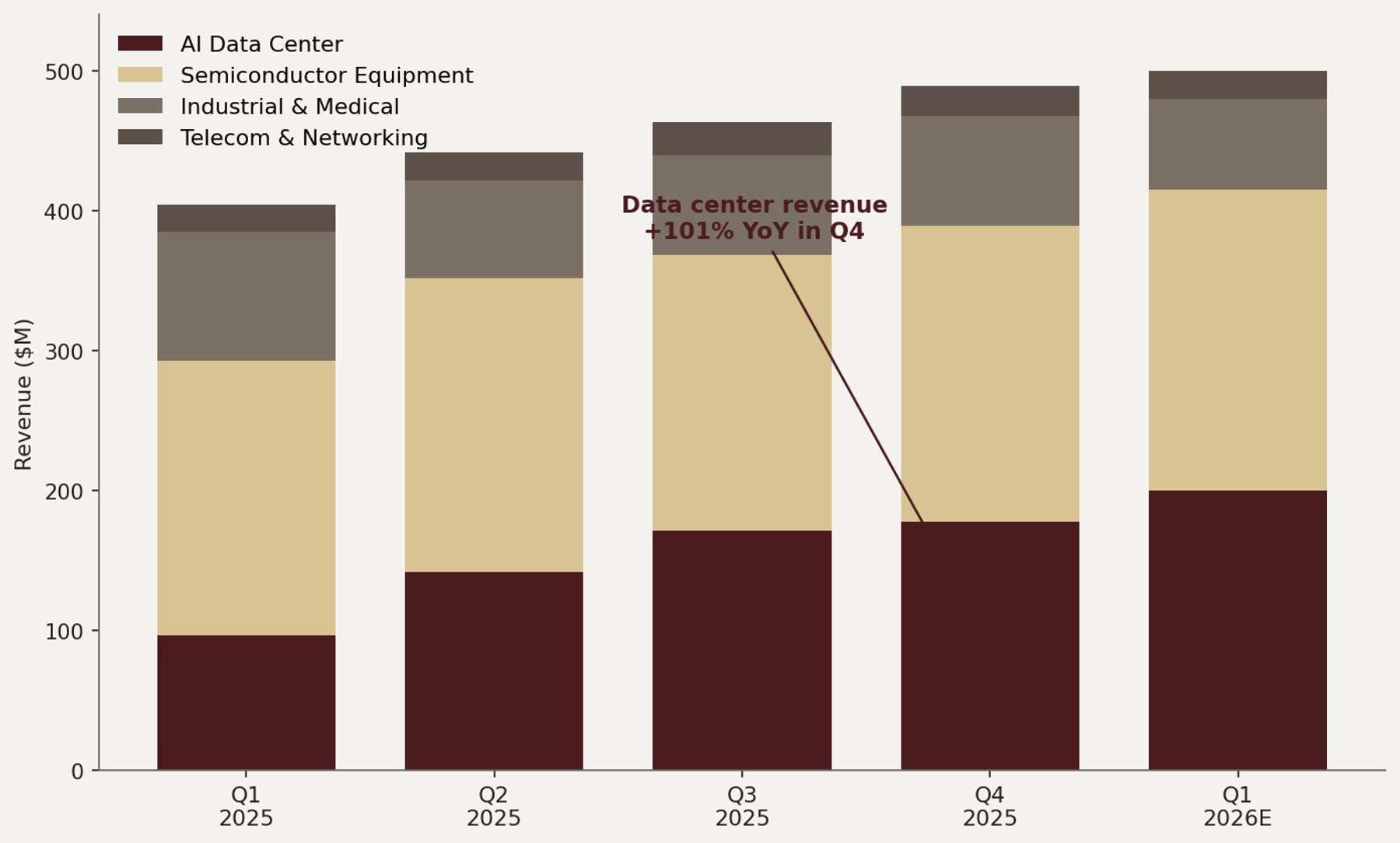
Source. AEIS quarterly earnings releases via Motley Fool transcripts and company press releases for Q1 2025 through Q4 2025 actual segment revenue; Q1 2026E composition based on management's $500M total revenue midpoint guidance and analyst expectations for the segment-level split.2
The Track Record of Beats
AEIS has beaten consensus EPS in 6 of the last 6 quarters, with an average surprise of +12.0%.5 The trailing six quarters break down as Q3'24 +5.30%, Q4'24 +16.34%, Q1'25 +13.83%, Q2'25 +12.47%, Q3'25 +16.07%, and Q4'25 +7.77%.5
For IESC, only the last three quarters have published estimates. Those are Q2 FY25 +5.22%, Q3 FY25 +18.84%, and Q1 FY26 a 4.78% miss.5
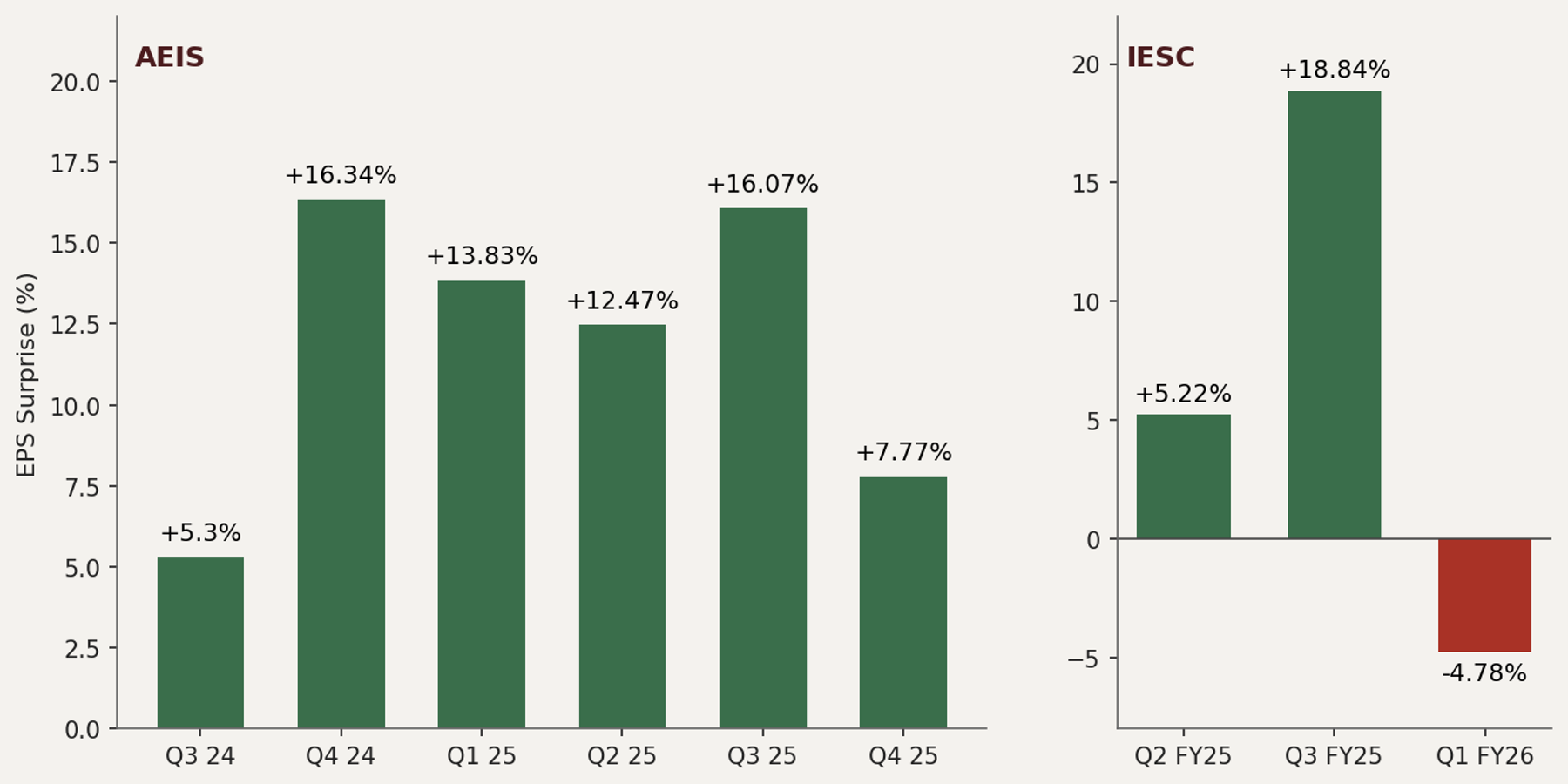
Source. Company earnings, trailing six quarters for AEIS and the three quarters of available Finnhub estimates for IESC.5
The Catalyst Window
AEIS reports Q1 2026 on May 4, 2026, sixteen days before NVDA. Q1 guidance from the Q4 2025 call was $500M revenue plus or minus $20M, and $1.94 EPS plus or minus $0.25.2
Consensus is at $2.014 EPS, $0.07 above management's $1.94 midpoint guidance and roughly two-thirds of the way to the $2.19 high end. The market is therefore already pricing a modest beat.3
The risk-reward asymmetry is tighter than the surface comparison suggests.
A clean beat with raised data center guidance reframes AEIS as an AI infrastructure name rather than a cyclical semicap stock. A merely in-line print could see a profit-taking reaction.
The Single Biggest Risk
If hyperscaler capex disappoints in calendar Q2 or Q3 2026, the data center segment could decelerate before the semi segment fully recovers. AEIS would then carry an awkward narrative for two quarters.2
The defense is that the data center growth is from an installed base so low that even a 50% deceleration leaves the segment growing above 50% year over year.
The corroborating base rate is that the same five hyperscalers most cited as potentially pausing have collectively raised 2026 capex guidance to $660 to $690 billion, roughly double 2025 levels.6
The Consensus and Where It Breaks
The consensus AI infrastructure trade in April 2026 is the same trade it was last summer. Buy NVDA, buy VRT, buy ANET, buy MPWR.
That cohort already sits at forward multiples of 25.7x, 52.9x, 48.0x, and 72.2x respectively, and the cohort has spent the last twelve months absorbing every dollar of fresh AI allocation that hit the tape.1
The data tells a different story about where the marginal earnings dollar lands.
NVDA Q4 FY26 datacenter revenue printed at $62.3 billion, up 75% year over year, and the company guided Q1 FY27 total revenue at $78 billion plus or minus 2%.7 Networking inside that figure crossed $11 billion, and aggregated 2026 hyperscaler AI capex from Microsoft, Alphabet, Amazon, Meta, and Oracle is now tracked in a $660 to $690 billion range.6
What is not in question is the dollar volume of AI capex. What is in question is who captures the marginal dollar of that capex at attractive entry multiples. NVDA has already been bid up to a 25.7x forward multiple by buyers who could not afford to be underweight, and the second-tier consensus names sit at 48x to 72x.
The market has not yet priced the third-tier suppliers at parity with their growth. IESC at 33.9x forward earnings has the lowest multiple of any third-tier supplier in the cohort (only NVDA itself trades lower at 25.7x, but as the cohort anchor with $216 billion in FY26 revenue it operates on a different scale) and the lowest analyst count, with FY+1 adjusted EPS growth modeled at 31.1%.1 AEIS at 43.5x has 39.8% FY+1 EPS growth and a data center business doubling year over year.1
Consensus breaks at the coverage layer.
When 71 analysts cover one stock and 7 cover another with double-digit forward EPS growth and direct exposure to the same capex cycle, the price discovery process is structurally incomplete on the under-covered name. That is not a permanent inefficiency, but it is the inefficiency that operates inside an earnings catalyst window.
The Counter-Argument
The serious bear case on this analysis is that low analyst coverage is not an edge in 2026.
It is a feature of small-and-mid-cap equity markets that has persisted for decades and that hedge funds, ETFs, and quant funds all incorporate into their factor models. Russell 2000 pure-plays with under-ten analyst coverage have not, on average, generated alpha since 2018, because the factor stopped working once it was systematized.
The harder version of this critique is that IESC and AEIS have already been discovered by price action. IESC is up 683% since January 2024 and 49% YTD. AEIS is up 263% since 2024 and 74% YTD. NVDA itself returned roughly 350% over the same window since January 2024 (split-adjusted), so IESC has outperformed NVDA across that horizon while AEIS has lagged it; YTD, both names have outperformed NVDA by a wide margin.8
If the market has bid them up by these magnitudes, the under-the-radar framing is wrong by definition. They are simply small-and-mid-cap AI infrastructure names that will trade at high beta to any AI re-rating. They will fall harder than NVDA in a tape break, not less, and that is the bear's strongest objection to treating them as a defensive expression of the same theme.
The third version of the bear case is concentration risk. IESC's Communications segment depends on a small number of hyperscaler general contractor relationships.
If Quanta Services or Comfort Systems decides to vertically integrate in a particular region, IESC could lose share faster than the analyst count suggests.4
AEIS's semiconductor segment depends on four customers (AMAT, LRCX, KLA, ASML), and any inventory correction at TSMC flows directly into the AEIS order book.
The 2023-2024 semi correction is the proof case. AEIS's semi revenue declined off its 2022 peak through 2023 and bottomed in 2024 (with management citing Q3 2024 as the trough), and the segment has been recovering through 2025, although the company's stock chopped sideways through much of the downturn.2
The reply to all three objections is the same. The trade is not buy these instead of NVDA. The trade is asymmetric exposure to the same fundamental driver (AI capex) at lower entry multiples and lower positioning risk.
If AI capex disappoints, NVDA at 25.7x forward will probably hold up better than AEIS at 43.5x. If AI capex continues to compound, the under-followed names see multiple expansion plus EPS upside, while NVDA's multiple expansion is structurally capped by its size and crowdedness.
The expected return distribution favors the under-covered names on any catalyst that confirms the bull thesis, and the May 1 and May 4 prints are exactly that kind of catalyst.
Monitoring Framework
Three confirming signals add conviction to the thesis if they show up across the May 1, May 4, and May 20 prints over the next three weeks.
AEIS Q1 data center revenue prints above $213M (which would be 20% sequential growth from Q4 2025's $177.9M) with management raising 2026 guidance. IESC Q2 Communications segment prints above $410M (above 50% year-over-year growth from Q2 FY25's $273M) with operating margin above 16%.
The third confirming signal is NVDA Q1 hyperscaler concentration ratio holding above 60% of data center revenue.
A separate cross-check is whether TSMC monthly revenue keeps printing at the elevated levels reported through Q1 2026, which can be verified directly from TSMC's monthly investor releases.
Three signals would cut conviction. AEIS data center sequential growth turning negative for two consecutive quarters, and IESC Communications operating margin compressing below 14%.
The third de-risking signal is hyperscaler 2026 capex commentary turning cautious from Microsoft, Meta, or Amazon. A downward revision from the $660 to $690 billion aggregate would force the entire AI infrastructure cohort to re-rate.
The Bottom Line
NVDA's earnings story is intact, but the trade is fully owned, and the cleanest way to express continued NVDA earnings dominance is to buy the suppliers of the suppliers. IESC for the data center build-out and AEIS for the fab tools that build the chips and the rack power that runs them, both reporting in the next six days, and both with consensus already lagging operating momentum on the segments that matter most. The bear case (already discovered by price action, concentration risk, factor decay) is real but resolves in the same direction as the bull case if the May 1 and May 4 prints confirm the segment trajectory.
Disclosures
Sources
Sources
Finnhub API endpoints quote, recommendation_trends, and company_eps_estimates, queried April 28, 2026; supports the cohort table (analyst counts, prices, forward P/E, FY+1 EPS growth) and the hero chart. IESC FY26 adjusted EPS consensus of $17.91 cross-checked against StockAnalysis Pro (Finnhub-sourced; mean $17.91, range $17.21–$18.44 across three analysts) and against FMP ($17.56 mean). finnhub.io/docs/api and StockAnalysis Pro IESC forecast.
Advanced Energy Industries Q4 2025 earnings release and conference call transcript, February 10, 2026; supports the AEIS data center +101% YoY, FY25 +107% to $587M, segment mix, 2026 guidance, and Q1 2026 guidance figures. Advanced Energy press release and Q4 2025 transcript (Motley Fool).
Earnings dates: IES Holdings Q2 FY26 release confirmed for May 1, 2026 (announced April 27, 2026), AEIS Q1 2026 release confirmed for May 4, 2026, NVIDIA Q1 FY27 release confirmed for May 20, 2026. IES Holdings May 1 announcement; AEIS May 4 announcement.
IES Holdings Q1 FY26 earnings press release, January 30, 2026, and Q1 FY26 10-Q filing; supports Communications $351.9M (40% mix, +51% YoY, 16.3% op margin), total revenue $871M (+16%), operating income +31%, FY25 segment data ($1,140.6M / $3,371.5M, 34% mix), and the adjusted diluted EPS history used in the watchlist table and trajectory chart (FY24A $9.56, FY25A $13.66; FY25A GAAP diluted EPS was $15.02). Q1 FY26 release; FY25 full-year release.
Finnhub company_earnings endpoint, trailing six quarters per ticker, queried April 28, 2026; supports the EPS surprise history chart and the 4.78% IESC Q1 FY26 miss vs the $3.90 Finnhub consensus (actual reported $3.71 adjusted). finnhub.io company_earnings
Hyperscaler 2026 capex aggregate ($660 to $690 billion across Microsoft, Alphabet, Amazon, Meta, and Oracle); cross-referenced. Introl AI Capex 2026 and CNBC AI capex 2026.
NVIDIA Q4 FY26 earnings release, February 25, 2026; supports Q4 FY26 data center revenue $62.3 billion (+75% YoY), Q1 FY27 total revenue guidance of $78 billion plus or minus 2%, and Q4 FY26 networking revenue of $11 billion. NVIDIA Q4 FY26 release.
Finnhub stock_candles daily close data, January 1, 2024 through April 27, 2026; supports IESC +683% and AEIS +263% returns since January 2024 and YTD returns referenced in the watchlist table and Counter-Argument section.