Silvia Insights · April 14, 2026
Intel’s 58% rally looks more like a trap than a turnaround
Intel surged 58% in nine trading days to a new 52-week high of $65.18, but the stock now trades at 64x forward earnings while generating negative free cash flow and shrinking revenue.
What to Know
- Intel (INTC) at $65.18 trades at 64x forward earnings, nearly four times the semiconductor peer median of 19.5x, while 33 of 41 analysts rate the stock a hold with a median price target of $48. The data favors fading this rally.1
- The forward P/E gap between Intel and Nvidia tells the story. Intel trades at 64x while Nvidia, the dominant AI chip franchise, trades at 17x, meaning the market prices Intel at nearly 4x the multiple of a company with vastly superior earnings power.3
- Q1 2026 earnings in late April will determine whether this rally holds or collapses. A miss against the roughly $0.25 quarterly EPS implied by consensus would trigger a violent repricing toward the $48 analyst median.2
Intel Surged 58% in 9 Days to a 52-Week High, Far Outrunning Its Fundamentals
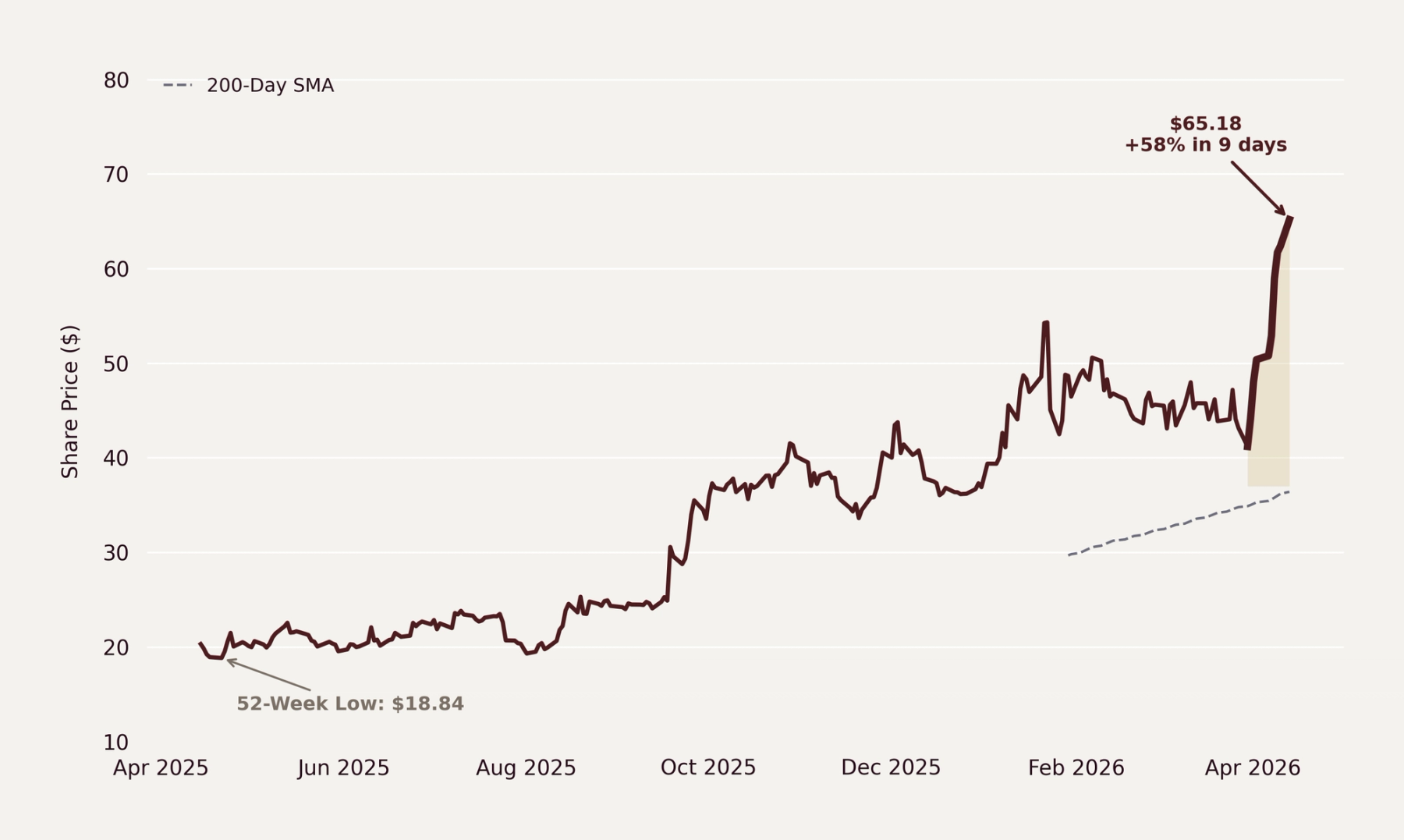
Intel (INTC) 1-year price history. The gold-shaded region marks the March 30 to April 13, 2026 rally. Yahoo Finance, as of April 13, 2026.¹
The Knockout Punch
Intel trades at $65.18 today. The median Wall Street price target is $48.2 That is not a stock the Street thinks has more room to run.
Forty-one professional analysts, on average, think INTC is 26% overvalued at the current price. The highest target on the Street is $76, just 16% upside from here. The stock priced in almost every conceivable piece of good news in under two weeks.
The number that reframes everything is Intel's forward P/E of 64x. Nvidia, the most dominant semiconductor company on the planet, trades at 17x forward earnings.3
AMD trades at 23x. Broadcom trades at 21x. Intel is being priced like a hypergrowth AI darling while generating negative free cash flow and shrinking revenue.3
The market is not pricing Intel's current business. It is pricing a fantasy version of Intel that does not yet exist.
The Consensus and Where It Breaks
The bull thesis on Intel rests on three pillars. The CHIPS Act provides approximately $8.5 billion in direct subsidies and up to $11 billion in loans for Intel's U.S. manufacturing buildout. The tariff environment has created urgency around domestic semiconductor production, and Intel is the only U.S.-based advanced chip manufacturer.
CEO Lip-Bu Tan's restructuring plan, which included cutting 15,000 employees in 2024, is beginning to show results in margin improvement. The Q4 2025 earnings beat was real. Intel posted $0.15 EPS versus the $0.08 consensus, an 81% upside surprise.1
Q3 was even more dramatic, at $0.23 versus $0.01 expected. The company has beaten estimates in the two most recent quarters (Q3 and Q4 2025), though Q2 2025 was a miss with EPS of -$0.10 against a +$0.01 estimate. But these beats came off an absurdly low bar, with consensus penciling in near-zero earnings and Intel delivering marginally above zero.
The consensus breaks on timing. Wall Street largely agrees that Intel's foundry business and 18A process node represent a credible long-term optionality play.2
What the Street does not agree on is whether that optionality is worth a 64x forward multiple on a company that lost money last year. Thirty-three of 41 analysts rate Intel a hold, not because they think the company is dead, but because they think the turnaround is already more than priced in at $65.
Intel's 9-Day Rally Dwarfed Every Semiconductor Peer
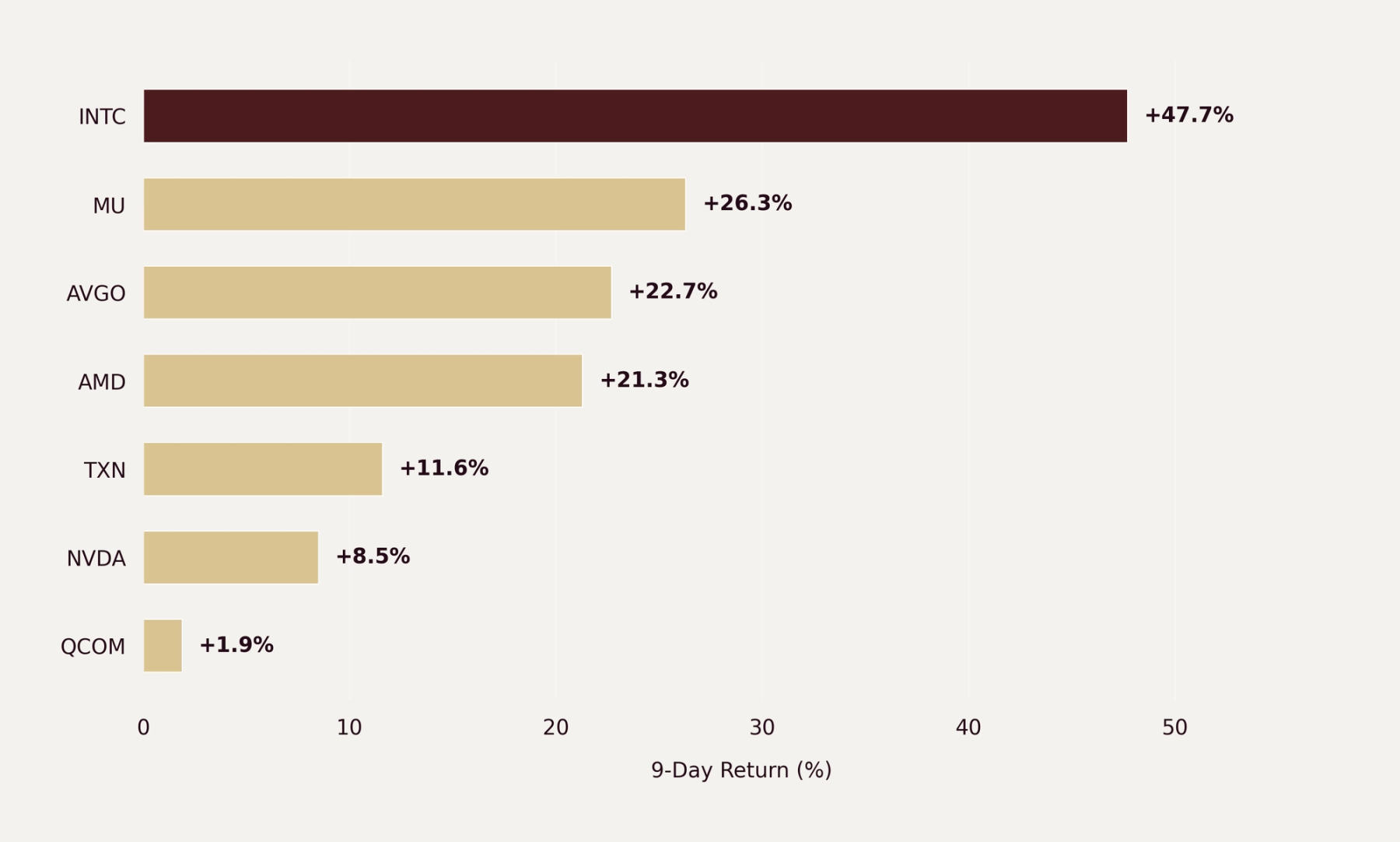
INTC gained 58.2% while the next-best performer, Micron, returned 32.6%. The rally appears driven by tariff exemption speculation and short-covering rather than fundamental improvement. Yahoo Finance, as of April 13, 2026.³
The Counter-Argument
The bear case against fading this rally deserves serious attention. Three specific arguments support the bulls, and none of them are trivial.
Intel's strategic position is genuinely unique. No other U.S. company can fabricate advanced semiconductors on domestic soil. In a world where the Taiwan Strait risk is increasingly priced by defense planners and semiconductor supply chain strategists, Intel's foundry business has option value that traditional valuation metrics cannot capture.
The CHIPS Act funding is real, contractual, and already being disbursed. The U.S. government has a vested national security interest in Intel succeeding, which creates a soft floor under the stock that other semiconductor names do not have.
The earnings trajectory is inflecting. The two most recent quarterly beats (Q3 and Q4 2025), improving from -$0.06 trailing EPS toward the $1.02 forward consensus, suggest the restructuring is gaining traction.1 Operating income turned positive in Q4 2025 at $550 million, the first positive print in several quarters.
If Intel can sustain that trajectory through 2026, forward P/E compression could be rapid. A stock trading at 64x forward earnings that delivers $2.00 in EPS within 18 months suddenly looks like a 32x stock. That is expensive but not absurd for a turnaround with government backing.
The TSMC joint venture speculation adds another catalyst layer. Reports of a potential partnership where TSMC would take a stake in Intel Foundry Services or co-develop the 18A process node would represent the strongest validation of Intel's foundry strategy since the business was created. If a TSMC deal materializes, it would demolish the primary bear argument that Intel cannot execute on its manufacturing roadmap.
The historical parallel bulls cite is AMD's turnaround under Lisa Su from 2016 to 2020. AMD traded at extreme multiples during its foundry-to-fabless transition, and investors who sold on valuation alone missed a 30x return. Intel bulls argue the same patience is required here.
These are real arguments. But they require everything to go right. The 18A node must yield on schedule, the foundry must attract external customers, and revenue must stop declining.
The $14.7 billion annual capex bill must eventually produce positive returns. At $65, the stock prices all of this in with zero margin of safety.
Intel at 64x Forward Earnings Towers Over Every Semiconductor Peer
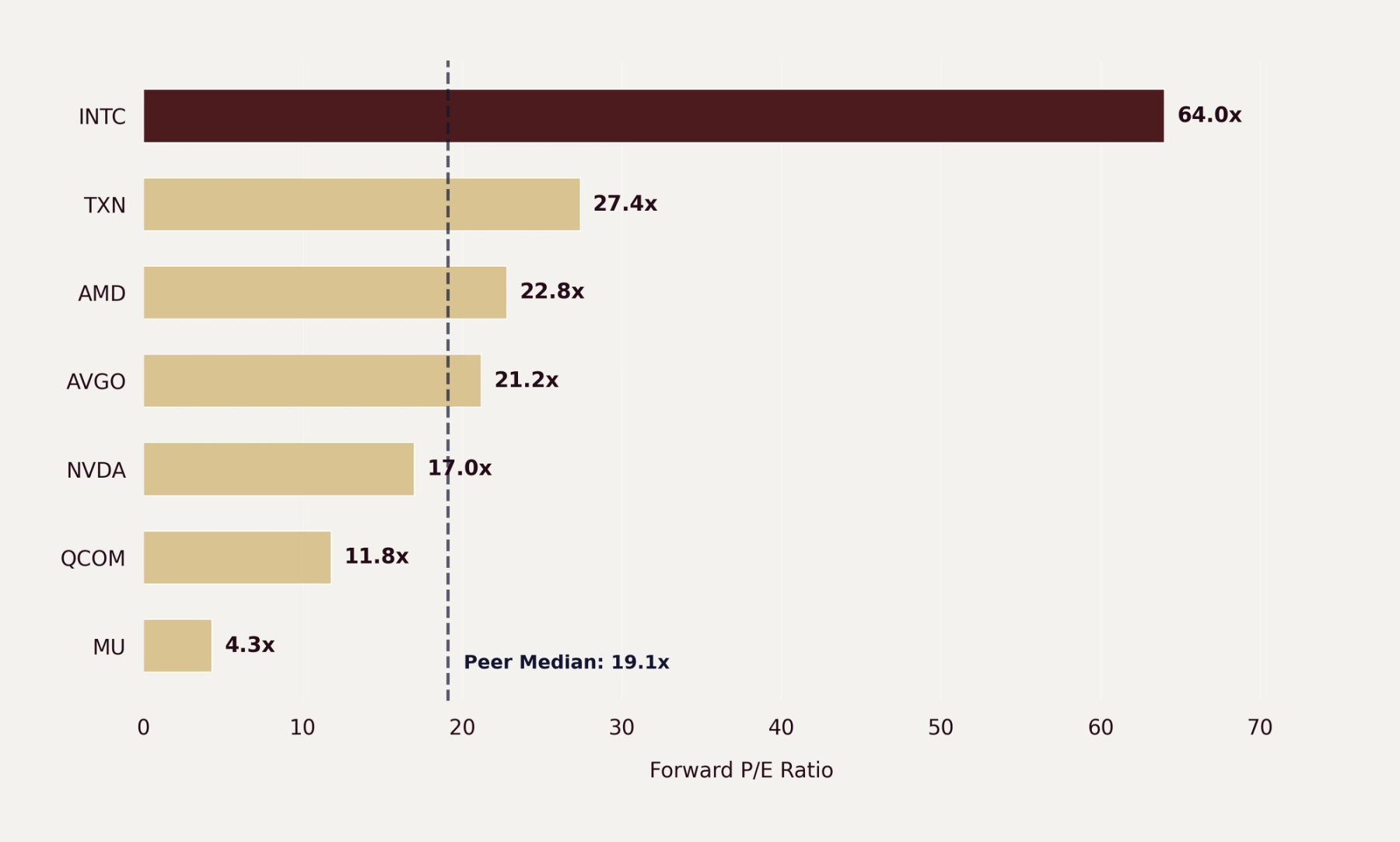
Forward P/E comparison across major semiconductor names. Peer median sits at 19.5x, making Intel the most expensive name in the group by a wide margin despite the weakest earnings profile. Yahoo Finance, as of April 13, 2026.³
Key Data
| Metric | Value |
|---|---|
| Current Price | $65.18 |
| Market Cap | $327.3B |
| Enterprise Value | $333.4B |
| FY2025 Revenue | $52.9B (-0.5% YoY) |
| FY2022 Revenue (Peak) | $63.1B |
| Q4 2025 EPS | $0.15 (beat $0.08 est. by 81%) |
| Forward P/E | 64.0x |
| EV/Revenue | 6.3x |
| EV/EBITDA | 26.4x |
| Free Cash Flow (FY2025) | -$4.95B |
| Total Cash | $37.4B |
| Total Debt | $47.1B |
| 52-Week Range | $18.25 - $65.65 |
| Analyst Price Target (Median) | $48.00 |
| Analyst Consensus | Hold (33 of 41 analysts rate Hold) |
Data as of April 13, 2026. Sources listed in endnotes.1 2 3
Catalyst Map
Near-Term (Next 30 Days)
Q1 2026 earnings report, expected late April. Consensus forward EPS of $1.02 implies roughly $0.25 per quarter. Any miss would trigger a violent correction given the elevated multiple.2
Tariff policy clarification on the semiconductor exemption remains speculative. Formal confirmation or denial will move the stock 10%+ in either direction.
Analyst target revisions will signal whether the Street validates the rally. With the stock 35% above the consensus target, a wave of upgrades or a conspicuous silence will be telling.2
Mid-Term (1 to 6 Months)
Intel Foundry Services customer announcements for 18A would validate the foundry thesis. Absence of announcements would erode confidence in the turnaround timeline.
CHIPS Act funding milestones and progress on Ohio and Arizona fab construction will determine whether government backing translates to manufacturing capability.
Lip-Bu Tan's strategic update covering the first full year of restructuring results and updated capital allocation framework will set expectations for 2027 and beyond.
Wildcard
A confirmed TSMC partnership or equity stake would be the most consequential catalyst in Intel's modern history. It would also likely put a ceiling on Intel's independent foundry ambitions.
China-Taiwan geopolitical escalation would immediately benefit Intel's national security narrative and could reprice the entire domestic semiconductor thesis.
The Bottom Line
Intel at $65 is priced for a turnaround that has not happened yet, with a 64x forward P/E, negative free cash flow, and revenue 16% below its 2022 peak. The counter-argument around CHIPS Act backing and geopolitical optionality is credible, but at nearly four times the peer median multiple, those catalysts are already fully reflected in the price. Q1 2026 earnings in late April will be the verdict, and if Intel does not deliver operating income acceleration that justifies a $327 billion market cap, the reversion toward the $48 analyst median will be swift.
Sources
Sources
Yahoo Finance, INTC stock quote and financial data, as of April 13, 2026
Yahoo Finance, INTC analyst estimates and price targets, as of April 13, 2026
Yahoo Finance, semiconductor peer comparison data (AMD, NVDA, AVGO, TXN, MU, QCOM), as of April 13, 2026