Silvia Insights · April 6, 2026
Buyback Stocks Doubled Dividend Stocks the Last 10 Years
S&P 500 companies are on track to have spent roughly $1 trillion on share repurchases in 2025, and the performance gap between buyback-focused strategies and dividend-focused strategies has never been wider. The data across most standard timeframes makes the same argument, and it is not close.
What to Know
- The Invesco BuyBack Achievers ETF (PKW) returned roughly 195% over the last 10 years versus roughly 88% for the iShares Select Dividend ETF (DVY) based on FMP price data from January 2016 through April 2026, a gap of approximately 107 percentage points favoring the buyback strategy. META, AAPL, and GOOGL, which allocate 82-86% of shareholder returns to buybacks, remain the strongest expressions of this thesis.
- Apple alone spent $90.7 billion on share repurchases in fiscal 2025, more than the combined annual dividend payments of Johnson & Johnson, Coca-Cola, and Procter & Gamble. That single-year buyback figure exceeded the entire market capitalization of 470 S&P 500 companies.
- The forward earnings growth differential between buyback-heavy and dividend-heavy companies is accelerating, with META projecting 16.3% EPS growth versus Coca-Cola at 7.2% and Procter & Gamble at 5.3%. The catalyst that breaks the dividend trade is already priced into the fundamentals.
$100 Invested in Buyback Stocks Became Roughly $295 While $100 in High-Dividend Stocks Became Roughly $188
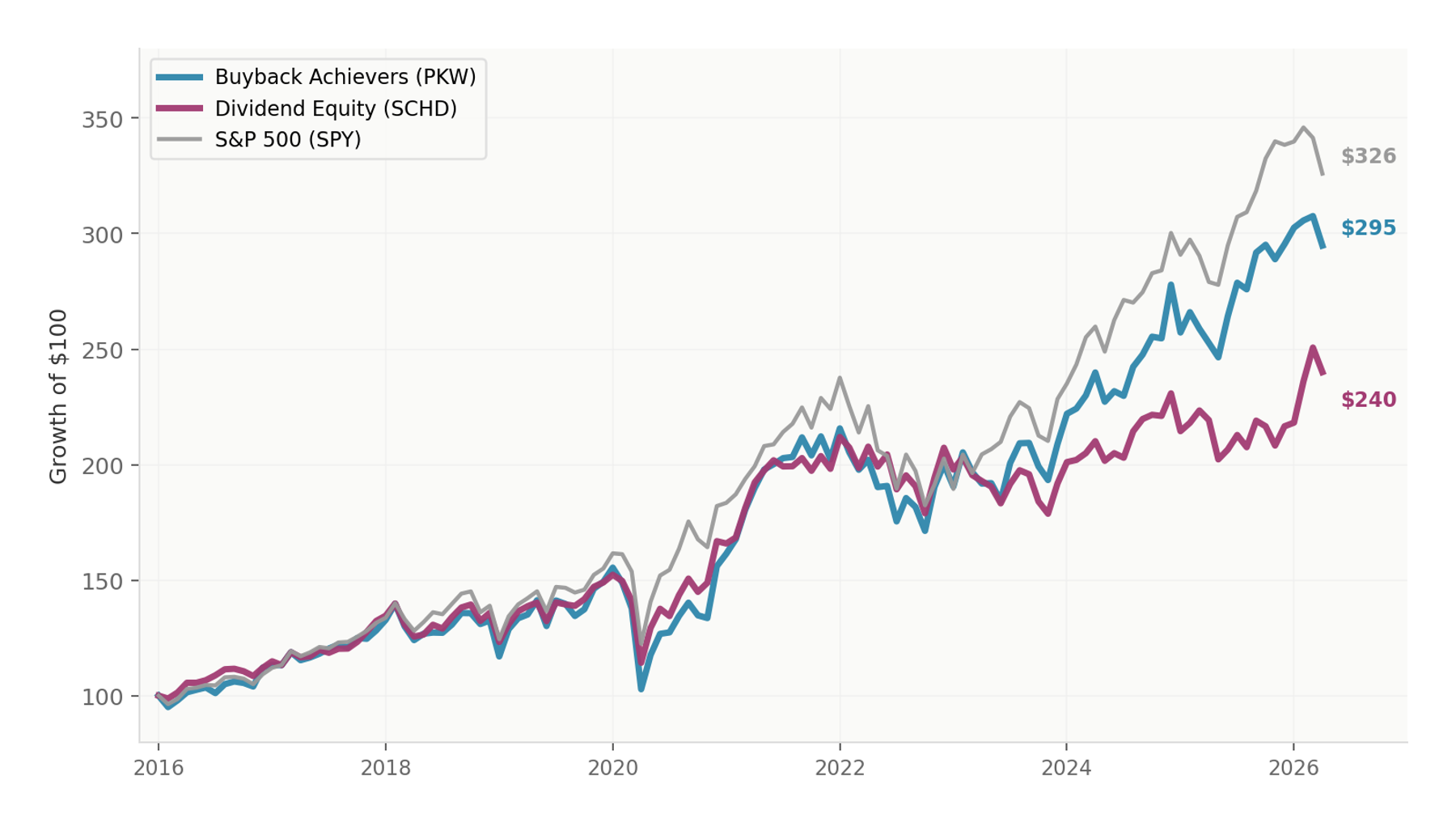
FMP via OpenBB. PKW = Invesco BuyBack Achievers ETF. SCHD = Schwab U.S. Dividend Equity ETF. SPY = SPDR S&P 500 ETF. Price returns indexed to $100 at January 2016. Data as of April 1, 2026.
The Buyback Machine Has No Off Switch
In the 12 months through September 2025, S&P 500 companies spent a record $1.02 trillion on buybacks and an estimated $685 billion on dividends, bringing combined shareholder returns past $1.7 trillion.1 The ratio has tilted decisively toward buybacks for five consecutive years, and the gap is widening.
This is not a cyclical preference. It is a structural shift in how the most valuable companies in the world allocate capital. In recent years, roughly 60% of cash returned to U.S. shareholders has taken the form of buybacks, up from an estimated 25-30% in the early 2000s, based on long-run capital return data compiled by Aswath Damodaran.2
The reason is straightforward. A company with a 30% return on equity that buys back stock at a reasonable valuation compounds wealth faster than the same company mailing cash to shareholders who owe taxes on it. The math favors repurchases when the business is high-quality, and the businesses doing the most buybacks happen to be the highest-quality businesses on the planet.
The Consensus and Where It Breaks
The dominant narrative among retail investors is that dividends equal safety, income, and compounding. An entire industry of "dividend aristocrat" lists, high-yield ETFs, and income-focused financial advisors reinforces this view.
The psychological appeal is powerful. Cash hitting your brokerage account every quarter feels like wealth creation.
The data says otherwise. Based on FMP price data from January 2016 through April 2026, the Invesco BuyBack Achievers ETF (PKW) returned roughly 195%, the Vanguard Dividend Appreciation ETF (VIG) roughly 166%, the Schwab Dividend Equity ETF (SCHD) roughly 128%, and the iShares Select Dividend ETF (DVY) roughly 88%.3 The pattern holds across most standard measurement windows from five to ten years. Over the last five years, PKW outperformed the major dividend ETFs examined here by roughly 10 to 30 percentage points.
Investors who chose high-dividend-yield strategies over buyback strategies left approximately 100 percentage points of return on the table over a decade, based on our calculation from FMP price data. In dollar terms, $100,000 invested in PKW in January 2016 became roughly $295,000 by April 2026.
The same amount in DVY became roughly $188,000.
The Higher the Dividend Tilt, the Worse the Performance
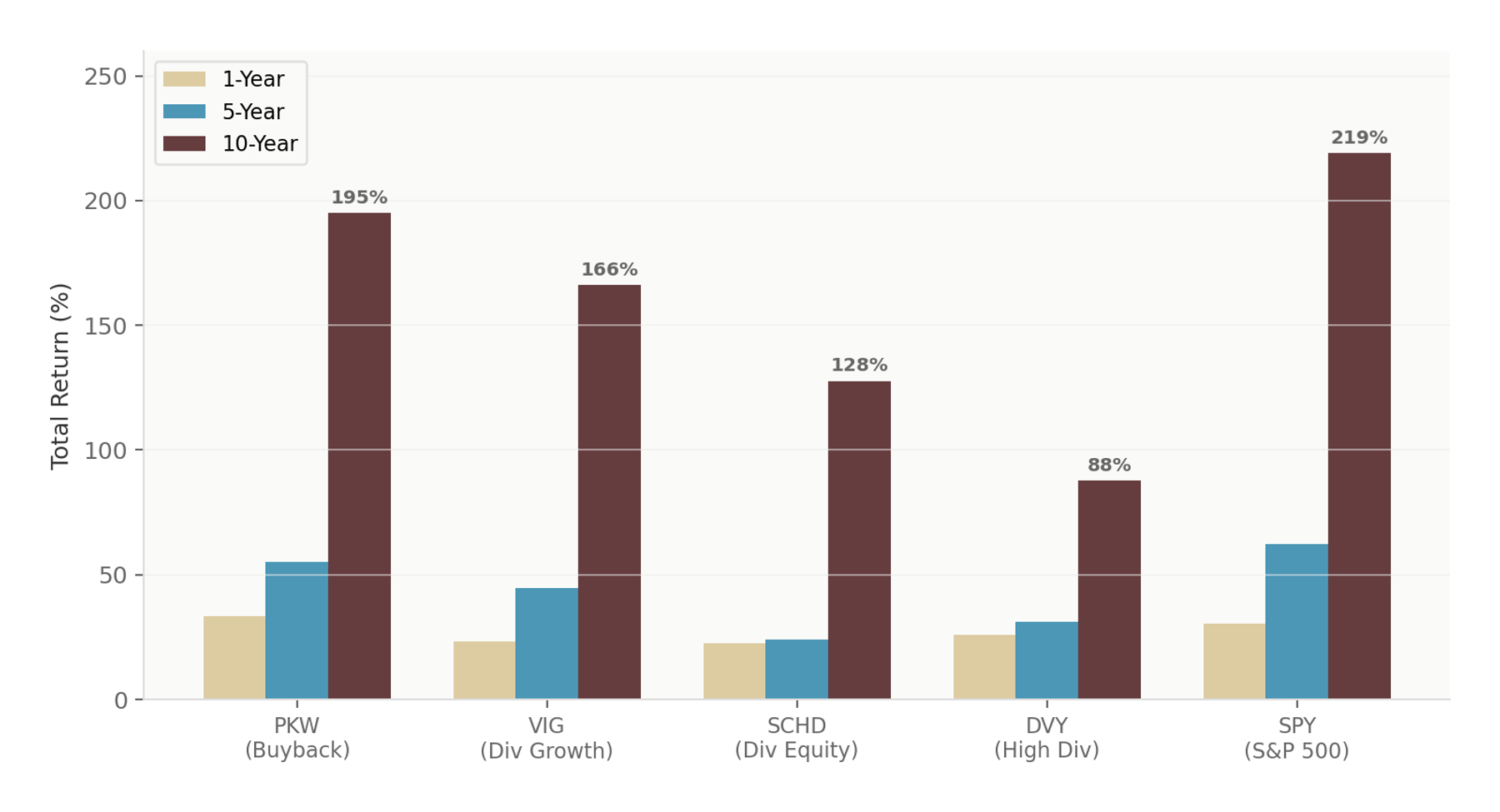
FMP via OpenBB. Total returns as of April 4, 2026.
The counterargument that "dividend stocks are less volatile" has eroded. Based on FMP daily price data, SCHD's peak-to-trough drawdown during the 2022 bear market was approximately 20%, compared to roughly 18% for PKW.4 Dividend stocks did not clearly protect capital better during that drawdown. They simply grew it slower.
The Names That Express It
Meta Platforms (META) is the purest expression of the buyback-over-dividend thesis. The company generated $115.8 billion in operating cash flow in 2025 and allocated $26.2 billion to buybacks versus $5.3 billion to dividends, an 83/17 split.5 META only initiated its dividend in 2024, and management made clear from day one that buybacks would remain the primary capital return vehicle.
The stock trades at 24.1x trailing earnings with a 30.6% return on equity. Every dollar META spends on buybacks compounds at that 30.6% rate rather than being taxed in shareholders' hands at the qualified dividend rate.
Apple (AAPL) is the canonical buyback compounder. The company spent $90.7 billion on share repurchases in fiscal 2025, the largest single-year buyback in corporate history.6 Since 2013, Apple has retired more than 40% of its outstanding shares. That share count reduction turned mid-single-digit revenue growth into double-digit EPS growth, which is the mechanical advantage of buybacks that dividend strategies cannot replicate.
Alphabet (GOOGL) came late to the capital return game but arrived with force. The company spent $45.7 billion on buybacks and $10.0 billion on dividends in 2025, its first full year of dividend payments.7 Alphabet allocated 82% of shareholder returns to repurchases.
With $164.7 billion in operating cash flow and a 35% return on equity, Alphabet has the financial profile that makes buybacks the obvious choice. Forward EPS growth of 17.4% dwarfs the 5-8% growth trajectory of traditional dividend aristocrats.
Apple Spent More on Buybacks Than the Top Dividend Payers Spent on Everything
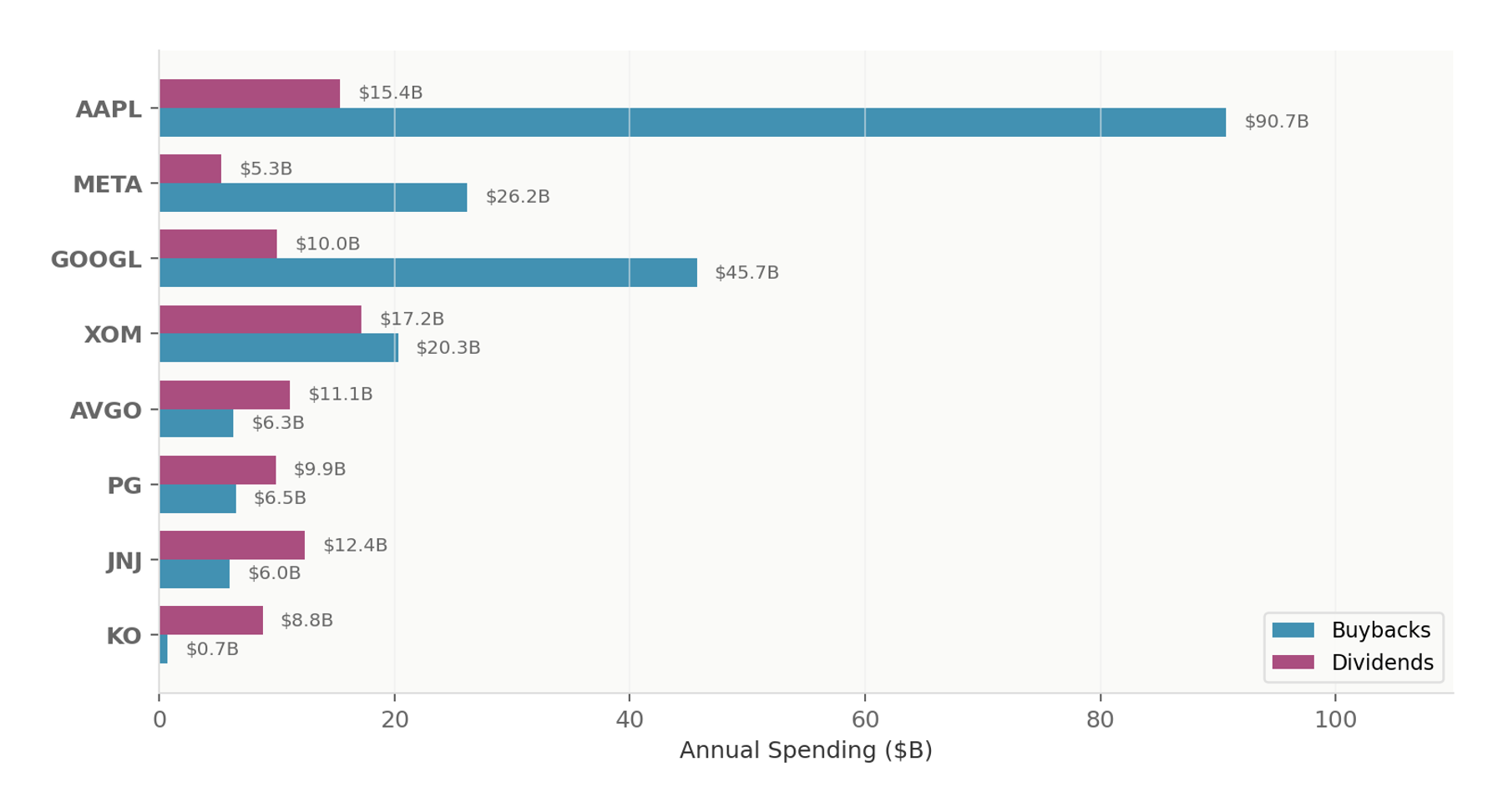
FMP via OpenBB. Most recent fiscal year cash flow statements. All figures in billions USD.
The contrast with dividend-heavy companies is stark. Coca-Cola (KO) spent $746 million on buybacks and $8.8 billion on dividends in 2025, a 92/8 split favoring dividends.8 Johnson & Johnson (JNJ) spent $6.0 billion on buybacks and $12.4 billion on dividends.
Procter & Gamble (PG) spent $6.5 billion on buybacks and $9.9 billion on dividends. These companies are constrained by dividend commitments that consume the majority of their free cash flow, leaving less room for opportunistic repurchases or reinvestment.
The return-on-equity gap tells the story. Apple posts a 160% ROE, META 30.6%, and Alphabet 35.0%. On the dividend side, Exxon posts 11.0%, Procter & Gamble 31.2%, and Johnson & Johnson 33.8%.9 Higher ROE means every retained dollar works harder, which is precisely why these companies prefer buybacks.
Buyback-Heavy Companies Generate Higher Returns on Every Dollar of Equity
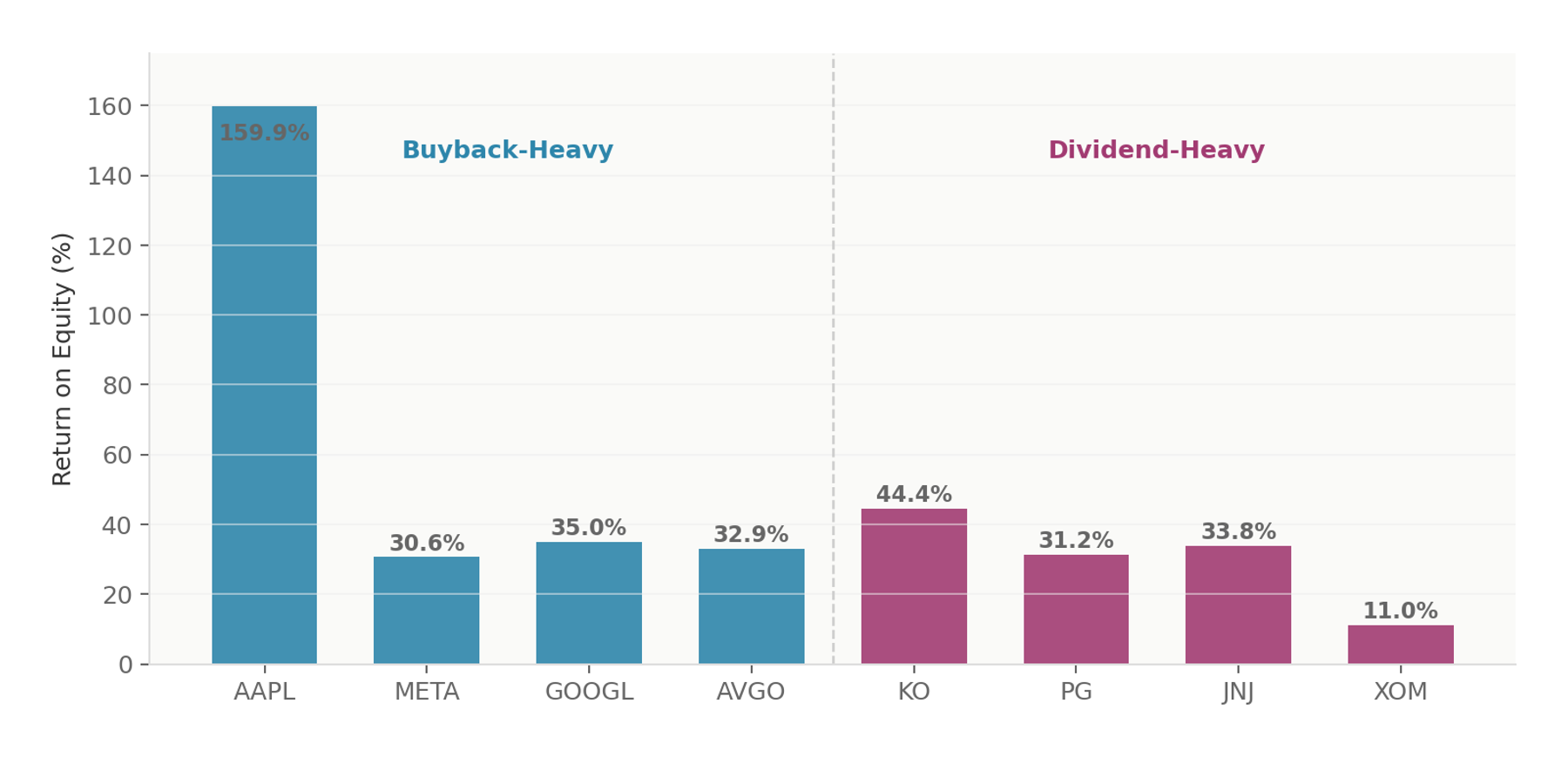
FMP via OpenBB. Trailing twelve months as of April 6, 2026.
The Counter-Argument
The strongest case against the buyback thesis has three components, and each deserves serious engagement. First, buyback strategies have a survivorship and selection problem. The Invesco BuyBack Achievers ETF is heavily weighted toward technology, which has been the best-performing sector for a decade.
Is it buybacks that drove outperformance, or is the buyback ETF simply a backdoor tech bet? The correlation between buyback intensity and sector composition is real. If technology underperforms for a sustained period, the buyback trade could reverse.
Second, Aswath Damodaran's annual capital allocation data shows that many companies execute buybacks at exactly the wrong time, repurchasing shares near market peaks and pulling back during corrections.2 Research spanning 2001 to 2020 across S&P 500 firms found a large cohort where buybacks destroyed rather than created value because management bought high and stopped buying low. The aggregate numbers favor buybacks, but individual company execution varies enormously.
Third, the tax advantage of buybacks narrows in a rising-rate environment. With the 10-year Treasury at 4.31% as of April 2, 2026, and the 1% excise tax on repurchases finalized in November 2025, the after-tax math has shifted modestly toward dividends.10 The excise tax adds a direct cost to buybacks that did not exist before 2023. If Congress raises the excise tax to 4% as some proposals have suggested, the calculus changes more substantially.
The dividend stability argument also carries real weight for retirees and income-dependent investors. A 3.5% dividend yield from Coca-Cola or Procter & Gamble provides predictable cash flow that no buyback strategy can match. For an investor who needs income today rather than total return tomorrow, dividends remain the rational choice.
Finally, the current earnings growth gap may not persist. If AI-driven capital expenditure at META, GOOGL, and AAPL fails to generate adequate returns, their ability to sustain massive buyback programs while funding $50-90 billion annual capex cycles could come under pressure. META spent $69.7 billion on capital expenditure in 2025, nearly triple the $27.3 billion it spent in 2023.5 That acceleration is the biggest risk to the buyback thesis for these specific names.
Key Data Table
| Company | Market Cap | Buyback / Div Split | ROE | Forward EPS Growth | 1Y Return |
|---|---|---|---|---|---|
| META | $1.46T | 83% / 17% | 30.6% | 16.3% | +33.2%11 |
| AAPL | $3.81T | 86% / 14% | 159.9% | 9.7% | +30.5%11 |
| GOOGL | $3.63T | 82% / 18% | 35.0% | 17.4% | +23.3%11 |
| KO | $332B | 8% / 92% | 44.4% | 7.2% | +22.6%11 |
| PG | $332B | 40% / 60% | 31.2% | 5.3% | +26.0%11 |
| JNJ | $581B | 33% / 67% | 33.8% | 8.7% | +25.9%11 |
Sources listed in endnotes.
Catalyst Map
Q2 2026 earnings season, July through August. META, GOOGL, and AAPL will report quarterly buyback totals and announce new authorization levels. Any increase in buyback authorizations reinforces the thesis.
Any pull-back due to AI capex pressure weakens it.
Federal Reserve rate decisions (June and September 2026). If the Fed begins cutting rates, the relative advantage of buybacks over dividends increases because lower rates reduce the opportunity cost of holding non-yielding growth stocks. The fed funds rate sits at 4.33% as of the latest FRED data.12
Congressional action on the buyback excise tax. Multiple proposals would raise the 1% excise tax to 4%. If passed, the incremental cost could reduce net buyback volumes by 5-10% and modestly narrow the performance gap.
S&P Dow Jones Q4 2025 buyback report (expected March 2026). This will confirm the final full-year 2025 buyback total, setting the baseline for 2026 expectations. The initial 2026 outlook shows companies planning to increase repurchase activity.1
The Bottom Line
Buyback stocks outperformed dividend stocks by roughly 100 percentage points over 10 years based on FMP price return data, and the structural drivers behind that gap, including higher ROE, faster earnings growth, and tax efficiency, are accelerating rather than fading. The counter-argument that buyback companies overpay for their own shares has merit at the individual stock level, but fails in aggregate; the risk that breaks this thesis is a congressional increase of the buyback excise tax from 1% to 4%, which would narrow the cost advantage without eliminating it. The trade remains long the buyback compounders, specifically META at 24x earnings, AAPL as the canonical share-count reducer, and GOOGL as the newest mega-repurchaser.
Sources
1. S&P Global, "S&P 500 Q3 2025 Buybacks Post Modest 6.2% Gain to $249.0 Billion," December 18, 2025.
2. Aswath Damodaran, "Data Update 8 for 2026: Dividends and Buybacks," Substack, 2026.
3. FMP via OpenBB, equity price performance data. Returns as of April 4, 2026.
4. FMP via OpenBB, historical price data, January 2016 through April 2026.
5. Meta Platforms FY2025 10-K, cash flow statement. Filed January 29, 2026.
6. Apple Inc. FY2025 10-K, cash flow statement. Filed October 31, 2025.
7. Alphabet Inc. FY2025 10-K, cash flow statement. Filed February 5, 2026.
8. The Coca-Cola Company FY2025 10-K, cash flow statement. Filed February 20, 2026.
9. FMP via OpenBB, equity fundamental metrics (TTM). As of April 6, 2026.
10. Federal Reserve, Treasury rates via OpenBB. IRS Final Regulations on Section 4501, November 24, 2025.
11. FMP via OpenBB, equity price performance, one-year total return. As of April 4, 2026.
12. FRED, Federal Funds Effective Rate (DFF). As of February 2025 (latest available).