Silvia Insights · April 16, 2026
Allbirds stock is up 700% on the same AI pivot that tanked BuzzFeed and Rent the Runway
Allbirds sold its brand for $39 million, announced a GPU-as-a-Service pivot called "NewBird AI," and the stock ripped as high as 700% on pure retail momentum. Every historical analog for this exact playbook ended the same way, and the pattern is about to repeat.
What to Know
- BIRD surged 668% to $19.13 on April 15 after announcing a full corporate pivot from footwear to GPU-as-a-Service. The $50 million convertible financing facility is 2.4x the company's pre-announcement equity value, with undisclosed conversion terms that could dilute existing shareholders by 50% or more.
- BuzzFeed surged 120% on an identical AI-pivot playbook in January 2023 and crashed 92% within eight months. Rent the Runway surged 254% during the week of April 10–12, 2024 before running to $41.81 in May, then gave back 75% from its peak within six months.
- The May 18 shareholder vote, the identity of the unnamed institutional backer, and the convertible note's conversion price will determine whether BIRD follows or defies the pattern.
Every Non-Tech AI Pivot Surged on Hype, Then Collapsed on Fundamentals
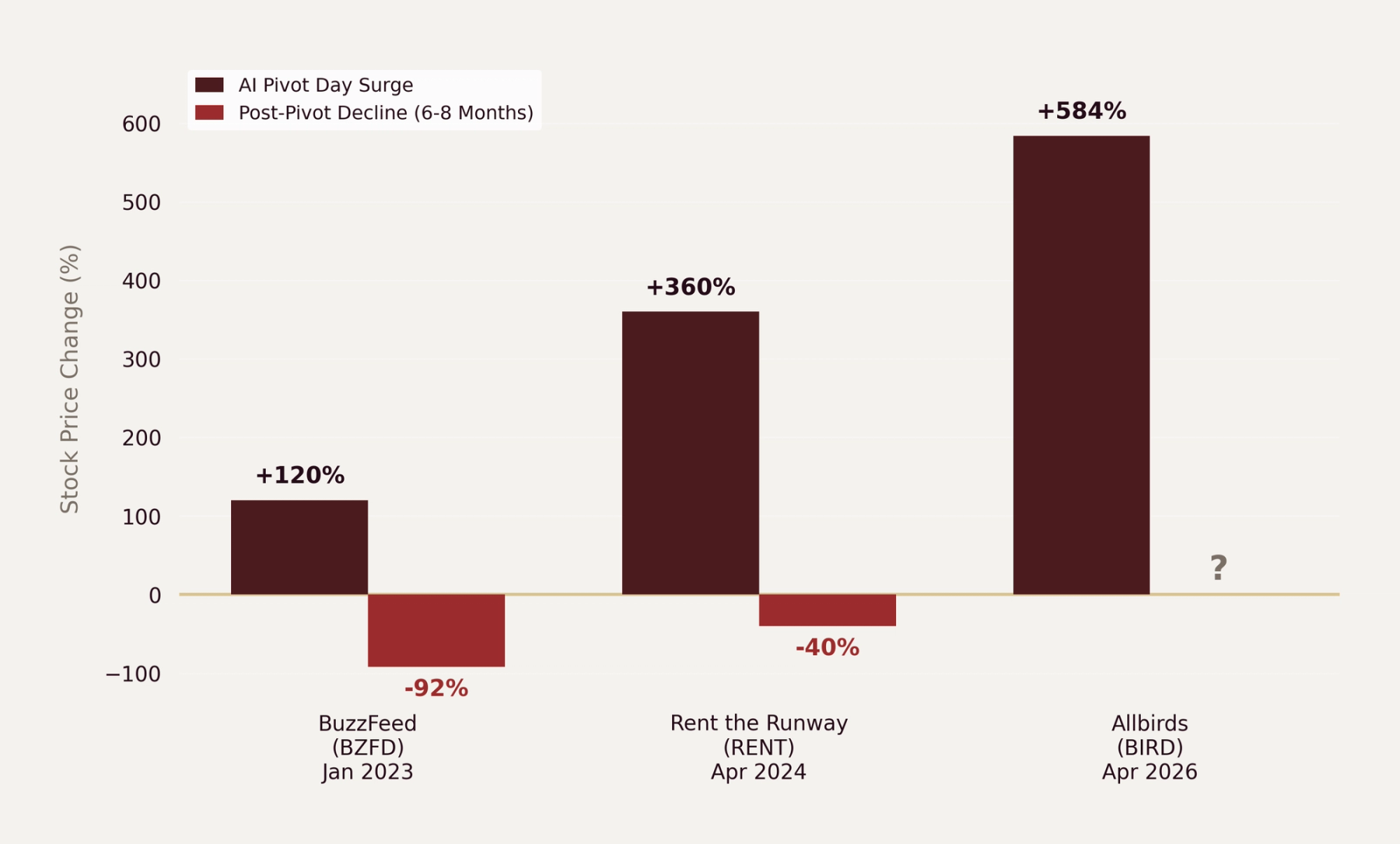
Source: Finnhub API, FXStreet, Reuters market-close data. BIRD price as of April 15, 2026 intraday. BZFD and RENT measured from AI-announcement day through 6-8 months post-surge.¹
What Happened
Allbirds (BIRD) announced a complete corporate transformation on April 15, 2026, selling its sustainable footwear brand and intellectual property to American Exchange Group for $39 million and pivoting the listed entity into "NewBird AI," a GPU-as-a-Service provider funded by a $50 million convertible financing facility from an unnamed institutional investor. The stock surged as high as 700% in a single session.2
The Market Reaction Has a Perfect Playbook, and It Ends Badly
The first-day surge priced in optionality. It did not price in history. Two companies have run this exact play since ChatGPT launched in November 2022, and the data from both is unambiguous.
BuzzFeed announced an OpenAI partnership in January 2023, promising AI-generated quizzes and listicles. The stock surged 120% in a single session.
Eight months later it had crashed 92% from the AI-day peak, as AI content produced zero discernible improvement in revenue that was already declining 27% year-over-year.3 BuzzFeed ultimately faced Nasdaq delisting and executed a 1-for-4 reverse stock split in May 2024.
Rent the Runway surged as much as 254% over the week of April 10–12, 2024 after reporting Q4 earnings and announcing an AI-powered search feature, then ran to an intraday peak of $41.81 by May 17.4
The critical difference with RENT is that the underlying business actually improved.
Q4 FY2025 results, reported April 14, 2026, showed active subscribers up 20.1% and revenue up 20% to $91.7 million.5 RENT still gave back 75% from its May peak over the following six months, trading around $10 by October 2024.
BIRD's fundamentals are closer to BuzzFeed's. Revenue of $152.5 million in 2025 declined 19.7% year-over-year, with a net loss of $77.3 million, marking 17 consecutive loss quarters since IPO.6
The $39 million brand sale represents 0.26x trailing revenue, a fire-sale multiple that values the brand at roughly 1% of its $4.1 billion first-day market capitalization from November 2021.
18 Straight Quarterly Losses Tell the Story of a Business That Ran Out of Road
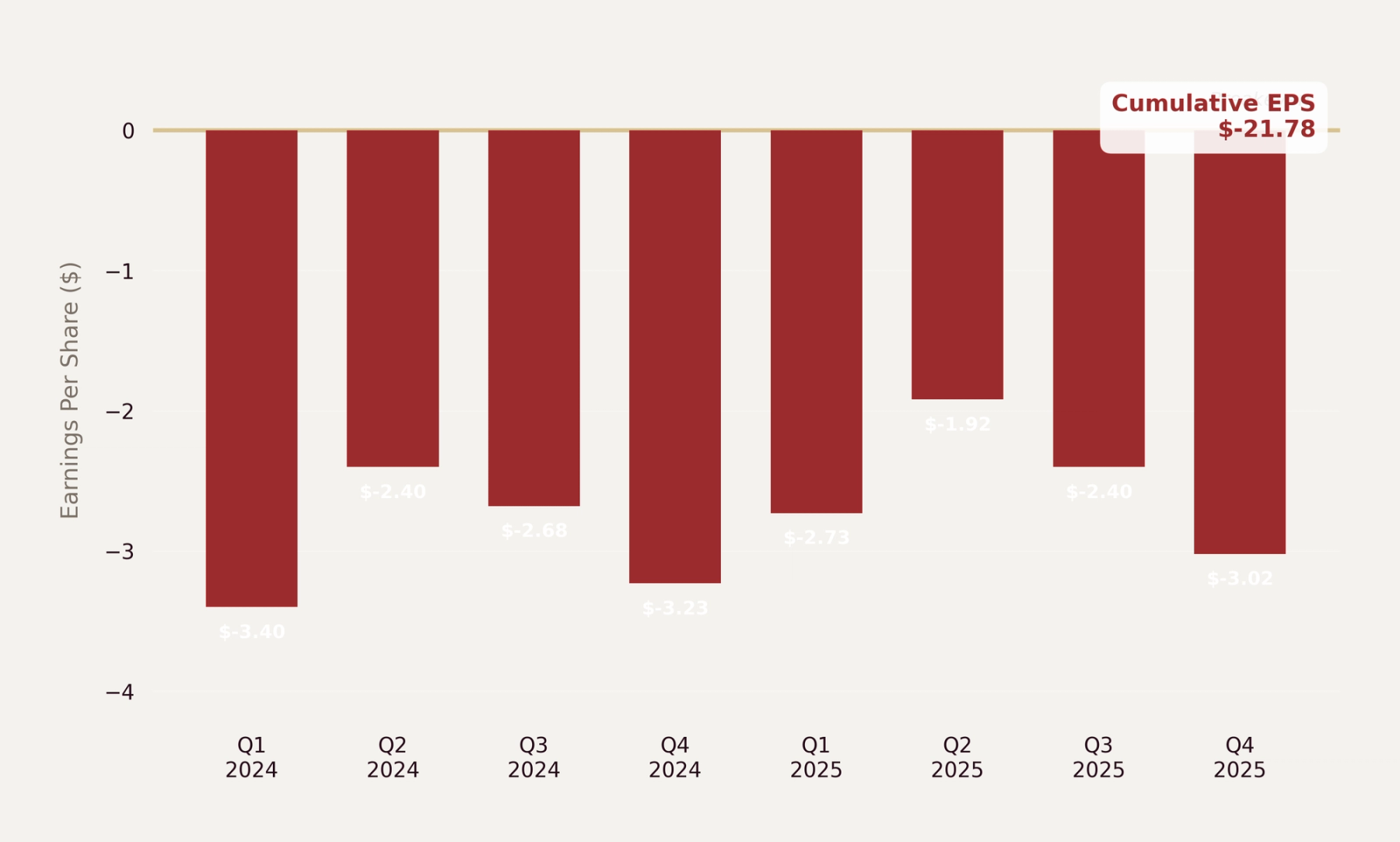
Source: Finnhub API, BIRD 10-K filed March 31, 2026. Earnings per share by quarter.⁷
The $50 Million Question Nobody Is Asking
The convertible financing facility is simultaneously BIRD's lifeline and its trap. At $50 million, the facility is 2.4x the company's pre-announcement market capitalization of approximately $21 million. The terms are undisclosed, the investor is unnamed, and the conversion price is not public.8
The math on dilution is punishing at any realistic conversion price. At $12 per share, the facility converts into roughly 4.2 million new shares, diluting existing holders by approximately 50%. At $6 per share, it converts into 8.3 million shares, diluting holders by well over 100%.
The lower the conversion price, the more the $50 million benefits the lender and the less it benefits anyone who bought the stock at $19.
BIRD is entering a GPU-as-a-Service market where the minimum competitive threshold is measured in billions. CoreWeave, the closest comparable, raised $28 billion in 12 months and just closed an $8.5 billion credit facility.9 BIRD's $50 million is 0.2% of CoreWeave's capital base.
From $4.1 Billion First-Day Market Cap to a $39 Million Brand Fire Sale in Four and a Half Years
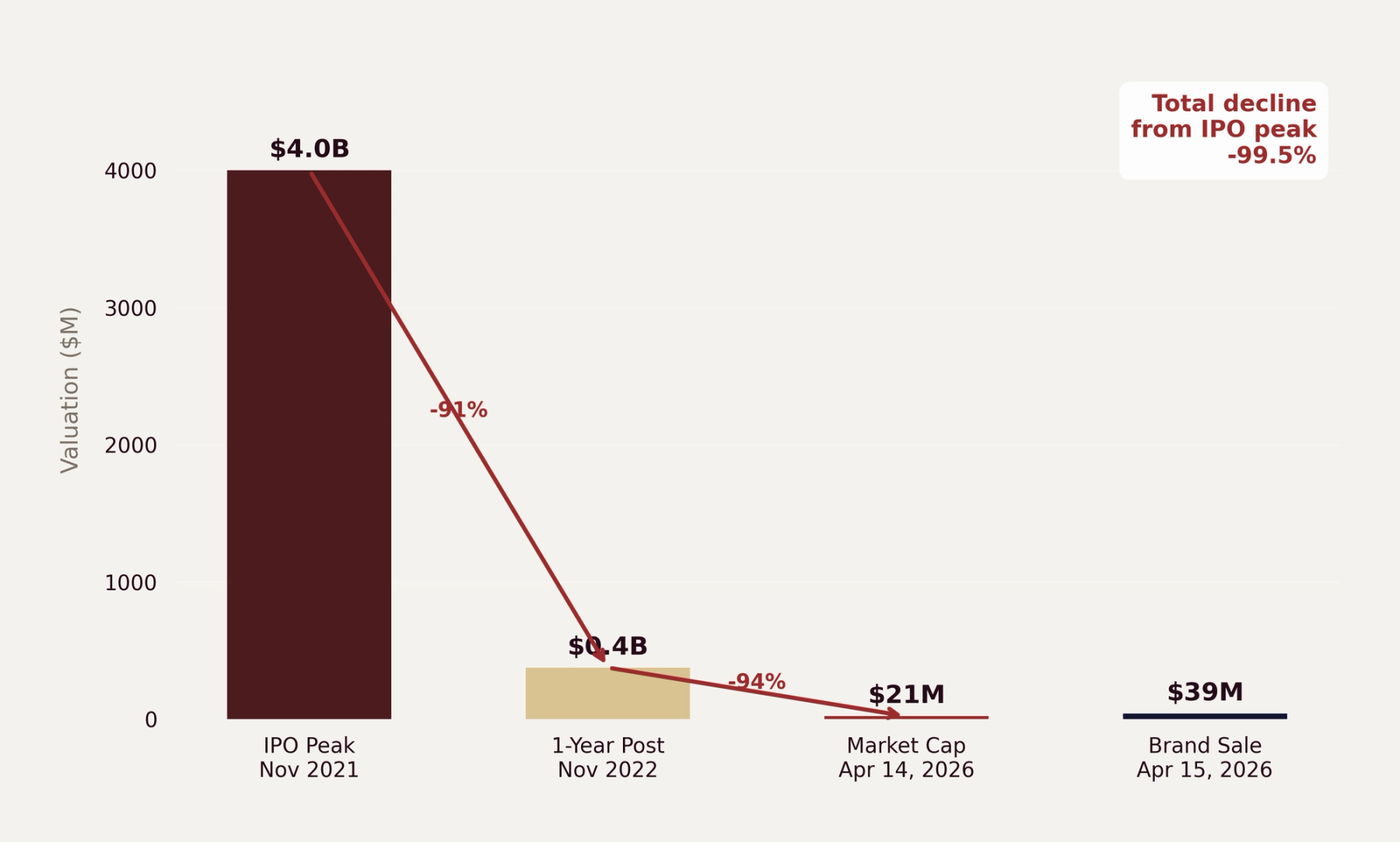
Source: Finnhub API, SEC filings (PREM14A), company press releases. Valuation milestones from November 2021 IPO through April 2026 brand sale.¹⁰
The Counter-Argument
GPU demand genuinely outstrips supply, and non-traditional entrants have proven the model works. CoreWeave raised $28 billion in 12 months and just completed an $8.5 billion credit facility, demonstrating that GPU-as-a-Service can attract serious institutional capital at scale.
The business model itself is not the issue. The issue is whether BIRD can execute it.
A clean Nasdaq listing with $50 million in fresh capital and no legacy footwear liabilities has real option value. The company sheds a declining brand, clears the balance sheet, and starts with a single purpose.
If the unnamed institutional backer turns out to be a credible infrastructure investor or hyperscaler partner, the probability distribution shifts materially. Clean-shell pivots have worked before in other sectors, though rarely at this scale or speed in AI infrastructure.
The bull case ultimately rests on three specific unknowns. First, the identity and credibility of the institutional backer. A name like Blackstone, Microsoft, or a major sovereign wealth fund would transform this from a meme trade into a legitimate infrastructure play.
Second, the conversion terms of the facility. If the conversion price is set near or above the current trading price, dilution is manageable.
Third, the May 18 shareholder vote. Approval is not guaranteed, and a failed vote would collapse the entire thesis.
Each of these unknowns must resolve favorably for BIRD to defy the BuzzFeed analog. The probability is weighted heavily toward the historical pattern, but the option value is non-zero if all three break right.
What to Watch
- The May 18 shareholder vote. This is the single binary event. A failed vote kills the pivot entirely and likely sends the stock below the $2.49 pre-announcement price.
- Disclosure of the institutional backer's identity. The PREM14A proxy filing should name the investor before the vote. A credible name changes the calculus. An obscure offshore fund confirms the pattern.
- Convertible note terms. The conversion price, conversion triggers, and any anti-dilution provisions will determine whether existing equity holders participate in any upside or get diluted into irrelevance.
- Volume decay over the next five sessions. If daily volume drops 80% or more within five trading days, as BuzzFeed's did after its AI-day spike, price support evaporates rapidly.
- Any announcement of GPU procurement, data center partnerships, or engineering hires. Actual infrastructure commitments would be the first evidence that NewBird AI is more than a corporate rebrand.
The Bottom Line
BIRD's 668% surge fits a pattern that has ended the same way every time, with BuzzFeed crashing 92% and Rent the Runway giving back 75% from its May 2024 peak after identical AI-pivot announcements. The bull case for defying that pattern hinges entirely on the May 18 shareholder vote, the identity of the unnamed backer, and the convertible terms, and until those three variables are resolved, the evidence overwhelmingly favors the historical analog. The probability is weighted toward a fade, but the May 18 vote is the catalyst that determines which direction this resolves.