Silvia Insights · April 13, 2026
SpaceX IPO has history working against it
Since 2015, eleven space companies have entered public markets and seven of them destroyed shareholder value. SpaceX recently filed IPO documents with the SEC, with reports indicating the company may target a valuation of roughly $1.75 trillion.
What to Know
- The four space stocks that survived (RKLB +553%, ASTS +703%, PL +205%, LUNR +135% from listing) carry a combined $91 billion in market cap. The seven that failed, including one bankruptcy and one forced delisting, are worth less than $5 billion combined.
- Revenue separated the winners from the dead. Every survivor converted technology into paying government or commercial contracts before the capital markets window closed in 2022, and every failure burned cash on milestones alone.
- SpaceX is estimated to have generated around $16 billion in 2025 revenue and roughly $7.5 billion in EBITDA, numbers that dwarf every other public space company combined. The roadshow is expected to begin in June 2026, and at a $1.75 trillion valuation the implied ~109x revenue multiple would land in a sector where the median public comp trades at 17x.
Public Markets Have Not Been Kind to Space Companies
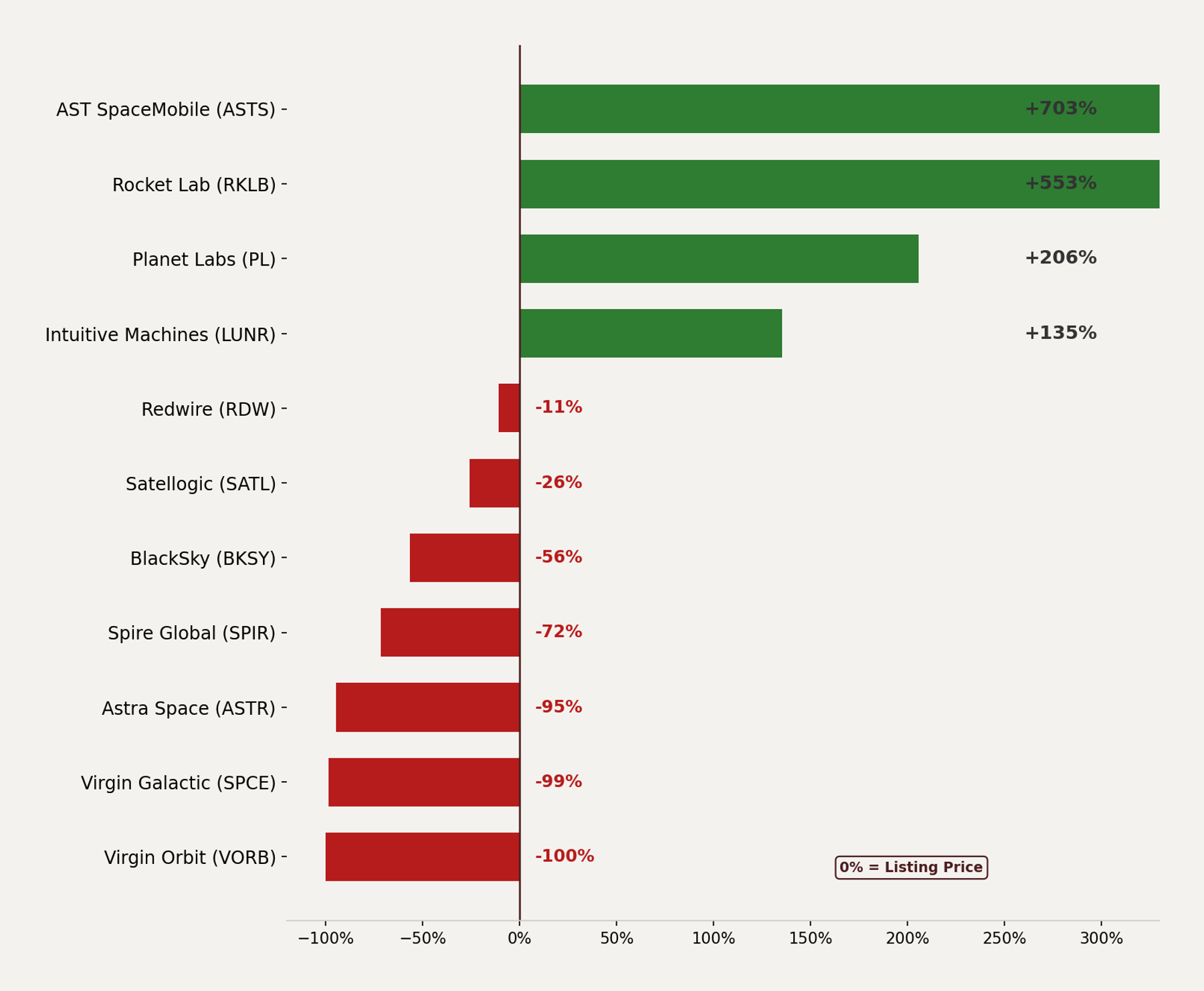
Source: FMP, OpenBB. Returns measured from first trading day close to April 10, 2026. Virgin Orbit filed for bankruptcy in April 2023. Astra Space taken private at $0.50/share in July 2024.
11 Companies Pitched the Same Story. The Market Only Bought It From 4.
Between 2019 and 2023, eleven space companies transitioned from private to public markets. Ten came through SPACs, one through a traditional IPO. All of them told investors the same thing at the time of listing.
Space is the next frontier. Total addressable markets measured in the hundreds of billions. Revenue was either nascent or non-existent, and the implicit contract with shareholders was that execution would come later.
Later arrived. Rocket Lab now sits at a $38.7 billion market cap with $602 million in 2025 revenue, a $1.85 billion backlog, and 21 successful launches last year at a 100% success rate. AST SpaceMobile reached $37.8 billion after activating its direct-to-cell satellite network across the continental United States.1
Planet Labs hit $11.2 billion after posting its first full year of adjusted EBITDA profitability. Intuitive Machines reached $3.8 billion on the strength of NASA lunar delivery contracts.2
Virgin Galactic trades at $3.02, a 99% decline from its 2021 peak. Virgin Orbit filed for bankruptcy in April 2023 and auctioned its assets for $36 million, roughly 1% of its SPAC-era valuation of $3.5 billion. Astra Space was taken private at $0.50 per share in July 2024 after its board concluded the only alternative was Chapter 7 liquidation.3
The Bubble Narrative Misses the Point. Rates Did Not Cause This Split.
The consensus explanation for the 2021 SPAC collapse is that it was a speculative bubble that popped when interest rates rose. That reading is incomplete. Rates rose on everyone equally.
Rocket Lab gained 553% from its listing while Virgin Galactic lost 99% over the same rate cycle. The macro environment did not cause the bifurcation. Execution did.
Every space company that survived the 2022-2023 drawdown had one thing in common. It converted its technology into paying customers before the capital markets window closed. Rocket Lab won an $816 million Space Development Agency prime contract.4
Planet Labs locked in multi-year government deals including a $21 million annual NGA contract. AST SpaceMobile secured over $1 billion in committed carrier revenue.
The survivors sold product. The casualties burned cash on milestones that never reached paying customers.
Virgin Orbit completed only two launches in all of 2022 before a catastrophic mission failure in January 2023 ended the company. Astra suffered repeated launch failures and never reached reliable cadence. Virgin Galactic flew a handful of tourism missions but generated negligible revenue relative to its burn rate.5
The Great Divergence Started in 2023 and Has Only Accelerated
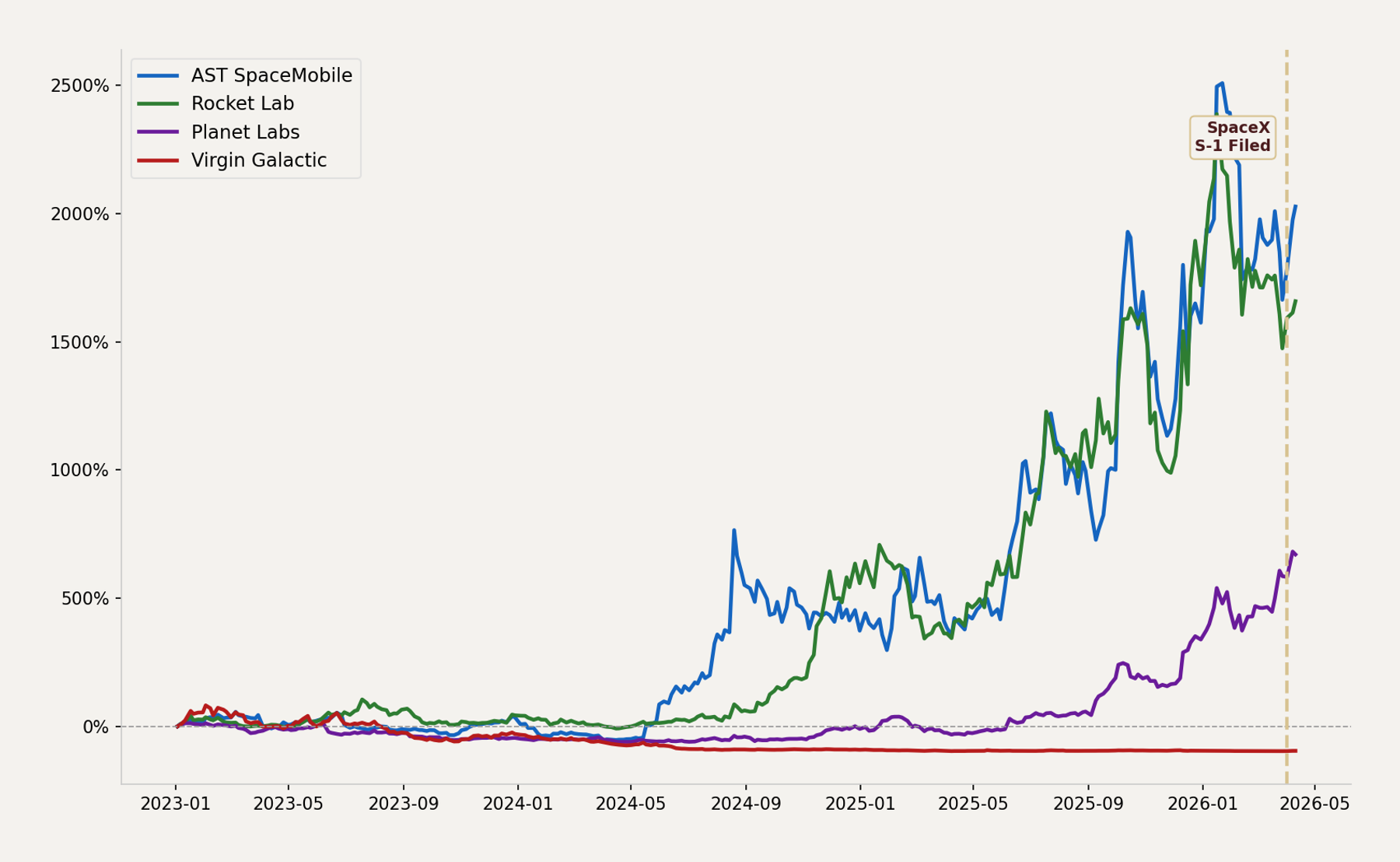
Source: FMP, OpenBB. All returns normalized to 0% as of January 3, 2023. Vertical dashed line marks SpaceX S-1 filing on April 1, 2026.
What the Four Survivors Look Like Now
Rocket Lab (RKLB). The closest public analog to SpaceX and one of the few companies operating a reusable orbital launch vehicle while simultaneously developing a medium-lift rocket (Neutron, targeting Q4 2026 first launch). Full-year 2025 revenue hit $602 million, up 38% year-over-year, with a $1.85 billion backlog.6
At $38.7 billion in market cap, RKLB trades at 64x trailing revenue. The stock is up 553% from its August 2021 SPAC listing.
AST SpaceMobile (ASTS). The highest-beta name in the group and the most aggressive bet on space-based connectivity replacing terrestrial telecom. 2025 revenue was $71 million, with guidance for $150-200 million in 2026 and management targeting $1 billion by 2027.7
The direct-to-cell technology works and activated commercially across the U.S. in late 2025. At $37.8 billion, ASTS trades at 532x trailing revenue, the richest multiple in the sector by a wide margin.
Planet Labs (PL). The most financially disciplined company in the group. Fiscal 2026 revenue reached $308 million, up 26% year-over-year, with defense and intelligence revenue growing over 50%. Planet Labs achieved its first full year of adjusted EBITDA and free cash flow profitability.8
At $11.2 billion, PL trades at 36x trailing revenue, the cheapest of the four survivors and the only one generating positive cash flow.
Intuitive Machines (LUNR). The lunar economy play. Revenue reached an estimated $227 million in 2025, driven by NASA Artemis program contracts. The company landed the first private spacecraft on the moon in February 2024 and has built a repeatable delivery model for lunar payloads.9
At $3.8 billion, LUNR trades at roughly 17x trailing revenue. The stock is up 135% from its February 2023 IPO and 249% over the past year.
What This Sector Looks Like at $1.75 Trillion
SpaceX confidentially filed IPO documents with the SEC around April 1, 2026, with media reports suggesting a potential valuation in the $1.75-2 trillion range. The company is estimated to have generated around $16 billion in 2025 revenue and roughly $7.5 billion in EBITDA, with Starlink often estimated at roughly $10 billion in revenue and about 9 million subscribers across more than 150 countries.10
The February 2026 merger with xAI added an AI dimension to the business, with reports indicating the combined company was recently valued at about $1.25 trillion. A $1.75 trillion IPO would represent a further 40% markup from that level in under four months.
Using the ~$16 billion revenue and ~$7.5 billion EBITDA estimates above, a $1.75 trillion valuation implies roughly 109x trailing revenue and 233x trailing EBITDA. The median price-to-sales ratio among profitable public space companies (Planet Labs, Redwire, BlackSky) is roughly 17x. Even among the high-growth survivors, 109x would sit second only to ASTS.
The Valuation Spectrum Across Public Space Stocks and the Proposed SpaceX IPO
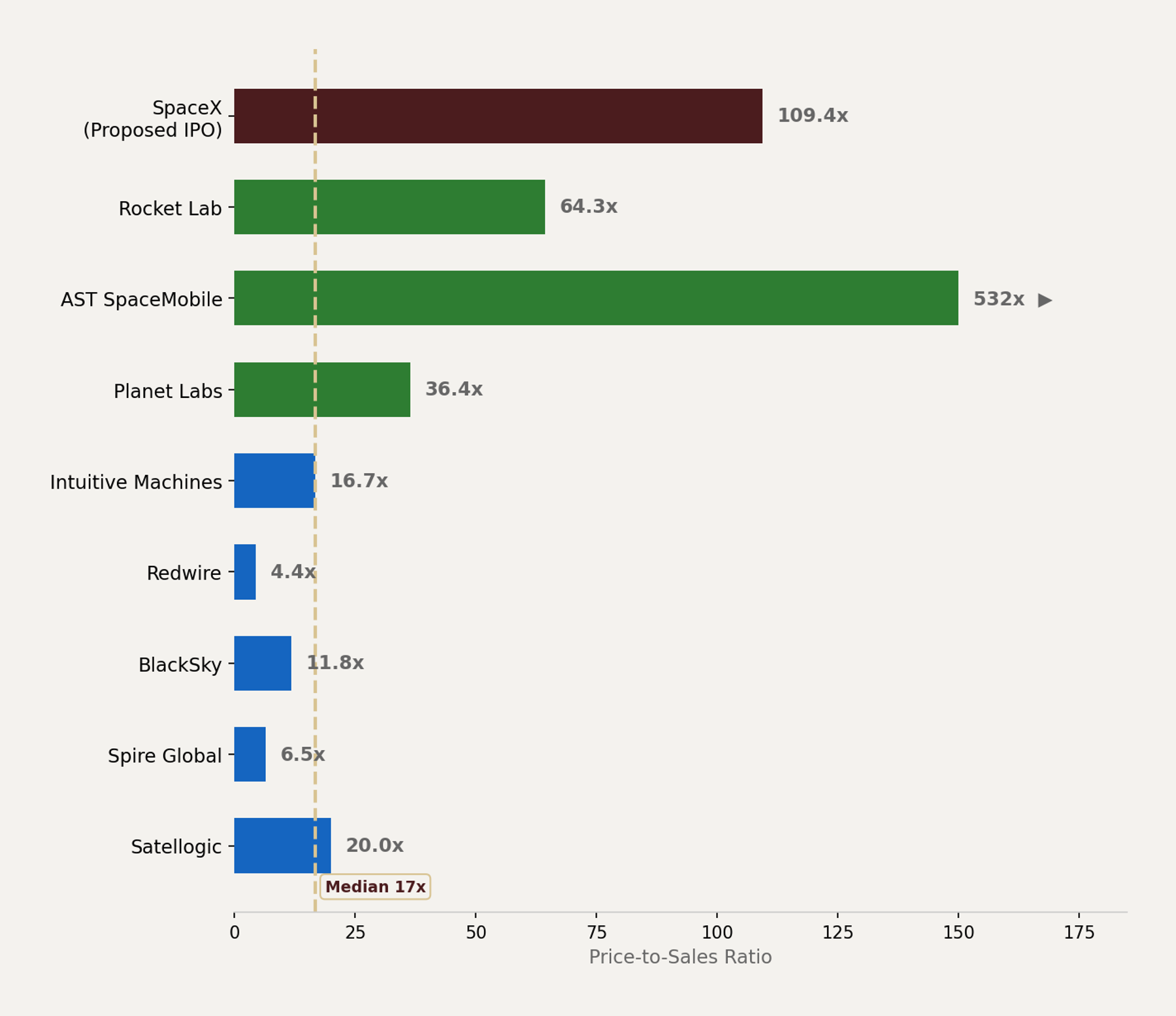
Source: FMP, OpenBB, company filings, Bloomberg. Market caps as of April 10, 2026. SpaceX revenue and valuation based on S-1 filing reports. AST SpaceMobile bar capped for readability (actual 532x).
The Full Scorecard
| Company | How It Went Public | Market Cap (Apr 2026) | 2025 Revenue | Return From Listing | Status |
|---|---|---|---|---|---|
| Rocket Lab (RKLB) | SPAC, Aug 2021 | $38.7B | $602M | +553% | Winner |
| AST SpaceMobile (ASTS) | SPAC, Apr 2021 | $37.8B | $71M | +703% | Winner |
| Planet Labs (PL) | SPAC, Dec 2021 | $11.2B | $308M | +205% | Winner |
| Intuitive Machines (LUNR) | IPO, Feb 2023 | $3.8B | ~$227M | +135% | Winner |
| Redwire (RDW) | SPAC, Sep 2021 | $1.5B | ~$340M | -11% | Underwater |
| Satellogic (SATL) | SPAC, Jan 2022 | $801M | ~$40M | -26% | Underwater |
| BlackSky (BKSY) | SPAC, Sep 2021 | $1.3B | ~$110M | -57% | Underwater |
| Spire Global (SPIR) | SPAC, Aug 2021 | $722M | ~$107M | -72% | Underwater |
| Virgin Galactic (SPCE) | SPAC, Oct 2019 | $191M | Minimal | -99% | Near zero |
| Astra Space (ASTR) | SPAC, Jun 2021 | N/A | N/A | -95% | Taken private at $0.50 |
| Virgin Orbit (VORB) | SPAC, Dec 2021 | $0 | N/A | -100% | Bankrupt, Apr 2023 |
Sources listed in endnotes. Revenue estimates based on latest available filings and earnings reports.
Catalyst Map
June 2026. SpaceX is expected to begin its IPO roadshow, which is reported to include an unusually large retail investor component, including a dedicated event, though specific dates and attendee counts have not been formally disclosed. The pricing will establish the first institutional-grade valuation benchmark for a space company with real revenue at scale.11
Q4 2026. Rocket Lab's Neutron first launch. A successful medium-lift vehicle would make RKLB only the second company with a reusable rocket in operation.
H2 2026. AST SpaceMobile targets 45-60 BlueBird satellites in orbit by year-end 2026. The pace of deployment determines whether the company can hit its $1 billion 2027 revenue target.
The Counter-Argument
The most obvious objection to drawing conclusions from this sample is that it is too small. Eleven companies over seven years is not a statistically robust dataset, and the SPAC vehicle itself introduced selection bias. Many of the companies that went public via SPAC in 2021 were earlier-stage than a traditional IPO process would have allowed, which inflated the failure rate.
That objection has merit. SpaceX is nothing like the median space SPAC. It is estimated to have generated around $16 billion in revenue and roughly $7.5 billion in EBITDA in 2025, has launched over 400 orbital missions, and serves an estimated 9 million Starlink subscribers across more than 150 countries.
The comparison to Astra or Virgin Orbit is absurd on its face. SpaceX has the revenue, the margins, and the reusable launch infrastructure that none of the failed SPACs ever came close to building.
The more useful counter-argument is about what happens to the survivors, not SpaceX itself. If SpaceX prices near $1.75 trillion with estimated revenue and EBITDA that dwarf the rest of the sector, institutional investors suddenly have a liquid, high-quality space investment at scale. The capital that previously flowed to Rocket Lab and AST SpaceMobile as "SpaceX proxies" now has access to the real thing.
The 1995 Netscape IPO offers the closest historical parallel. It launched an entire sector of internet companies, but it also eventually funneled institutional capital toward the dominant platforms and away from the smaller names. The long-term winners were the companies with structural moats, not the ones that rode the initial wave of sector enthusiasm.12
The SPAC-era data mirrors this pattern. When capital was abundant in 2021, every space stock rallied together. When capital tightened in 2022-2023, money concentrated into the three or four companies with real revenue.
A SpaceX IPO could trigger the same concentration effect. The smaller names would need to prove they offer something SpaceX cannot provide.
Rocket Lab at 64x revenue is not cheap by any traditional metric. ASTS at 532x requires flawless execution on a global rollout never attempted at this scale. Planet Labs at 36x is the most defensible, but even that multiple assumes continued government contract acceleration.
The 30% retail allocation SpaceX has promised is unusual for an offering of this size. That retail capital has to come from somewhere. Retail investors currently holding RKLB, ASTS, and PL as space sector bets may rotate into SpaceX on listing day.
The Bottom Line
Seven of eleven space companies that entered public markets since 2015 destroyed shareholder value, and the four that survived all converted technology into revenue before capital dried up. SpaceX, which generated more revenue in 2025 than every other public space company combined, is about to list at a price that will reshape the valuation framework for the entire sector.
Sources
1. Rocket Lab Q4 and Full Year 2025 Financial Results, GlobeNewsWire, February 26, 2026. AST SpaceMobile Q3 2025 Business Update, BusinessWire, November 10, 2025.
2. Planet Labs Q4 Fiscal Year 2026 Financial Results, BusinessWire. Intuitive Machines company filings.
3. CNBC, "Virgin Orbit: What went wrong with Richard Branson's company," March 31, 2023. InvestorPlace, "Astra Space Delists as Take-Private Deal Closes," July 2024.
4. Rocket Lab SDA contract announcement, 2025. Planet Labs NGA EOCL contract, company filings.
5. Virgin Orbit Chapter 11 bankruptcy filing, April 2023, assets auctioned for $36 million. Astra Space take-private at $0.50/share, July 2024.
6. Rocket Lab Q4 2025 earnings: $180M quarterly revenue, $602M full-year, $1.85B backlog, 38% YoY growth.
7. AST SpaceMobile Q3 2025 earnings: $14.74M quarterly revenue (~1,236% YoY). 2026 guidance $150-200M. Over $1B in committed carrier revenue.
8. Planet Labs fiscal 2026: $308M revenue, 26% YoY growth. First year of adjusted EBITDA profitability. Defense and intelligence revenue up 50%+ YoY.
9. Intuitive Machines IPO February 2023. First private moon landing February 2024. Revenue estimated from market cap and sector comparables.
10. CNBC, "SpaceX confidentially files for IPO, setting stage for record offering," April 1, 2026. Bloomberg, "Elon Musk SpaceX IPO: $2 Trillion Valuation Push Explained," April 8, 2026. Sacra, "SpaceX revenue, valuation and funding," 2026.
11. CNBC, "SpaceX lays out IPO details, targets early June roadshow," April 7, 2026.
12. FMP, OpenBB MCP API. All price data, market caps, and performance metrics as of April 10, 2026.