ProCap Insights · April 30, 2026
There’s a 9-point gap for S&P 500 targets between prediction markets and Wall Street
Wall Street strategists have spent April marking 2026 S&P 500 targets up to a base-case mean of 7,780. Kalshi’s prediction market for the year’s high is pricing the same index to drift sideways, with the 7,800 touch contract trading at 37.5 cents and the 8,000 touch contract at 27.7 cents.3 One side is wrong.
What to Know
- The trade is long Kalshi YES on the S&P 500 touching 7,800 in 2026 at 37.5 cents and the 8,000 touch contract at 27.7 cents. Mid fair values of 59 percent and 49 percent imply plus 57 percent and plus 77 percent return on capital at risk, with quarter-Kelly sizing of roughly 9 percent and 7 percent of speculative bankroll per leg.
- The knockout number is the path premium. With 246 days left and trailing 30-day realised vol at roughly 17 percent, an upward-drifting index has a 53 percent chance of touching 7,800 even at zero drift, before adding a single basis point of Wall Street’s plus 12 percent annualised target drift.4
- The catalyst that settles the disagreement is an Iran de-escalation paired with one Fed rate cut. Either alone clears 7,500, and both together clear 7,800 to 8,000 and force Kalshi to reprice toward the bank-desk consensus.
Kalshi prices the 7,800 and 8,000 touches 17 to 33 points cheap to the bank-desk consensus drift case.
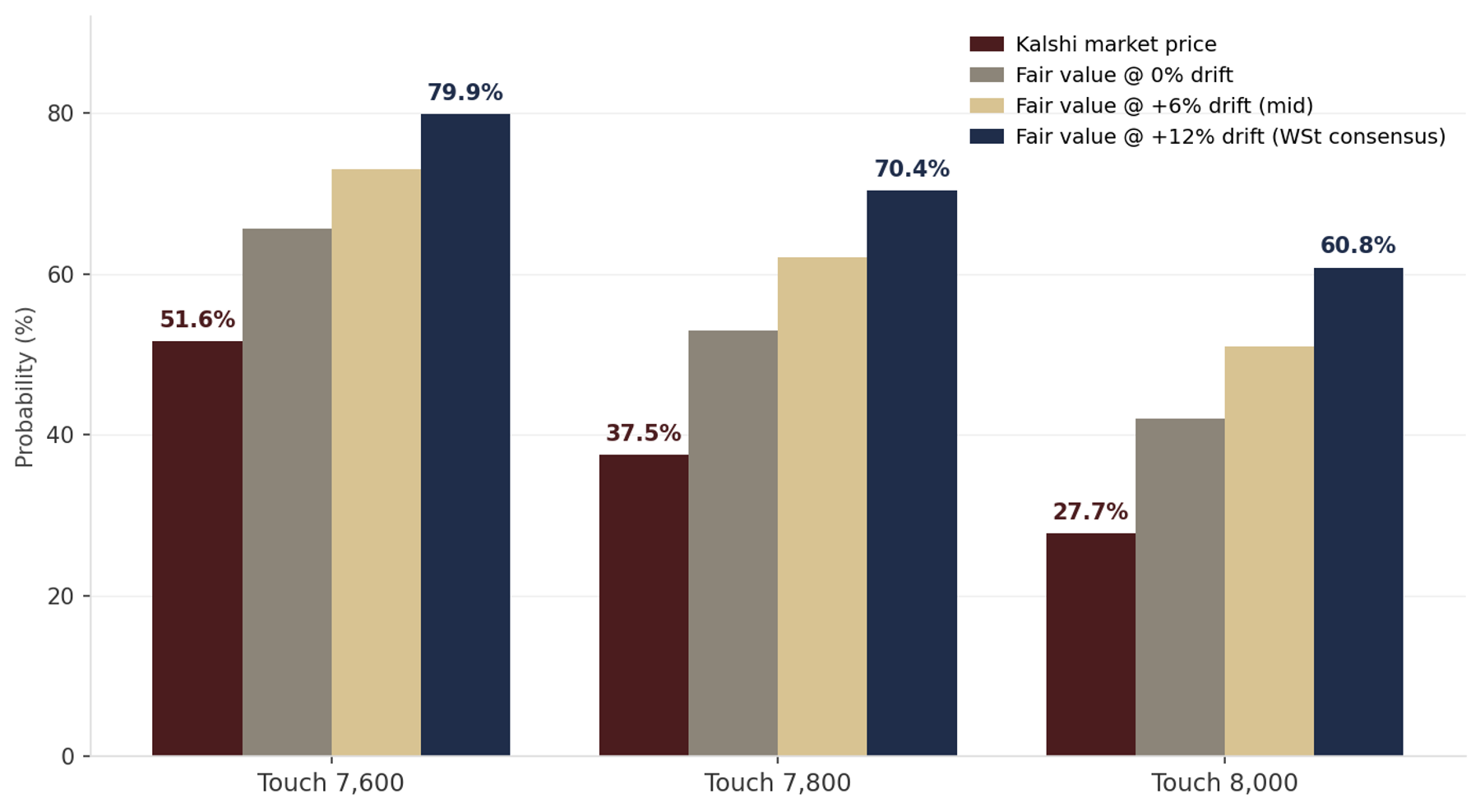
Kalshi KXINXMAXY-01JAN2027 series, last prices as of April 29, 2026; ProCap GBM barrier-hit model at σ equals 18 percent.³,⁴
2 Markets, One Index, 2 Wildly Different Forecasts
The Kalshi prediction market and the Wall Street strategist consensus are pricing two different worlds.
After the Iran-driven late-Q1 correction that bottomed on March 30 at an intraday 6,316.91, Wall Street has spent April marking targets up rather than down.2
The S&P 500 hovers above at 7,100, and JPMorgan raised its base case from 7,200 to 7,600 on April 21.5
Goldman Sachs sits at 7,600. Morgan Stanley’s Mike Wilson — called Wall Street’s “biggest bear” and “the Street’s favourite permabear” through 2023–2024 before turning bullish in mid-2024 — sits at 7,800.346,7
Deutsche Bank and Oppenheimer anchor the high end at 8,000 and 8,100.8,9 The base-case mean target across ten strategists is 7,780, and the median is 7,750, implying plus 9 percent upside in eight months.1
Kalshi is pricing a different trajectory.
The Kalshi touch curve is roughly consistent with a year‑end forecast in the 7,200 to 7,400 zone, flat to modestly up from today.3
The gap between these two worldviews is roughly 400 to 600 S&P 500 points, or 6 to 8 percent of index value.
Both views cannot be correct, and one of them is exploitable.
The asymmetry compounds because the Kalshi market measures path, not endpoint.
A barrier-hit (touch) probability mathematically exceeds a year-end (close) probability for any upside level by the path premium. That premium is typically 15 to 25 percentage points for an upward-drifting GBM.
Kalshi has erased it almost entirely.
Is Kalshi Wrong?
Three explanations for the gap exist. Each has weight, but the third remains the most likely.
Explanation one. Wall Street is too bullish. This was the consensus view in March when the index approached 6,316.91 intraday on Iran panic.
Since then, JPMorgan, Goldman, Morgan Stanley, Barclays, and Yardeni have all raised or held their targets, although the picture is not unanimous: Wells Fargo cut from 7,800 to 7,300 specifically on the Iran war and softer tax-refund outlook, UBS trimmed from 7,700 to 7,500 in April, Bank of America’s Savita Subramanian sits at 7,100 (the most bearish bulge-bracket call), and Stifel’s Barry Bannister anchors the bear end of the street at 7,000.
The 17-strategist independently verified mean is 7,621; the median is 7,700.5,6,7,29,36,26,30,31,27
The FactSet bottom-up CY 2026 EPS estimate sits at 309.22 dollars, with strategist EPS forecasts ranging from roughly 287 dollars (Evercore ISI) to 330 dollars (JPMorgan); the bottom-up 12-month aggregate-of-targets index value is 8,362.16, fully 17.6 percent above the April 23 close of 7,108.40 referenced in the April 24 edition.10,18,19,20,21,22 Goldman’s framework rests on 305 to 309 dollars of EPS at a 22 forward P/E multiple, which on a calendar-2026 basis produces fair value near 6,800 and only reaches their 7,600 target by rolling into 12-month forward NTM earnings (the FactSet forward 12-month P/E is 20.9, implying NTM EPS near 340 dollars).6,10
The bull case to 7,750 requires either FactSet bottom-up EPS being too low by roughly 5 percent or sustained multiple expansion to 24 to 25 times calendar-2026 EPS.
Multiple expansion to 23 to 24 on AI-capex-driven earnings revisions higher is what gets you to 7,750. The math behind 7,750 is not heroic.
Explanation two. Kalshi traders see something Wall Street doesn’t. This is the most defensible bear thesis right now. The Iran-Israel ceasefire that began on April 7 has effectively collapsed, the Strait of Hormuz remains closed to most commercial traffic, and Brent crude has spiked from 90.38 dollars on April 17 to an April 29 intraday print above 118 dollars (settling at 110.84 dollars), a roughly 23 percent rise in 12 trading days.11,12
March CPI re-accelerated to 3.3 percent year over year, up from 2.4 percent in February, with gasoline prices alone contributing roughly three quarters of the monthly print.13
That is a real macro deterioration. CME FedWatch is pricing the June 16 to 17 FOMC meeting in a hold-heavy range, roughly 70 to 94 percent hold and 4 to 28 percent cut depending on the snapshot, with the higher hold probability the more recent reading post the late-April Iran shock.14
The dovish-pivot tailwind is largely not in the curve. If oil holds above 110 dollars and inflation prints accelerate further, Kalshi’s pricing is closer to fair than Wall Street’s.
The trade still works, but the bear path is now the path with the most weight.
The 7,800 touch contract requires only that the index round-trip through this air pocket once over the remaining 246 days. The 8,000 contract requires more.
Explanation three. Kalshi is thin and inefficient. This is the supplemental answer. Prediction markets in path-dependent index contracts have low depth and are populated disproportionately by retail traders who anchor to current price rather than to forward distributions.
A retail trader looking at 7,138.81 and asked whether the index will touch 7,800 instinctively answers that a 9.3 percent rally is roughly a coin flip. That instinct is wrong.
With eight months of path and sigma of 16 to 18 percent, the touch probability of a 9.3 percent out-of-the-money barrier is 53 percent even with zero drift at sigma equals 18 percent, and 48 percent at sigma equals 16 percent.
Add Wall Street’s plus 12 percent annualised drift (computed as a +9 percent move from 7,138.81 to the 7,780 ten-strategist mean over 246 days, annualised to roughly +13.7 percent and rounded down for conservatism), and it is 70 percent at sigma 18 or 66 percent at sigma 16.4
Two Trades
Trade 1. Long Kalshi YES, S&P 500 reaches 7,800 in 2026, at 37.5 cents
The cleanest expression of the mispricing. Buy the contract at 37.5 cents (the most recent print; live order book at the moment of the audit shows bid 36.9 cents and ask 39.0 cents, a 5.6 percent bid-ask spread, with zero contracts traded in the prior 24 hours) with a fair value range of 53 percent at zero drift (sigma equals 18) to 70 percent at Wall Street consensus drift (sigma equals 18).3,4
An institutional-size order would likely cross the spread and pay closer to the ask; at 39.0 cents the edge is 20 percentage points and the return on capital at risk is 51 percent rather than 57 percent at the midpoint.
At realized vol of roughly 16 to 17 percent, the equivalent range is 48 to 66 percent. Mid-of-range fair value is 59 percent.
Expected value per contract is plus 21.5 cents, or plus 57 percent return on capital at risk.
A 1,000 dollar position returns $2,667 in cash if the index touches 7,800 at any point before December 31, a profit of $1,667, and is a total loss otherwise. The catalyst path is short.
The index needs a 9.3 percent rally over eight months. The recent 28-day rally from the March 30 intraday low of 6,316.91 to the April 27 intraday high of 7,178.74 was plus 13.6 percent.2
One AI capex revision higher, one Fed dovish surprise, or one oil-down-on-Iran-deal print clears the contract.
Trade 2. Long Kalshi YES, S&P 500 reaches 8,000 in 2026, at 27.7 cents
The convex expression. Buy at 27.7 cents (last print; live order book at the audit shows bid 22.7 cents and ask 25.5 cents, an 11.6 percent bid-ask spread, with 43 contracts in the prior 24 hours) with a fair value range of 42 percent at zero drift (sigma equals 18) to 61 percent at Wall Street drift (sigma equals 18).3
The wider spread on this contract means execution slippage is the dominant friction; at the ask of 25.5 cents the edge is 23.5 percentage points and the return on capital at risk is 92 percent.
At realized vol the equivalent range is 36 to 56 percent. Mid-of-range fair value is 49 percent.4 Expected value per contract is plus 21.3 cents, or plus 77 percent return on capital at risk.
A 1,000 dollar position returns $3,610 in cash if the index touches 8,000, a profit of $2,610, and is a total loss otherwise.
The 8,000 contract requires a 12.1 percent rally from current levels.
Three banks (Deutsche Bank, Oppenheimer, JPM bull case) have year-end targets at or above 8,000.5,8,9 The contract trades as if those bank desks are pricing tail scenarios. They are pricing base or bull cases.
Wall Street year-end targets cluster well above the level Kalshi is implying for the year’s high.
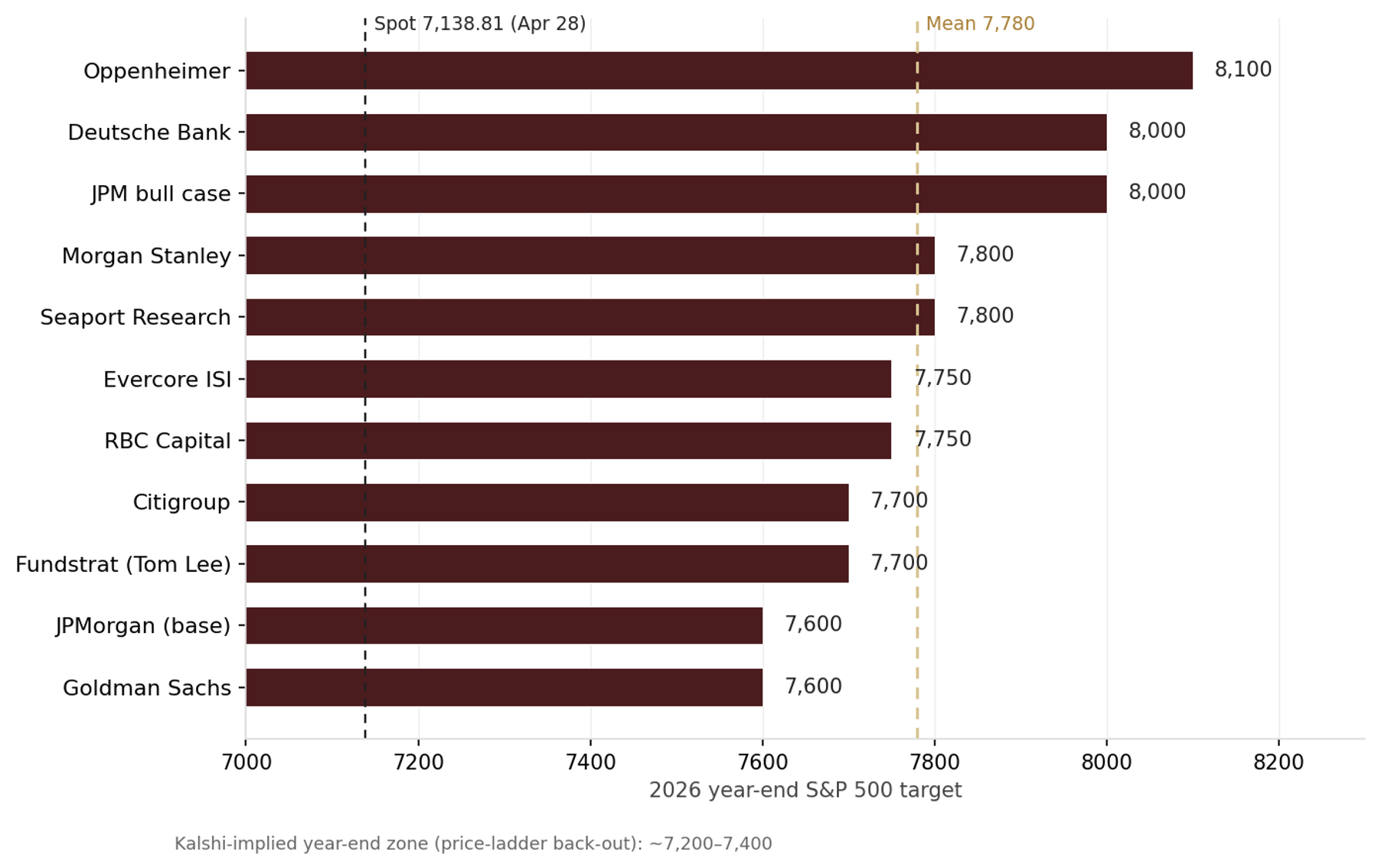
Chart shows the ten most bullish strategists (mean 7,780, median 7,750); the broader 17-strategist independently verified set has mean 7,621 and median 7,700 (footnote 1). Strategist coverage compiled from Bloomberg, CNBC and Reuters, April 2026; spot from Yahoo Finance / FMP April 28 close; Kalshi-implied zone from KXINXMAXY price-ladder back-out.¹,²,³
The Counter-Argument
Three real risks, none generic.
Risk one. The Iran-Hormuz crisis intensifies further and Brent breaches 130 dollars. The April 7 ceasefire has effectively unwound, the Strait of Hormuz is largely closed to commercial traffic, and Trump has indicated the U.S. naval blockade will continue until Iran agrees to a nuclear deal.11,12
The 2026 Iran war began on February 28 with roughly 900 U.S. and Israeli strikes in 12 hours and the killing of Iran’s Supreme Leader Khamenei, an extraordinarily large opening shock; Brent settled at 111.26 dollars on April 28 and on April 29 traded intraday above 118 dollars before settling at 110.84 dollars.11,12
A move to 130 dollars would compress S&P 500 multiples by one to two turns and could cut earnings estimates by 5 to 8 percent.
In that scenario, the 8,000 contract goes to zero.
The 7,800 contract probably survives if a ceasefire is reached within weeks. Eight months is a long time for one geopolitical setback to fully unwind, but the time decay is real and the trade is more exposed today than it was two weeks ago.
Risk two. Powell’s successor signals tighter policy than markets expect. Powell’s term ends May 15.15 President Trump announced his intent to nominate Kevin Warsh on January 30, with the formal nomination transmitted to the Senate on March 4; the Senate Banking Committee advanced the nomination 13 to 11 along party lines on April 29.15,16
Market positioning around Warsh is increasingly dovish on rates but mixed on the balance sheet. The April CNBC Fed Survey shows 58 percent of respondents expect Warsh to favor rate cuts (up 14 points from March) while 65 percent expect him to be hawkish on balance-sheet runoff (up 9 points).
His public comments emphasising AI-driven productivity gains as creating room to cut rates without sparking inflation have anchored the dovish-on-rates read.16,33
Powell’s separate Board of Governors seat does not lapse until January 31, 2028, so a holdover or non-Chair governor scenario is operationally possible.2325
The actual operative risk is a confirmation delay or a Powell holdover at the chair, which removes the dovish-pivot tailwind the market is partially pricing. If that scenario plays out, fair-value touch probabilities drop by 5 to 7 percentage points at the 7,800 strike, and the 10-year Treasury yield (which closed at 4.40 percent on April 29) would likely back up another 15 to 25 basis points, compressing equity multiples further.2829
Uncomfortable, but the trade remains positive expected value at midpoint drift.
Risk three. Earnings disappoint. Q1 2026 earnings are still being reported and the BEA Q1 2026 GDP advance estimate releases April 30 (the day after this report), with private nowcasts ranging from plus 1.2 to plus 2.4 percent annualised.35
As of the April 24 FactSet update, 28 percent of S&P 500 companies have reported, with 84 percent beating EPS estimates (versus a five-year average of 78 percent) and aggregate earnings 12.3 percent above estimates.10 If the AI capex thesis breaks, with a hyperscaler cutting guidance or announcing capex moderation, 2026 EPS estimates fall from the FactSet bottom-up of 309 dollars and the bullish strategist range of 320 to 330 dollars toward 290 to 295 dollars.10,29
At a 22 multiple, fair value compresses to roughly 6,400. The 7,800 touch becomes a roughly 22 percent rally, not 9.3 percent.
The contract is still positive expected value at midpoint drift, but the margin compresses materially.
The composite risk is that Kalshi is pricing the right tail of a fat-tailed distribution and Wall Street is pricing the modal case.
If returns are bimodal, much higher or much lower depending on geopolitical resolution, Kalshi prices come closer to fair.
The honest answer is that the trade is mispriced under all single-distribution assumptions tested, but the bimodal disaster scenario is the cleanest break. The trade still works because both contracts have eight months of path. Even if the index drops 10 percent in May on an Iran shock, a recovery to 7,800 or 8,000 in the second half remains plausible.
The touch only needs to happen once.
Comparative Trade Economics
| Metric | Trade 1. 7,800 Touch | Trade 2. 8,000 Touch |
|---|---|---|
| Entry price (Apr 29 last) | 37.5 cents | 27.7 cents |
| Fair value (zero drift, σ 18) | 53 percent | 42 percent |
| Fair value (mid range, plus 6 drift) | 59 percent | 49 percent |
| Fair value (Wall St plus 12 drift, σ 18) | 70 percent | 61 percent |
| Edge (mid versus entry) | plus 21.5 points | plus 21.3 points |
| EV per contract (mid) | plus 0.215 dollars | plus 0.213 dollars |
| Return on risk (mid) | plus 57 percent | plus 77 percent |
| Full Kelly fraction | 34.4 percent | 29.5 percent |
| Quarter-Kelly fraction | 8.6 percent | 7.4 percent |
| Max profit on 1,000 dollar stake | $1,667 ($2,667 total cash) | $2,610 ($3,610 total cash) |
| Max loss on 1,000 dollar stake | 1,000 dollars | 1,000 dollars |
| Required move from 7,138.81 | plus 9.3 percent | plus 12.1 percent |
| Time to expiry | 246 days | 246 days |
Drift by Vol Sensitivity Grid (P touch, S0 equals 7,138.81, T equals 0.673)
| Drift / Vol | σ 15 | σ 18 | σ 22 |
|---|---|---|---|
| 7,800 barrier | |||
| Zero drift | 46 percent | 53 percent | 60 percent |
| Plus 6 drift (mid) | 57 percent | 62 percent | 67 percent |
| Plus 12 drift (Wall St) | 68 percent | 70 percent | 73 percent |
| 8,000 barrier | |||
| Zero drift | 34 percent | 42 percent | 50 percent |
| Plus 6 drift (mid) | 45 percent | 51 percent | 58 percent |
| Plus 12 drift (Wall St) | 57 percent | 61 percent | 65 percent |
σ 22 read as a tail-vol stress case, not the base. Trailing 30-trading-day SPX realized volatility through April 28 is approximately 17.0 percent and VIX closed at 17.83 on April 28.322
Catalyst Map. What Confirms or Breaks the Thesis
| Date | Event | Direction if dovish or positive |
|---|---|---|
| April 28–29, 2026 (concluded) | Powell’s final FOMC meeting; Committee voted to hold the federal funds target range at 3.50–3.75 percent | Neutral to long Kalshi (no surprise hike, no surprise cut) |
| By May 15, 2026 | Full-Senate vote on Kevin Warsh as Fed Chair | Long Kalshi if confirmed; risk if delayed or holdover |
| May to June 2026 | Q1 earnings completion | Long Kalshi if AI capex held |
| Q2 2026 | Iran de-escalation, Strait of Hormuz reopening | Long Kalshi (oil down, multiples up) |
| April 20, 2026 onward | CBP CAPE-platform IEEPA tariff refund processing (Phase 1) | Long Kalshi (cash back to importers, supports earnings) |
| June 16–17, 2026 | FOMC meeting (CME FedWatch implies 4 to 28 percent cut probability depending on snapshot) | Long Kalshi if cut delivered |
| Q3 2026 | September FOMC and Jackson Hole symposium (late August) | Long Kalshi if cuts begin or are signalled |
| Q4 2026 | Year-end seasonality (historically approximately plus 2 percent in November and plus 1.3 percent in December for an average combined gain of roughly plus 3 percent, with positive months 73 and 75 percent of the time respectively) | Long both contracts |
The cleanest single combination is an Iran de-escalation paired with one Fed rate cut. Either alone gets the index to 7,500. Both together get it to 7,800 or 8,000.
Note that the Supreme Court already ruled against IEEPA tariffs in Learning Resources, Inc. v. Trump and Trump v. V.O.S. Selections, Inc. on February 20, 2026 (6-3), and the Customs and Border Protection CAPE refund portal opened April 20, 2026.
The tariff catalyst is therefore behind us as a binary event; the live question is the pace and scope of refunds, which is supportive but not decisive.17
The Bottom Line
The Kalshi 7,800 touch contract at 37.5 cents and the 8,000 touch contract at 27.7 cents both offer positive expected value of plus 57 percent and plus 77 percent at midpoint fair value, with the path premium alone larger than the entire mispricing. The macro backdrop is materially worse than it was on April 17 (Brent up to roughly 118 dollars from 90, March CPI re-accelerated to 3.3 percent, June FOMC pricing only a 28 percent cut probability), so the bear path has more weight than it did two weeks ago. The thesis breaks if Brent breaches 130 dollars on a Hormuz escalation, in which case the 8,000 contract is a zero. The 7,800 contract survives most single-shock scenarios because eight months is enough time for one round trip, and the trade clears on a single Iran de-escalation paired with one rate cut. Execution risk is non-trivial: open interest at both strikes runs in the 35,000-contract range with thin recent flow (zero 24-hour volume on the 7,800 strike at the moment of this audit), and an institutional order would likely cross the spread; the trade remains positive expected value at the ask but readers should size accordingly.
Sources
Wall Street strategist 2026 year-end S&P 500 targets compiled from Bloomberg, CNBC and Reuters strategist coverage, April 2026. The 7,780 base-case mean and 7,750 median are computed across the ten named, predominantly bullish strategists shown in the chart (Goldman, JPMorgan base, Citigroup, Fundstrat, RBC, Evercore ISI, Morgan Stanley, Seaport Research, Deutsche Bank, Oppenheimer); the broader 17-strategist independently verified sample (each anchored to a primary publication) shows a mean of 7,621 and a median of 7,700, with the range running from Stifel/Bannister at 7,000 to Oppenheimer/Stoltzfus at 8,100; the Bloomberg compiled consensus across a 21-strategist sample shows a mean of approximately 7,555 and a median of 7,650, broadly consistent. Wells Fargo (Ohsung Kwon) cut its 2026 year-end target from 7,800 to 7,300 in late March / early April 2026, UBS trimmed from 7,700 to 7,500 in April, and Bank of America (Savita Subramanian) anchors the bulge-bracket bear cluster at 7,100. Per-strategist primary citations 5–9, 18–22, 26–27 and 29–31.
S&P 500 (^GSPC) daily OHLC from Yahoo Finance and FMP as queried April 29, 2026. April 28 close 7,138.80; April 27 close 7,173.91 (highest close of the rally); April 27 intraday high 7,178.74; April 24 close 7,165.08; April 23 close 7,108.40; March 30 intraday low 6,316.91. VIX (^VIX) April 28 close 17.83. https://finance.yahoo.com/quote/%5EGSPC/history
Kalshi prediction market series KXINXMAXY (“How High Will the S&P 500 Get This Year”), expiry January 1, 2027. Market resolution language: “If the value of the S&P 500 index value starting Jan 1, 2026 and ending before Jan 1, 2027 is above [strike], then the market resolves to Yes,” confirming this is a max-during-year (touch) market. Fractional trading enabled. Live snapshot as of April 29, 2026: 7,799.99 strike last 0.375 dollars (bid 0.369 / ask 0.390, spread 5.6 percent of mid), 24-hour volume 0 contracts, total volume 88,987, open interest 37,385; 7,999.99 strike last 0.277 dollars (bid 0.227 / ask 0.255, spread 11.6 percent of mid), 24-hour volume 43.2 contracts, total volume 81,022, open interest 34,906; 7,599.99 strike last 0.516 dollars (bid 0.523 / ask 0.540), open interest 32,517. Live re-verification required before execution — the 24-hour-volume and last-update timestamps indicate thin order flow at the upper strikes, materially relevant to institutional sizing. https://kalshi.com/markets/kxinxmaxy/sp-500-max-yearly/kxinxmaxy-01jan2027
ProCap Insights GBM barrier-hit model. Reflection-principle analytical formula cross-checked with 100,000-path Monte Carlo simulation. S0 equals 7,138.81, T equals 0.673 years (246 calendar days from April 29 to December 31, 2026).
JPMorgan strategist Dubravko Lakos-Bujas raised the firm’s 2026 S&P 500 base-case target from 7,200 to 7,600 on April 21, 2026, with a bull-case scenario at 8,000. U.S. News & World Report / Reuters, April 21, 2026. https://money.usnews.com/investing/news/articles/2026-04-21/j-p-morgan-lifts-s-p-500-year-end-target-to-7-600-on-ai-driven-earnings
Goldman Sachs S&P 500 outlook, early April 2026: year-end target 7,600 on EPS of 305 to 309 dollars (12 percent growth) at a 22 times forward P/E multiple held throughout the year. Outgoing chief U.S. equity strategist David Kostin and successor Ben Snider authoring. https://www.goldmansachs.com/insights/articles/the-sp-500-expected-to-rally-12-this-year
Morgan Stanley / Mike Wilson, 2026 S&P 500 year-end target 7,800. https://finance.yahoo.com/news/morgan-stanley-resets-p-500-193013332.html
Deutsche Bank / Binky Chadha, 2026 S&P 500 year-end target 8,000 with EPS forecast of 320 dollars. https://finance.yahoo.com/news/wall-streets-2026-forecasts-are-rolling-in--and-some-see-the-sp-500-hitting-8000-110002501.html
Oppenheimer / John Stoltzfus, 2026 S&P 500 year-end target 8,100 with EPS forecast of 305 dollars and a forward P/E of 26.5 times. https://www.oppenheimer.com/news-media/2026/insights/oam/2026-market-outlook
FactSet Earnings Insight, April 24, 2026 edition. Bottom-up 12-month aggregate-of-targets index value 8,362.16 versus the April 23 close of 7,108.40 (the most recent close referenced in the Friday-morning publication). FactSet bottom-up CY 2026 EPS estimate 309.22 dollars (FactSet); CY 2026 earnings growth projection of plus 18.6 percent year over year. Q1 2026 earnings to date: 28 percent of S&P 500 companies reported, 84 percent beat EPS estimates (vs five-year average 78 percent and ten-year average 76 percent), aggregate earnings 12.3 percent above estimates, 81 percent beat on revenues. Forward 12-month S&P 500 P/E ratio 20.9 (above five-year average 19.9, ten-year average 18.9). https://insight.factset.com/sp-500-earnings-season-update-april-24-2026
The 2026 Iran war began February 28, 2026 with U.S. and Israeli strikes on Iranian military, missile, air defense and leadership targets (codenamed Operation Epic Fury), with Iranian Supreme Leader Ali Khamenei killed in the opening strikes. President Trump announced an Iran-Israel ceasefire framework on Truth Social on April 7, 2026 (April 8 local time) for an initial two-week duration with Iran agreeing to reopen the Strait of Hormuz; the ceasefire has been extended but the Strait has never operationally reopened to commercial shipping. NPR, April 28, 2026, “Deadlock over Iran’s nuclear program and the Strait of Hormuz cripples peace efforts.” https://www.npr.org/2026/04/28/nx-s1-5802283/iran-middle-east-updates
Brent crude (BZ=F) settlement: April 17, 2026 close 90.38 dollars; April 28 close 111.26 dollars; April 29 traded intraday above 118 dollars and settled at 110.84 dollars after President Trump pledged to maintain the U.S. naval blockade until a nuclear deal. CNBC, April 29, 2026, “Brent oil tops $118 after Trump says he will blockade Iran until it agrees to a nuclear deal.” https://www.cnbc.com/2026/04/29/oil-prices-brent-wti-trump-iran.html
U.S. Bureau of Labor Statistics, “Consumer Price Index — March 2026,” released April 10, 2026. Headline CPI plus 3.3 percent year over year (versus plus 2.4 percent in February); month over month plus 0.9 percent driven by a 10.9 percent rise in energy and a 21.2 percent jump in gasoline. https://www.bls.gov/news.release/archives/cpi_04102026.htm
CME Group FedWatch Tool, accessed April 29, 2026. Implied probabilities for the June 16–17, 2026 FOMC range across snapshots: hold at 3.50–3.75 percent shown at roughly 70 percent on some vendors and as high as 93 to 95 percent on others; cut probability between roughly 4 and 28 percent. Pricing has shifted hold-ward since the late-April Iran escalation. Re-verify before publication. https://www.cmegroup.com/markets/interest-rates/cme-fedwatch-tool.html
Federal Reserve Board calendar; Powell’s term as Chair ends Friday, May 15, 2026. https://www.federalreserve.gov/monetarypolicy/fomccalendars.htm
Trump announced his intent to nominate Kevin Warsh as Fed Chair on January 30, 2026; the formal nomination was sent to the Senate on March 4, 2026. The Senate Banking Committee voted 13–11 on April 29, 2026 to advance the nomination. NPR, January 30, 2026; The Washington Post, April 29, 2026; CNBC, April 29, 2026. https://www.washingtonpost.com/business/2026/04/29/trump-federal-reserve-kevin-warsh-committee/
U.S. Supreme Court, Learning Resources, Inc. v. Trump and Trump v. V.O.S. Selections, Inc., decided February 20, 2026 (6-3); IEEPA does not authorize the President to impose tariffs. CBP launched the Consolidated Administration and Processing of Entries (CAPE) refund-claim platform on April 20, 2026. K&L Gates summary, February 20, 2026; Skadden, April 2026. https://www.klgates.com/Summary-Supreme-Court-Decision-on-IEEPA-Tariffs-2-20-2026
Citigroup, Scott Chronert, 2026 S&P 500 year-end target 7,700 reaffirmed early April 2026 with bull case 8,300 and bear case 5,700. https://www.financialcontent.com/article/marketminute-2026-4-2-citi-defies-geopolitical-gloom-with-bold-7700-s-and-p-500-forecast-amid-global-energy-shocks
Fundstrat, Tom Lee, 2026 S&P 500 year-end target 7,700 (originally December 2025; reaffirmed in CNBC "Power Lunch" April 27, 2026 as “very probable”). https://www.cnbc.com/2026/04/27/tom-lee-says-its-very-probable-stocks-will-sail-past-7700-this-year.html
Evercore ISI, Julian Emanuel, 2026 S&P 500 year-end target 7,750 (initiated September 2025; reaffirmed in Q1 2026 commentary; bull case 9,000, bear case 5,000). https://www.cnbc.com/2025/09/02/evercore-isi-sets-2026-sp-500-target-at-7750.html
RBC Capital Markets, Lori Calvasina, 2026 S&P 500 year-end target 7,750 (Bloomberg, December 1, 2025; reiterated Q1 2026). https://finance.yahoo.com/news/rbc-sets-12-month-sp-500-target-at-7750-as-more-wall-street-firms-turn-bullish-on-stocks-180100024.html
Seaport Research, 2026 S&P 500 year-end target 7,800. https://seekingalpha.com/article/4853661-2026-s-and-p-500-outlook-7800-target-and-5-risks-markets-ignore
Powell’s 14-year term as a Member of the Board of Governors of the Federal Reserve System runs through January 31, 2028, separate from his term as Chair (which ends May 15, 2026). If Powell remains on the board after his Chair term ends, he would be the first former Chair since Marriner Eccles (who stayed on as a governor from 1948 to 1951) to do so. As of April 29, 2026 he has not publicly announced a decision. Federal Reserve Board membership records via Congressional Research Service; Wikipedia “Chair of the Federal Reserve.” https://www.congress.gov/crs-product/R48233
S&P 500 closed at 7,118.21 on April 29, 2026 (down 20.59 / minus 0.29 percent on the day, post-FOMC). Brent crude (BZ=F) settled at 110.84 dollars on April 29 after intraday high above 118 dollars. (Yahoo Finance / FMP, queried April 29, 2026.) https://finance.yahoo.com/quote/%5EGSPC/
Methodology notes. (a) Path premium definition: P(touch B) minus P(close greater than or equal to B); for B equals 7,800 with sigma equals 18 percent and zero drift, the path premium is approximately 27 percentage points by the reflection-principle formula. (b) Mid fair value of 59 percent for the 7,800 contract is the unweighted mean of the four corner cases (sigma in {16, 18}, drift in {0 percent, +12 percent}); 49 percent for the 8,000 contract is the same average. (c) Kelly fraction for a binary contract priced at p with true probability q is (q minus p) divided by (1 minus p); the report applies a quarter-Kelly haircut as standard practice for thin prediction markets with execution uncertainty.
Wells Fargo Investment Institute / Ohsung Kwon, S&P 500 2026 year-end target cut to 7,300 from 7,800 in late March / early April 2026, citing the U.S.-Iran war and lower-than-expected tax refunds. Bloomberg, March 31, 2026; The Daily Hodl, April 2, 2026. https://www.bloomberg.com/news/articles/2026-03-31/wells-fargo-trims-s-p-500-target-says-iran-war-to-limit-gains
Stifel Nicolaus / Barry Bannister, S&P 500 2026 year-end target 7,000 (lowest among major sell-side strategists) with a 6,500–7,500 corridor; 25 percent recession probability assigned. Investing.com, December 2025; Stifel CIO April 2026 Insight. https://www.investing.com/news/stock-market-news/stifel-maps-out-2026-sp-500-scenarios-9-upside-vs-5-downside-4402940
U.S. 10-year Treasury yield (^TNX): April 27 close 4.336 percent; April 28 close 4.354 percent; April 29 close 4.400 percent. 13-week T-bill (^IRX) close 3.59 percent on April 29 (consistent with the federal funds upper bound at 3.75 percent). Yahoo Finance, queried April 29, 2026. https://finance.yahoo.com/quote/%5ETNX/
Barclays / Venu Krishna, S&P 500 2026 year-end target raised to 7,650 from 7,400 in late March 2026 with EPS forecast of 321 dollars. https://www.financialcontent.com/article/marketminute-2026-3-26-barclays-raises-s-and-p-500-year-end-target-to-7650-amid-industrial-super-cycle
UBS Global Wealth Management, S&P 500 2026 year-end target trimmed to 7,500 from 7,700 in April 2026; HSBC year-end target 7,500. https://finance.yahoo.com/news/ubs-sees-sp-500-hitting-7500-by-year-end-2026-fueled-by-ai-and-strong-corporate-profits-155408599.html
Bank of America Securities / Savita Subramanian, S&P 500 2026 year-end target 7,100 (most bearish among bulge-bracket strategists), with an EPS forecast of approximately 310 dollars (plus 14 percent year over year) and a thesis of "significant multiple compression" centered on AI exposure. CNBC, December 15, 2025; Stocktwits / TheStreet coverage. https://www.cnbc.com/2025/12/15/bofas-savita-subramanian-says-sp-500-will-rise-to-just-7100-in-2026.html
Trailing 30-trading-day SPX close-to-close annualised realised volatility through April 28, 2026: 17.05 percent (computed from Yahoo Finance ^GSPC). 22-trading-day window: 16.00 percent; 21-trading-day window: 14.45 percent. The body uses 16 to 17 percent as the operative range and 17 percent as the headline figure.
CNBC Fed Survey, late April 2026 release: 58 percent of respondents expect Warsh to favor rate cuts as Chair (up 14 points from March), 65 percent expect him to be hawkish on balance-sheet runoff (up 9 points). Reuters and Bloomberg coverage of his Senate confirmation hearing (April 21, 2026) emphasised his “productive dovishness” framing on AI productivity. https://www.cnbc.com/2026/04/27/doubts-persist-about-whether-fed-chair-nominee-warsh-will-be-independent-cnbc-survey-finds.html
Mike Wilson’s prior bearish stance is widely documented: Fortune, May 20, 2024 (“Wall Street’s biggest bear just turned bullish”); BNN Bloomberg, November 18, 2024 (“Prominent Wall Street Bear Wilson Sets Bullish US Stocks Target”); Morgan Stanley “Thoughts on the Market” podcast archive. His 2024 year-end S&P 500 target was 4,500 against an actual close above 5,800. https://fortune.com/2024/05/20/wall-street-biggest-bear-bullish-stocks-uncertain-backdrop-economy/
U.S. Bureau of Economic Analysis, GDP “Advance Estimate” for Q1 2026 scheduled for release April 30, 2026, 8:30 a.m. ET. Pre-release private nowcasts (Atlanta Fed GDPNow most recently printed plus 1.24 percent on April 21, 2026 (revised down from a March base of plus 2.0 percent and an earlier April 9 print of plus 1.3 percent); other commercial nowcasts span the plus 1.2 to plus 2.4 percent annualised range as of late April). Polymarket implied probabilities concentrate in the plus 1.5 to plus 3.0 percent range. https://www.bea.gov/news/schedule
Yardeni Research / Ed Yardeni, 2026 S&P 500 year-end target 7,700, citing record bottom-line numbers, broadening market participation, and an economy that “refuses to falter.” https://finance.yahoo.com/news/ed-yardeni-sees-sp-500-reaching-7700-next-year-says-profits-and-growth-will-remain-resilient-191946146.html