Silvia Insights · April 16, 2026
Snap copied Meta's layoff playbook but the growth story still isn't clear
Snap cut 16% of its workforce today and investors rewarded it immediately. The move follows activist pressure from Irenic Capital and mirrors the same cost-cutting formula that sent Meta up 194% in 2023. The question now is whether Snap has the revenue engine to back it up.
What to Know
- SNAP shares rallied ~8% intraday to $6.04 after announcing 1,000 layoffs and $500M+ in annualized savings, joining Block (~24% on cuts of nearly half its workforce) and Meta (+194% after 2023 efficiency purge) as the latest company rewarded for slashing headcount. The setup favors cautious positioning at current prices with a defined catalyst three weeks away.
- Snap now generates 65%+ of its new code through AI tools, suggesting the layoffs are structurally permanent rather than cyclical. Q4 2025 produced $45M in GAAP net income, Snap's most profitable quarter in company history, hinting that the cost problem is fixable.
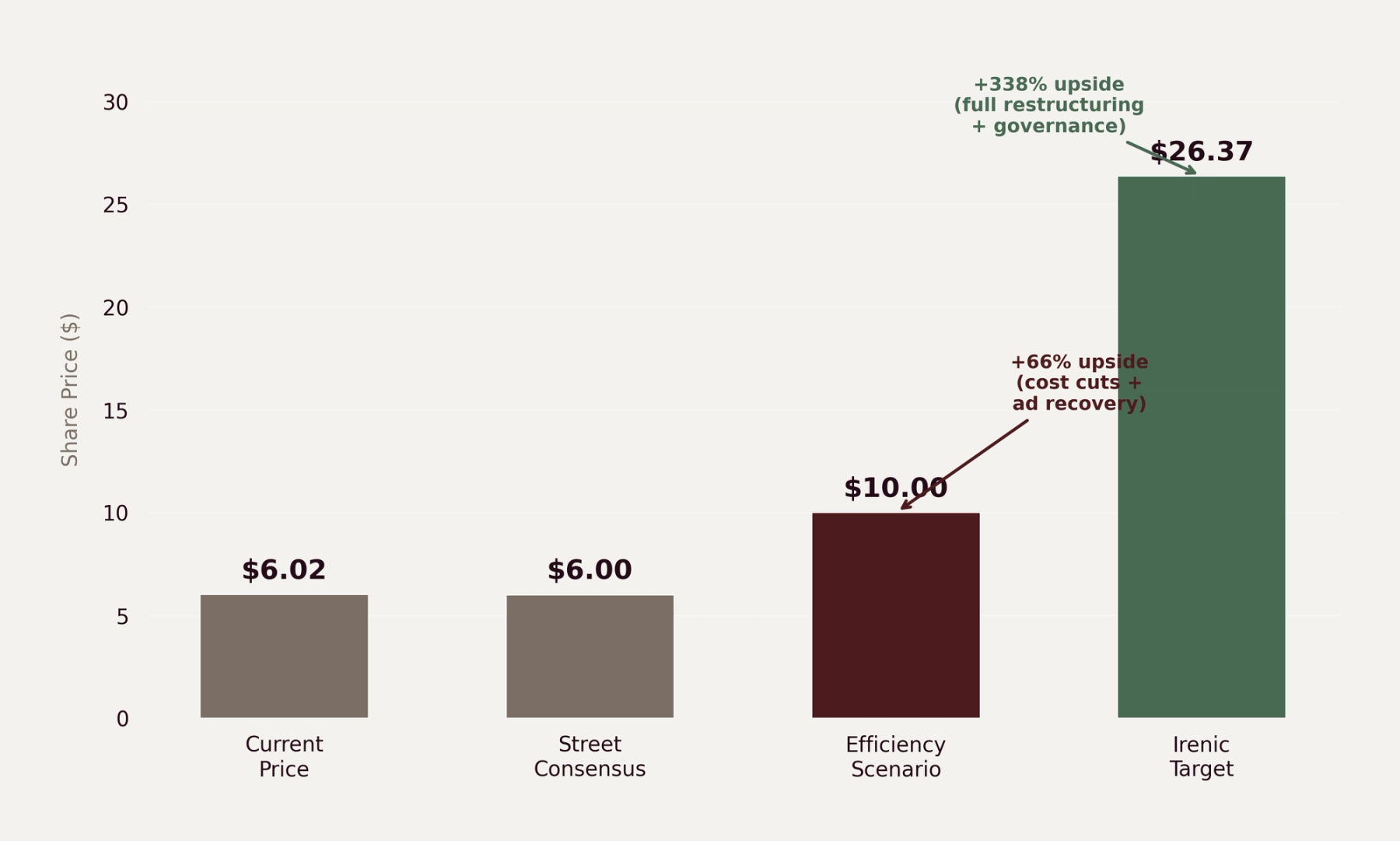
- Activist investor Irenic Capital sees $26.37 per share if Snap shuts its Spectacles hardware division and refocuses AI on ad monetization. Q1 earnings on May 6 will reveal whether the efficiency thesis survives first contact with a tariff-hit ad market.
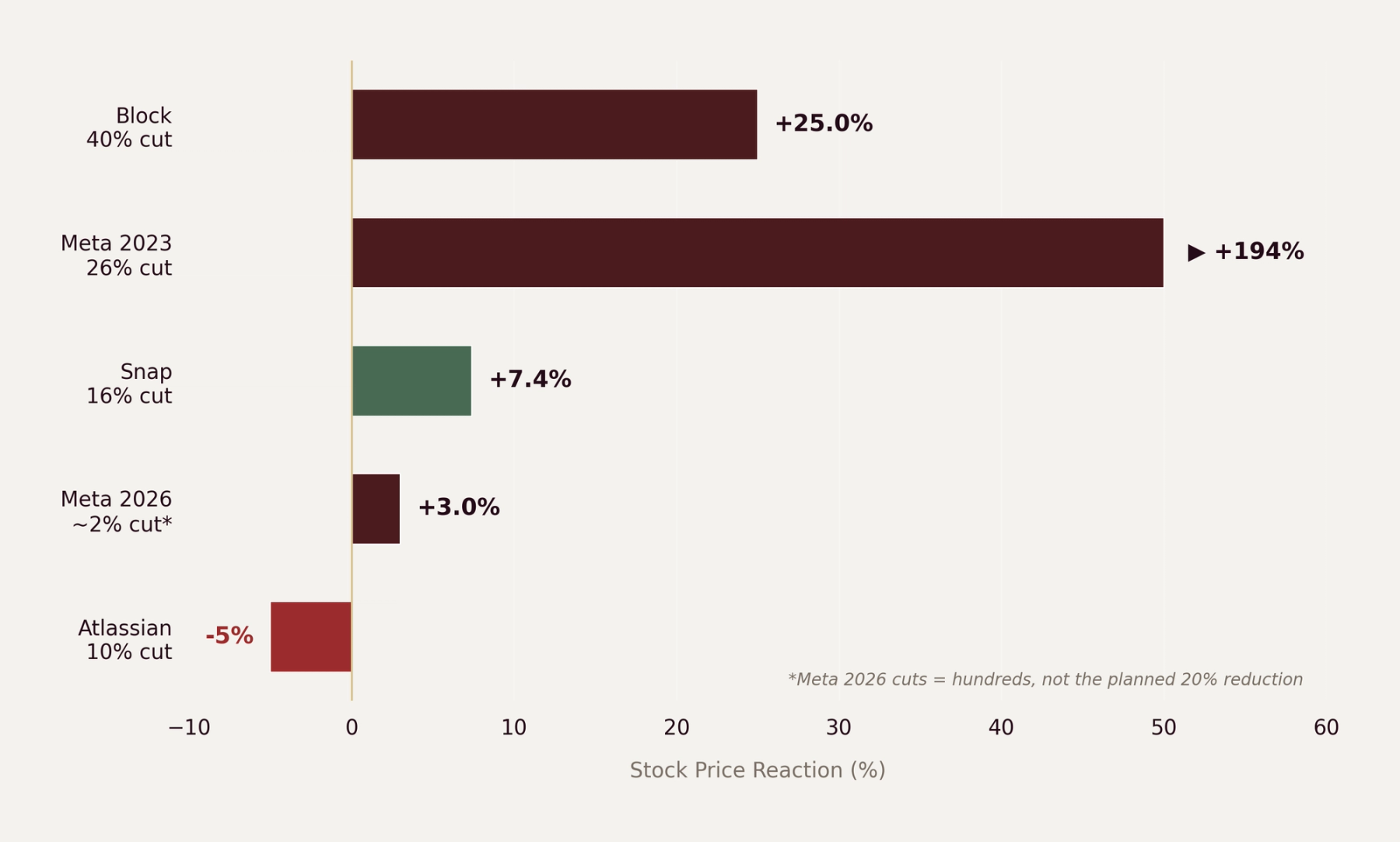
Wall Street Is Rewarding Layoffs. Bigger Cuts Mean Bigger Pops.
Source: Finnhub, company press releases, SEC filings (as of April 15, 2026)
The Layoff Premium Is Real, and Snap Just Bought a Ticket
The 2026 tech layoff cycle has produced a remarkably consistent market signal. Companies that announce deep, AI-justified workforce reductions get rewarded on the spot. Block surged ~24% in February when Jack Dorsey slashed nearly half its headcount and said AI had changed "what it means to build and run a company."1
Meta gained 3% on its March 2026 cuts and still trades on the afterglow of its 2023 restructuring, which turned a 64% stock decline into a roughly 194% calendar-year 2023 rally.2 Snap's ~8% pop today fits the pattern exactly.
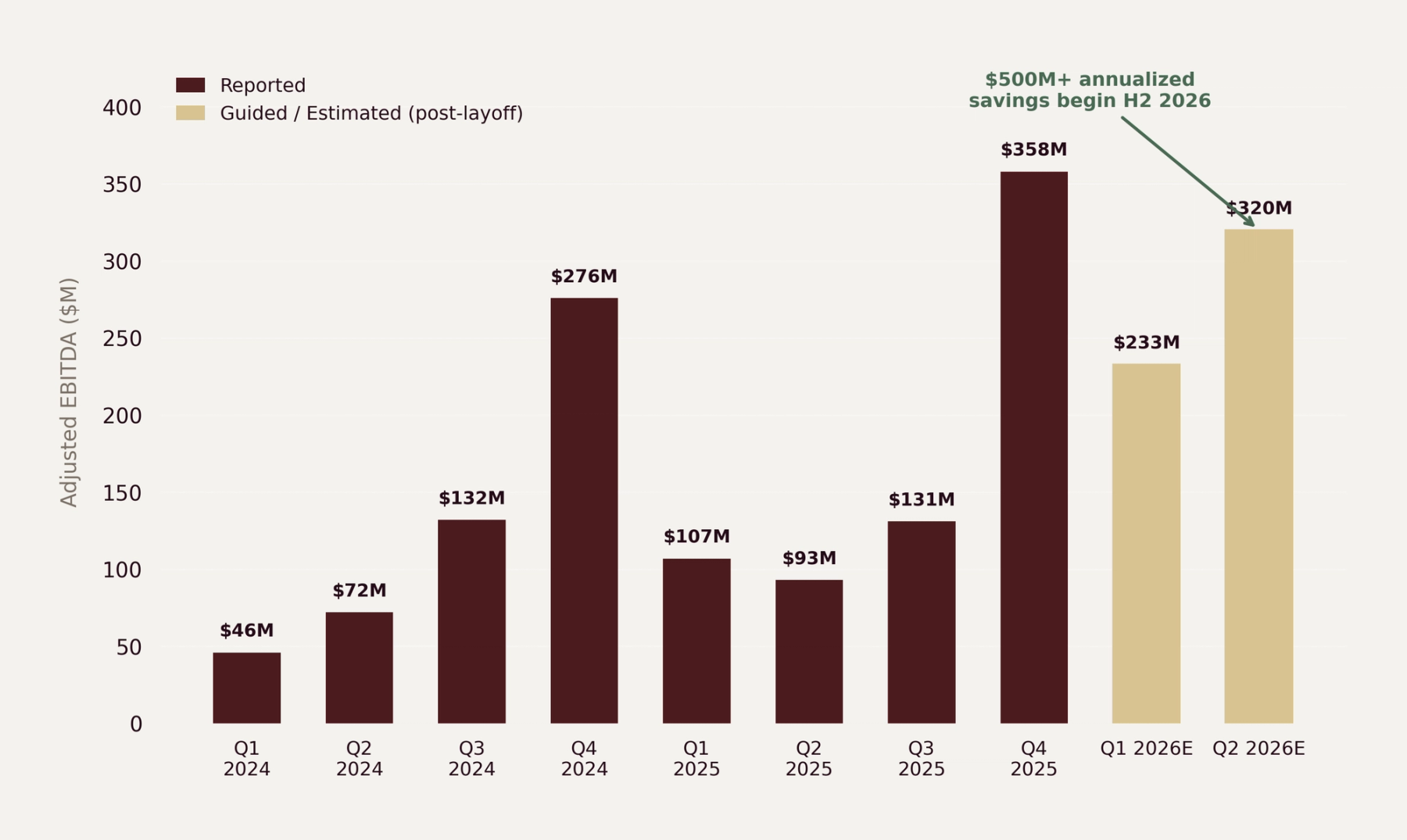
The company cut 1,000 employees, roughly 16% of its full-time staff, closed 300+ open roles, and projected $500M+ in annualized savings by the second half of 2026.3 The restructuring charges of $95-130M, mostly hitting Q2, are trivial against a company generating $437M in annual free cash flow.4
The knockout number is this. Snap had ~3,200 employees before COVID. By December 2025, it had swelled to 5,261.5
After today's cuts, it will operate with approximately 4,200, still roughly a third larger than its pre-pandemic workforce while generating AI-assisted code for 65%+ of new engineering output. Irenic Capital, the activist with a 2.5% stake, argued in its March 31 letter that Snap's cost structure was bloated by $500M-$1B annually. Management just conceded half that argument.
Wall Street Is Split, and Nobody Models the Full Efficiency Scenario.
Wall Street is split on SNAP, with 6 Buy ratings, 20 Holds, and 3 Sells across 29 covering analysts.6 Canaccord lowered its target from $7 to $6 on the layoff news. Citi holds at $6 after slashing from $10.
Stifel lowered its target from $7 to $5.50 and upgraded from Sell to Hold. The consensus price target sits near $8, implying roughly 33% upside from the post-layoff price, but that target predates both the tariff shock and the restructuring.16 The bull-bear spread is wide, and conviction is thin on both sides.
The consensus correctly identifies Snap's core problem. It remains the smallest independent player in digital advertising, competing against Meta's $201B revenue machine, Google's search-and-YouTube duopoly, and TikTok's engagement dominance.7
Revenue grew 11% in FY2025 to $5.93B, solid but not spectacular. Q1 2026 revenue guidance of $1.50B-$1.53B, implying ~12% growth, faces real headwinds from tariff-driven ad spending uncertainty.
Where consensus breaks is the margin expansion story. Every Hold rating models Snap as a slow-growth company with a permanent cost problem. None of the published targets incorporate $500M in annualized savings flowing through the P&L by late 2026.8
If Snap can hold revenue flat at $6B and strip out $500M in costs, adjusted EBITDA jumps from $689M to something approaching $1.2B. That is a 20% margin on a company currently valued at roughly $10B enterprise value.
Snap's EBITDA Is Inflecting. The Layoff Savings Have Not Hit Yet.
Source: Snap Inc. SEC filings, Q1 2026 company guidance (as of April 15, 2026)
Five Companies Tried This Playbook in 2026. Only One Was Rewarded Big.
The first quarter of 2026 saw over 52,000 tech workers lose their jobs, with AI leading all cited reasons for cuts in March at 25% of that month's announcements.9 The market's response varied dramatically based on one factor. Whether investors believed the cuts would translate into margin expansion without killing the growth story.
Block's February restructuring is the most direct comparison. Dorsey eliminated 4,000 roles, cutting nearly half its workforce, and the stock surged ~24% because Block simultaneously guided to 26% adjusted operating margins (up from 20% in 2025) and raised its 2026 gross profit growth forecast to 18%.10
Meta's 2023 "Year of Efficiency" remains the gold standard. Zuckerberg cut 21,000 employees across two rounds, shrunk middle management, and redirected resources to AI and Reels. The stock returned 194% in 2023.2
The critical difference was that Meta sat on a revenue base of $116B that would grow 16% in 2023, with advertising demand that proved resistant to the economic cycle. Oracle cut an estimated 20,000-30,000 employees in Q1 2026 with $2.1B in restructuring charges, but the stock reaction was muted because investors questioned whether the cloud transition would actually accelerate.11
Atlassian's 10% cut in March produced a modest positive reaction of 2-4% in extended trading. Amazon's January layoffs of 16,000 were priced in before they happened.12
The pattern is clear. Layoffs work as a stock catalyst when three conditions are met. First, the cuts must be deep enough to move the margin needle.
Second, the growth story must remain intact. Third, management must articulate a structural reason, usually AI, that makes the cuts permanent rather than cyclical.
Snap checked the first and third boxes today. The second remains an open question.
Key Data
| Metric | Value |
|---|---|
| Current Price (Apr 15) | $6.04 (intraday) |
| Market Cap | ~$10.2B |
| FY2025 Revenue | $5.93B (+11% YoY) |
| Q4 2025 Revenue | $1.72B (+10% YoY) |
| FY2025 Net Loss | -$460M (narrowed from -$698M) |
| Q4 2025 Net Income | $45M (largest GAAP quarterly profit in company history) |
| FY2025 Adj. EBITDA | $689M |
| FY2025 Free Cash Flow | $437M |
| Q1 2026 Revenue Guidance | $1.50B-$1.53B (+12% YoY) |
| DAU / MAU | 474M / 946M |
| Snapchat+ Subscribers | 24M (+71% YoY) |
| Employees (post-layoff) | ~4,200 |
| Annualized Savings | $500M+ by H2 2026 |
| 52-Week Range | $3.81 - $10.41 |
| YTD Return | -25% |
| Irenic Capital Target | $26.37 (338% upside) |
Data as of April 15, 2026. Sources listed in endnotes.
The Gap Between Wall Street's $6 Target and Irenic's $26 Target Tells the Whole Story
Source: Finnhub, Irenic Capital public letter, analyst reports (as of April 15, 2026)
The Counter-Argument
The Meta efficiency comparison flatters Snap in a way that misrepresents the fundamental business risk. When Meta cut 21,000 employees in 2022-2023, it sat atop a $116B revenue base with compressed margins from Reality Labs spending, but its core advertising business remained dominant. The cuts unlocked 35%+ operating margins by 2023 and removed excess from a franchise that would grow to $201B in revenue by 2025.
Snap is not Meta. Snap's $5.93B in 2025 revenue represents 3.6% of Meta's total. Its advertising technology, while improved, lacks the signal depth and targeting precision of Meta's ecosystem.
The layoffs fix the cost line. They do nothing for the revenue ceiling. Snap's $400M integration deal with Perplexity AI, announced in November 2025 as its most significant non-advertising revenue initiative, appears to have stalled. Multiple reports in recent weeks indicate the two companies have failed to agree on rollout terms, and the partnership's future remains uncertain. If the deal ultimately falls through, it would remove the only near-term revenue diversification catalyst Snap has disclosed.
The tariff environment creates a direct threat to Snap's ad recovery thesis. Digital advertising spending, particularly from direct-to-consumer brands and Chinese exporters on platforms like Temu and Shein, faces compression if tariffs hold.14
Snap's Q1 2026 guidance of $1.50B-$1.53B bakes in ~12% growth, but that guidance was issued before the April tariff escalation. Citi cut its price target from $10 to $6 in March specifically on tariff risk to the ad market.
The Spectacles question cuts both ways. Irenic argues the AR hardware division burns $500M annually with no near-term return. But Snap has invested $3.5B+ in AR over a decade, and shutting it down would surrender the company's most differentiated long-term asset.
If AR glasses become the next computing platform, as Apple, Meta, and Google are all betting, Snap's early investment could prove prescient. Killing it to juice near-term EBITDA would be the kind of short-termism that activist investors specialize in.
Finally, governance remains a structural obstacle. CEO Evan Spiegel and co-founder Bobby Murphy control voting power through a Class C share structure. Irenic can publish letters and nominate board members, but it cannot force operational changes without Spiegel's consent.
The stock's ~65% decline from its $17 IPO price happened under this exact governance framework. Today's layoffs happened because Spiegel chose them, not because Irenic demanded them. That dynamic is both the bull case and the bear case simultaneously.
Catalyst Map
- MAY 6 Q1 2026 earnings. First revenue print under tariff headwinds. Confirms or breaks the 12% growth trajectory. Updated Q1 EBITDA guidance of ~$233M (raised from $170M-$190M at Q4 earnings).¹³
- LATE JULY Q2 2026 10-Q filing. Restructuring charges of $95-$130M hit this quarter. Reveals whether $500M annualized savings estimate holds or whether additional cuts follow.
- H2 2026 Irenic Capital proxy fight ahead of annual meeting. The activist has publicly called for eliminating the dual-class share structure and nominating independent directors. Spiegel's response signals whether governance reform is on the table.
- YEAR-END Spectacles hardware decision. Irenic estimates $500M/year in cash burn on the AR division. A shutdown or spin would immediately boost free cash flow; continued investment signals Spiegel is ignoring the activist playbook.
The Bottom Line
Snap's layoff pop fits the 2026 efficiency playbook, but the counter-argument is real: Snap is not Meta, and no cost cut fixes a $5.9B revenue base competing against a $201B incumbent in a tariff-hit ad market. Q1 earnings on May 6 are the binary gate — if 12% growth holds, the efficiency thesis has legs; if it misses, the stock reprices the cost savings as a one-time sugar high. The single biggest risk is that Spiegel's unchecked governance power means every thesis, bull or bear, runs through one person's decisions.
Sources
Sources
Block Inc. press release, February 26, 2026; company SEC 8-K filing
Meta Platforms FY2023 10-K filing; Finnhub historical price data
Snap Inc. press release, April 15, 2026; company SEC 8-K filing
Snap Inc. FY2025 10-K filing, free cash flow statement
Snap Inc. Q4 2025 earnings report; Irenic Capital public letter, March 31, 2026
Finnhub recommendation trends; Canaccord Genuity, Citi, Stifel analyst reports (March-April 2026)
Snap Inc. FY2025 10-K annual report
ProCap Insights analysis based on company-disclosed restructuring savings
Challenger, Gray and Christmas Q1 2026 layoff report
Block Inc. Q4 2025 earnings call, February 26, 2026
Oracle Corporation SEC filing, Q1 2026 restructuring charges
Atlassian Corp. SEC 8-K, March 2026; Amazon.com Inc. press release, January 2026
Finnhub analyst recommendation trends, April 15, 2026; MarketBeat consensus data
Snap Inc. Q1 2026 updated guidance, SEC 8-K filing (April 15, 2026); Q4 2025 earnings call (February 4, 2026)
Citi Research, SNAP price target revision, March 2026