Silvia Insights · April 9, 2026
Oil just had its worst day in 6 years. History says stocks run from here
Crude collapsed 14.6% on the US-Iran ceasefire, the largest single-session drop since the OPEC+ price war of March 2020. In every historical analog where oil crashed 10%+ on a geopolitical resolution, the S&P 500 was higher one month and three months later.
What to Know
- The setup favors staying long broad equities (SPY) and rotating into oil-price-sensitive beneficiaries like industrials (XLI, +3.75% on the day) over energy (XLE, -3.5%). WTI at $96 remains 43% above its pre-war $67 level, meaning the relief trade has further to run if Hormuz reopens.
- Across six prior oil crashes of 10%+ since 1991, the S&P 500 gained a median of 4.7% one month later and 15.3% three months later. The 1991 Desert Storm analog, the closest parallel, delivered +12.6% in the first month and +19.1% in three months.
- The two-week ceasefire window expires April 22, and only two tankers have transited the Strait of Hormuz so far. If Hormuz traffic normalizes, another $10-15 of oil premium evaporates, extending the equity rally into May.
WTI Crude Surged 68% on the Iran War, Then Gave Back a Fifth of It in a Single Day
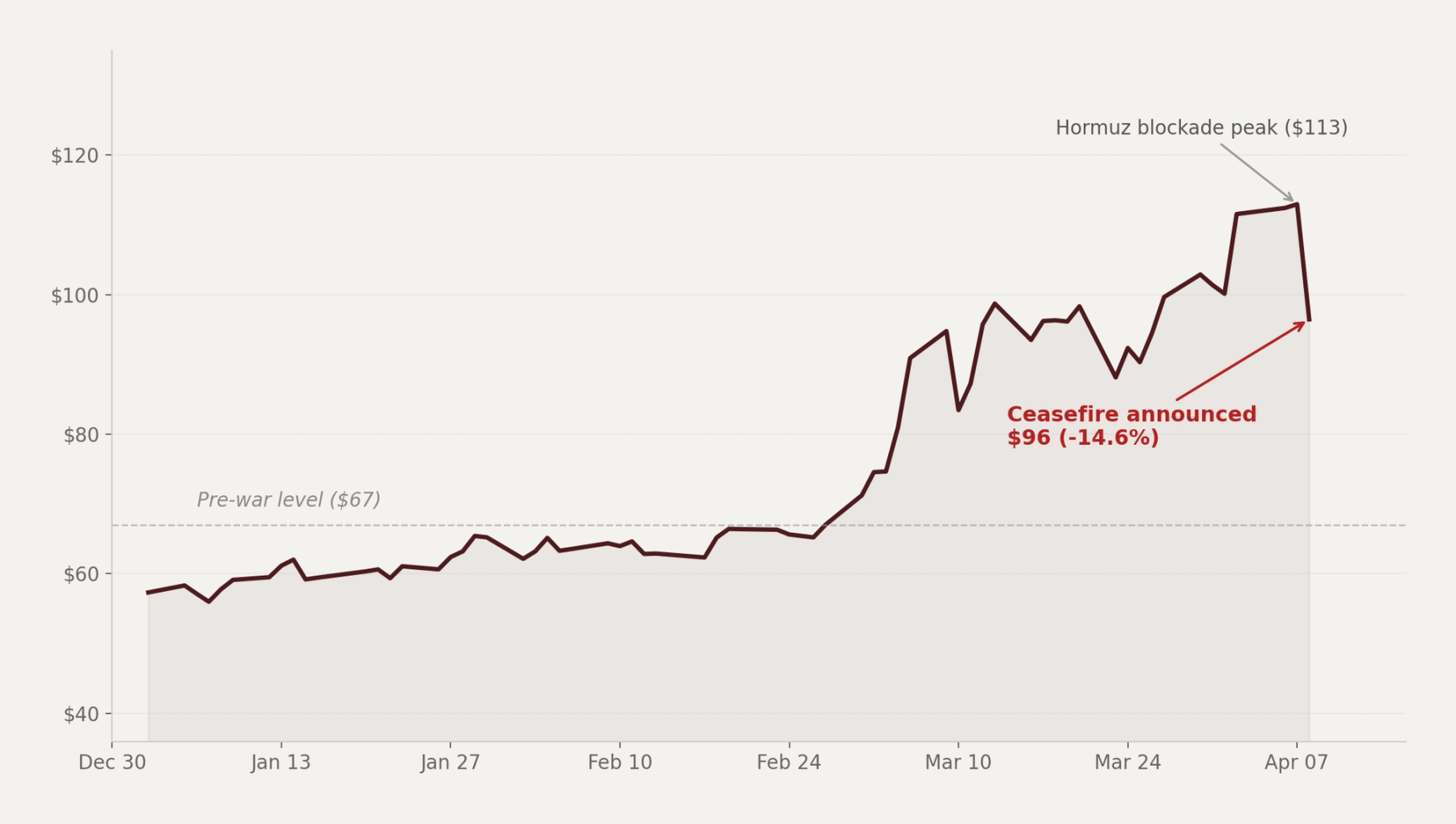
Data from OpenBB / Yahoo Finance (CL=F front-month futures), as of April 8, 2026.
What Happened
President Trump agreed to a two-week ceasefire with Iran less than two hours before his 8 p.m. ET deadline to destroy Iranian civilian infrastructure. WTI crude futures cratered from $112.95 to an intraday low of $91.05, settling at $96.45, a 14.6% single-session loss.1
The Dow surged 1,100 points (+2.9%), the S&P 500 jumped 2.5%, and the Nasdaq rallied 3.5%.2 It was the broadest single-day risk-on trade since the April 2025 tariff reversal, which triggered a 9.5% S&P gain.3
The Market Priced a Resolution That Has Not Arrived
The ceasefire hinges on reopening the Strait of Hormuz, through which 20% of global seaborne crude normally transits. As of Wednesday afternoon, only two tankers had crossed the strait since the agreement took effect.4 Iran's state news agency Fars reported that additional traffic was halted because Israel continues to strike Lebanon.
Even after the crash, WTI at $96 sits 43% above its pre-war level of $67 on February 27. The market did not unwind the war premium. It trimmed a fifth of it in a panic and called it a rally.
The gap between $96 and the pre-war $67 is the market's implied probability that the ceasefire fails, Hormuz stays restricted, and oil retests $110+ within weeks. That probability is not small. Trump himself described the deal as based on a "10-point proposal" from Iran that has not been made public.5
Six Analogs and What They Say About the Next Three Months
Since 1991, six prior episodes saw WTI crude fall 10% or more in a single session. The S&P 500's forward returns after each crash tell a consistent story.
The median one-month forward return was +4.7%. The median three-month forward return was +15.3%. Four of six episodes produced positive three-month returns.6
The two exceptions both involved Fed tightening, not oil.
The November 2021 Omicron crash preceded the Fed's hawkish pivot. The March 2022 Ukraine reversal came as the Fed launched its aggressive hiking cycle.
The strongest analog is January 17, 1991. Operation Desert Storm launched, oil crashed 33%, and the S&P jumped 3.7% that same session.7
Over the following month, the S&P gained another 12.6%. Over three months, the gain stretched to 19.1%. The full 1991 calendar-year price return was 27.8%.
The mechanism is identical to today. A geopolitical risk premium that had been compressing equity valuations for months evaporated overnight. Money that had been hiding in cash, commodities, and defense names rotated aggressively back into growth and cyclicals.
The Sector Split Reveals the Real Trade
The most important signal on April 8 was not the headline S&P move. It was the 7.3 percentage-point gap between industrials (+3.75%) and energy (-3.51%).8
Industrials Beat Energy by 7.3 Points in a Single Session, the Widest Spread Since March 2020
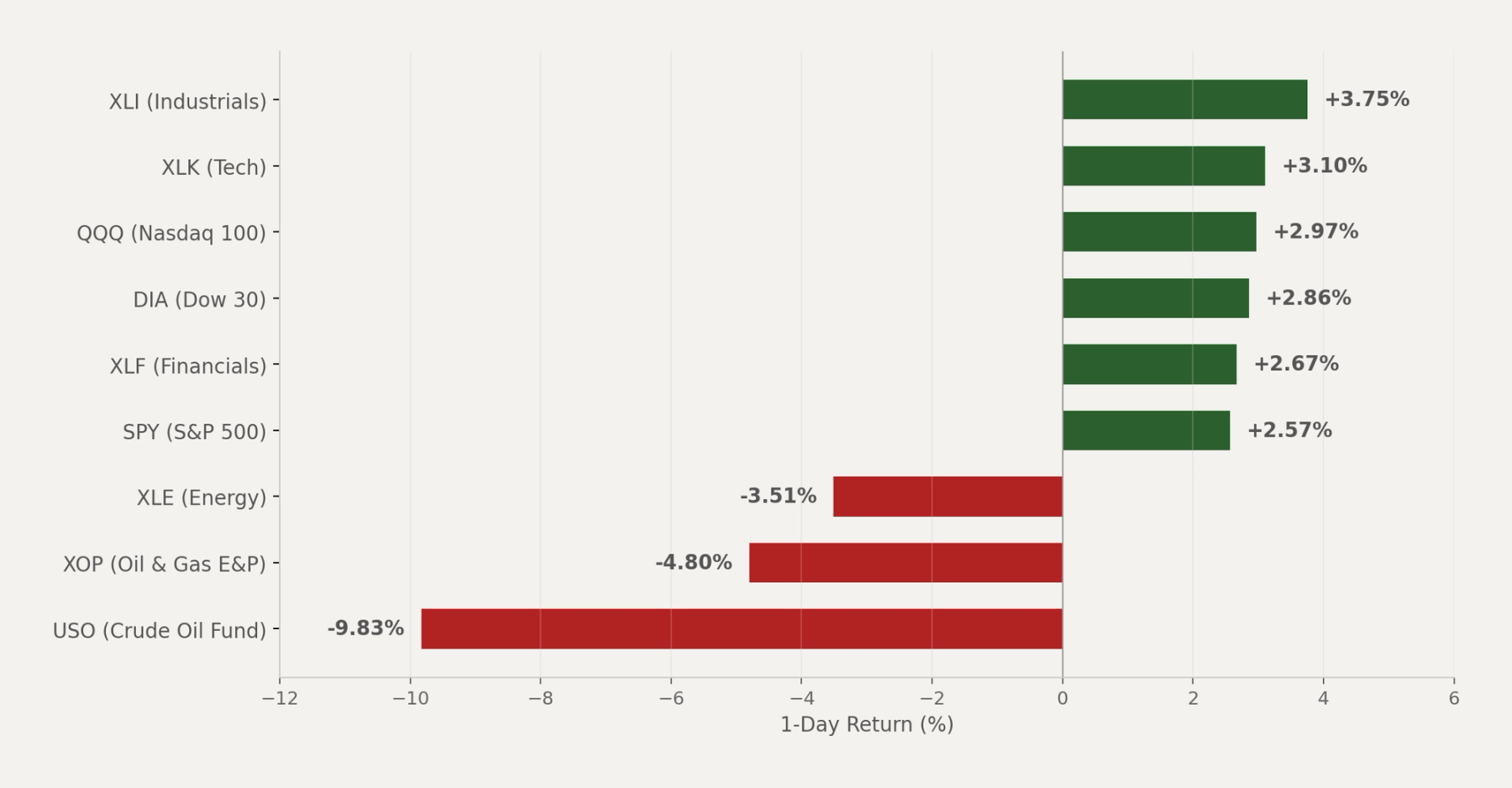
Data from FMP (ETF price performance), as of April 8, 2026.
USO, the crude oil tracking fund, lost 9.8%. XOP, the oil and gas exploration ETF, dropped 4.8%. XLE, the broader energy sector fund, fell 3.5%.
Every dollar leaving energy flowed into the sectors that benefit from cheaper crude.
Industrials (XLI) led at +3.75% because lower oil directly reduces input costs for manufacturing, transportation, and logistics. Tech (XLK, +3.1%) rallied on the broader risk-on bid plus the energy cost tailwind for data center operators running GPU clusters at massive scale.
Financials (XLF, +2.7%) gained because lower oil reduces the probability of a stagflationary outcome that would force the Fed to keep rates elevated longer. The CME FedWatch tool prices a 94.8% probability of a hold at the April 29-30 FOMC meeting.9
If oil stays below $100 through May, the rate cut calculus shifts for the June and September meetings.
The Counter-Argument
The ceasefire is two weeks old and already fraying. Iran halted additional Hormuz transits citing Israeli attacks on Lebanon. Bloomberg reported that 800 vessels remain trapped in or near the strait, waiting for clarity that may not come.10
A two-week pause is not a peace deal. It is a negotiating window that either side can collapse at any moment.
The 1991 Desert Storm analog, while structurally similar, had a critical difference. The U.S.-led coalition achieved decisive military superiority within days, making the geopolitical resolution durable. The current situation is a ceasefire between parties that were bombing each other 48 hours ago, with no treaty, no verification mechanism, and a public Iranian demand that the U.S. withdraw forces from the region.
If the ceasefire collapses before April 22, WTI retests $110+ within days. The S&P gives back the entire April 8 gain and then some.
The Fed adds a layer of risk. With the target range at 3.50-3.75% after three cuts in 2025, the central bank has limited room to ease further if oil re-spikes and inflation resurges.11 The March 2022 analog ended with the S&P down 3.7% at three months because the Fed began its aggressive hiking cycle.
If oil re-spikes, the same dynamic plays out in 2026. The two negative three-month analog outcomes (Nov 2021, Mar 2022) both coincided with Fed tightening, and a reversal in the oil decline would put rate cuts firmly off the table.
Finally, the market's initial reaction to geopolitical events often overshoots. The April 2025 tariff reversal triggered a 9.5% S&P surge, but the index spent the next two months grinding sideways as the underlying trade uncertainty persisted. Relief rallies can be traps when the underlying risk has not been resolved.
What to Watch
Strait of Hormuz tanker transit counts over the next 72 hours. If daily crossings stay below 10 (versus the pre-war average of ~60), the ceasefire is a ceasefire in name only, and the oil premium rebuilds.
The April 22 ceasefire expiration. Trump and Iranian negotiators have 14 days to convert a pause into something durable. Any breakdown before that date reverses the entire relief trade.
The April 10 CPI print. If March inflation came in hot (partly due to the oil spike running from late February through March), the Fed narrative shifts from "patient" to "trapped," and the rate-cut-from-cheaper-oil thesis stalls.12
XLE relative to XLI over the next five sessions. If the sector rotation accelerates (XLI outperforming XLE by 2+ points per week), the market is pricing a durable oil decline, not a one-day relief pop.
The Bottom Line
When oil crashes 10%+ on a geopolitical resolution, the S&P 500 has gained a median of +15.3% over the following three months, and the closest parallel (Desert Storm, 1991) delivered +19.1% in that window. The ceasefire is fragile and the April 22 deadline will test whether this is 1991 or a head-fake. The weight of evidence favors staying long equities and rotating from energy into the sectors that benefit from cheaper crude.