Silvia Insights · April 10, 2026
AI replaced 27,000 jobs this year. It's also prevented 1 million new hires.
The US economy added 178,000 jobs last month, nonfarm payrolls sit at 158.6 million, and unemployment is 4.3%. The "AI is stealing our jobs" narrative falls apart against the aggregate data. But underneath the headline numbers, the JOLTS hiring rate has fallen to levels that imply roughly 1 million fewer annualized hires than the 2023 pace, and that generational fracture is invisible in every traditional labor metric.
What to Know
- AI-attributed layoffs total 27,645 through March 2026, just 0.017% of total U.S. employment. The real story is the hiring freeze, with the JOLTS hiring rate at 3.1% in February, the lowest since April 2020, as companies slow or stop replacing roles where AI tools now handle a growing share of the work.
- Stanford's Digital Economy Lab found that workers aged 22 to 25 in AI-exposed occupations lost 16% of their employment since late 2022, while workers over 30 in the same occupations gained 6% to 12%. Young software developers alone are 20% below their 2022 peak.1
- The companies that profit from this split, selling AI tools that let one senior worker do what three juniors once did, trade at very different valuations than the firms whose business model depends on entry-level labor pipelines. ServiceNow at 31x EV/EBITDA versus Robert Half at 17.7x tells that story in two numbers.
The Hiring Freeze Is the Real AI Jobs Story
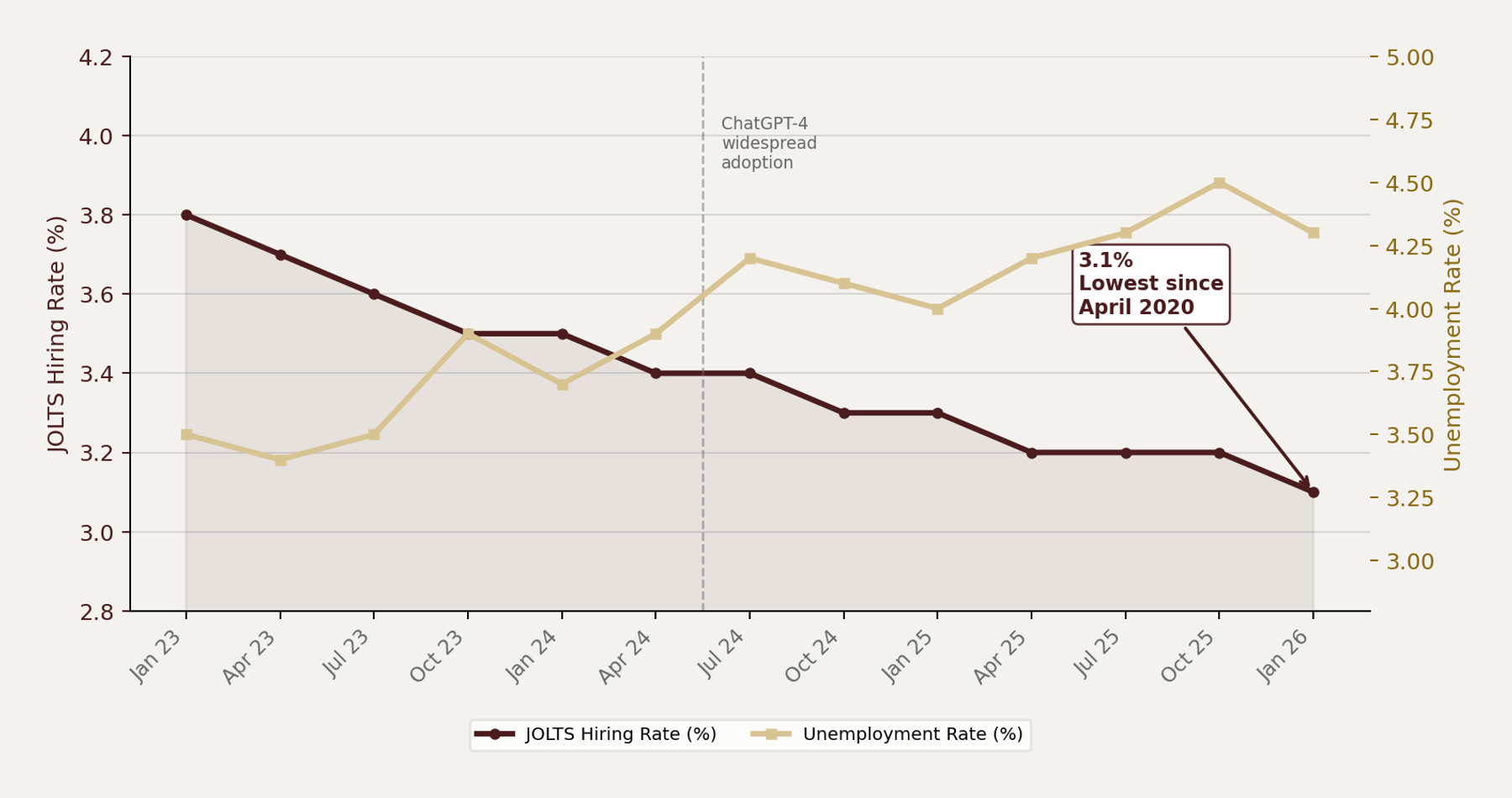
Source: Bureau of Labor Statistics, JOLTS Survey, FRED. Data as of February 2026.
The Macro Data Says No. The Micro Data Screams Yes.
Every month, the same debate replays across financial media and social platforms. AI is taking our jobs. AI is not taking our jobs.
Both sides cite data. Both sides are partially right. And both sides are missing the actual signal buried in the numbers.
The aggregate labor market, by any traditional measure, looks resilient. Total nonfarm payrolls hit 158.6 million in March 2026, up roughly 3.9 million from January 2023.2 The economy added 178,000 jobs in March, beating the 60,000 consensus estimate by nearly three times.3 The unemployment rate sits at 4.3%, elevated from its 2023 lows but still below the 50-year average.
But the traditional measures are hiding something. The JOLTS report for February 2026 showed the hiring rate plunging to 3.1%, the lowest reading since April 2020.4 Job openings fell to 6.88 million, down from 10.3 million in January 2023. The quits rate dropped to 1.9%, meaning workers have stopped voluntarily leaving their jobs at rates not seen since the depth of the COVID recession.
This is not an economy that is firing people en masse. This is an economy that has stopped bringing new people in. And the reason that matters is that the people most affected by a hiring freeze are the ones who have never been hired yet.
The Consensus and Where It Breaks
The dominant narrative has two camps. Camp one, represented by Challenger, Gray and Christmas data and amplified by social media, says AI is destroying jobs at an accelerating pace. They point to 27,645 AI-attributed layoffs through March 2026, up from 54,836 for all of 2025.5
Tech sector layoffs in Q1 2026 hit 52,050, up 40% year-over-year. In March alone, AI was the leading reason for job cuts, accounting for 25% of all announced reductions.
Camp two, represented by JPMorgan Asset Management's Stephanie Aliaga and the aggregate BLS data, argues the displacement narrative is overblown. Aliaga's research shows AI-related layoffs represent less than 5% of total announced job cuts and roughly 0.03% of overall employment.6 Productivity growth hit 2.8% annualized in Q4 2025, well above the pre-pandemic 1.2% average, but Aliaga argues attributing this to AI is "premature." The gains are more likely driven by pandemic-era restructuring, capital deepening, and labor scarcity forcing automation investment.
Both camps are wrong in the same way. They are arguing about whether AI is causing mass layoffs, when the more plausible effect is a structural hiring freeze that shows up nowhere in the layoff data. You do not fire a junior analyst if you simply never hire one.
That absence does not appear in the Challenger numbers or the weekly initial claims data, which remains stable around 220,000. It shows up only in the hiring rate, the quits rate, and in the employment trajectories of specific age cohorts.
AI Layoffs Are a Rounding Error on Total Employment
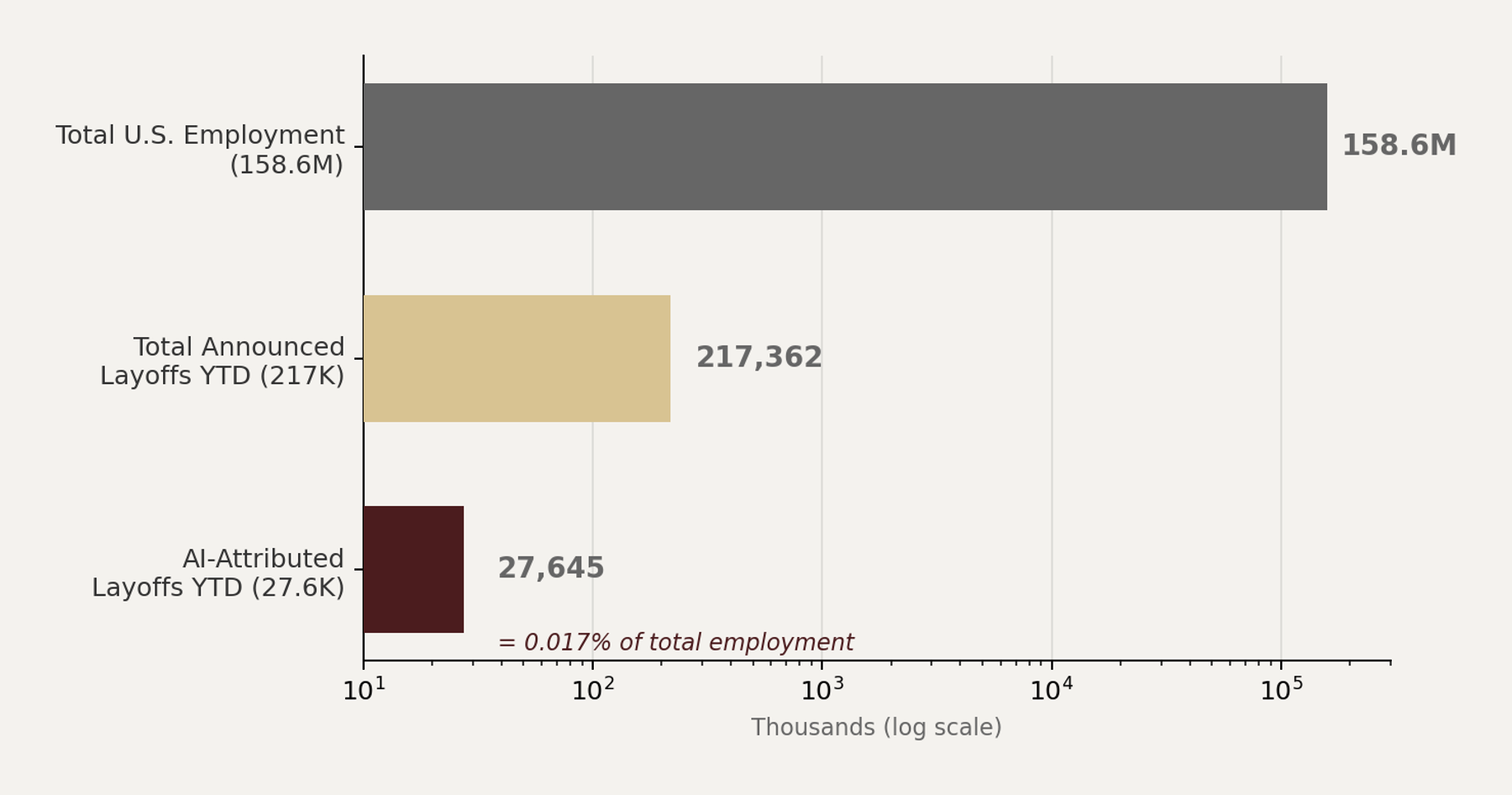
Source: Challenger, Gray and Christmas; Bureau of Labor Statistics. Data through March 2026.
The Stanford Data That Changes Everything
In August 2025, researchers at the Stanford Digital Economy Lab published what may be the most important labor market study of the AI era. Erik Brynjolfsson, Chinchih Chen, and others analyzed employment trends across occupations ranked by AI exposure. Their findings shatter both narratives simultaneously.1
Workers aged 22 to 25 in the most AI-exposed occupations experienced a 16% relative decline in employment since late 2022, after controlling for firm-level shocks. Young software developers specifically saw employment fall 20% below its late fall 2022 peak by mid-2025. Early-career customer service workers declined 11% from their November 2022 peak.
But workers aged 30 and over in those exact same high-AI-exposure occupations saw employment grow between 6% and 12% over the same period. The labor market did not shrink in these sectors. It bifurcated.
AI Split the Labor Market by Age, Not by Industry
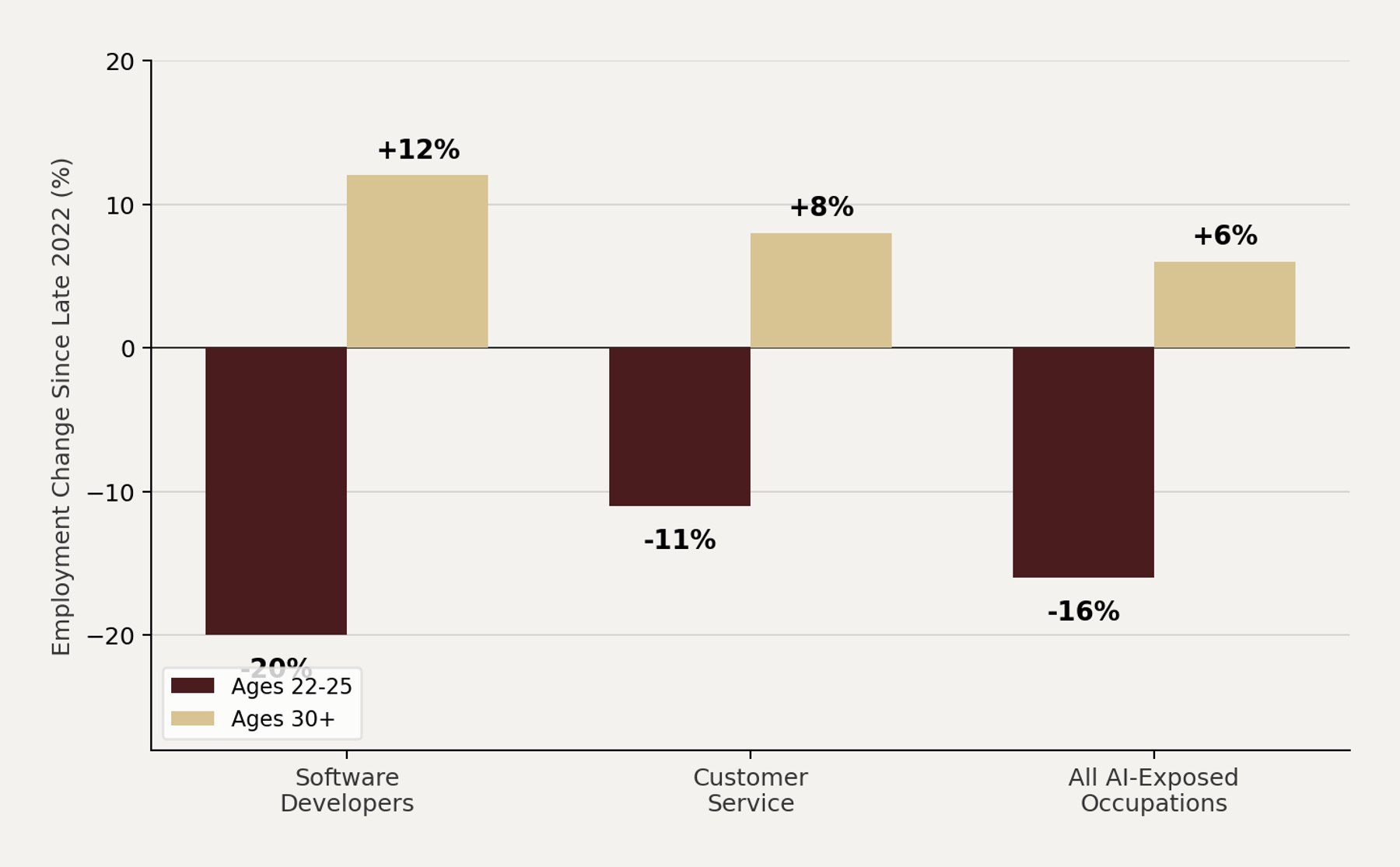
Source: Stanford Digital Economy Lab, Brynjolfsson, Chandar, and Chen (August 2025). Employment changes indexed from November 2022.
The mechanism is consistent with how AI tools interact with the labor force. AI handles a growing share of rules-based, structured tasks traditionally assigned to junior workers, from drafting emails and writing boilerplate code to summarizing documents and handling tier-one customer queries. Senior workers, whose value comes from tacit knowledge, judgment, and soft skills, are not displaced by these same tools.
They are augmented by it. One experienced developer with Copilot produces what previously required a team of three juniors.
JPMorgan's Aliaga found the same dynamic. Over one-third of U.S. workers now use generative AI for job tasks, but the St. Louis Fed estimates generative AI accounts for just 5.7% of total work hours as of mid-2025.7 That 5.7% falls disproportionately on the repetitive, entry-level work that defined the first rung of most professional careers.
Goldman Sachs estimates that two-thirds of U.S. occupations have AI exposure, but only 6% to 7% of workers face genuine displacement risk.8 The rest face augmentation, and augmentation benefits the experienced.
The Names That Express It
ServiceNow (NOW, $90.42, $94.6B market cap) sells the tools that make the bifurcation profitable. Its AI-powered workflow automation platform lets enterprises consolidate tasks that once required teams of junior IT and customer-service staff into a single senior operator managing AI agents. Revenue grew to $13.3 billion TTM with a 20.5x EV/free-cash-flow multiple, even after a 39% YTD drawdown driven by the broader tech selloff.9
The company's entire product thesis is that experienced workers amplified by AI produce more output than large junior teams. Every enterprise renewal is consistent with the hiring freeze operating from the demand side.
Block (SQ, ~$61, $37.2B market cap) is the case study that proves the thesis in real time. CEO Jack Dorsey cut the company from roughly 10,000 employees to fewer than 6,000, explicitly attributing the reduction to AI tools now performing functions previously handled by human employees.10 The stock has held steady on a YTD basis despite the cuts, with EV/EBITDA at 12.9x.
Block is what happens when a CEO decides to run the bifurcation playbook aggressively. The remaining senior workforce, augmented by AI, is expected to maintain or grow output.
Robert Half (RHI, $23.79, $2.4B market cap) sits on the wrong side of this structural shift. The company's core business is placing temporary and permanent professional staff, heavily weighted toward entry-level and mid-level accounting, finance, and technology roles. These are precisely the positions where AI adoption coincides with the sharpest declines in corporate hiring plans.
The stock has fallen 54% over the past year and 68% over three years.11 EV/Sales of 0.44x signals the market already prices a broken business model, as revenue contracts alongside the junior hiring slowdown Robert Half's business model depends on.
Chegg (CHGG, $0.83, $93M market cap) is the canary that already died. The education-technology company that once helped students with homework, study guides, and tutoring has lost 99% of its value since its 2021 peak.12 Generative AI now replicates Chegg's core function at zero marginal cost.
Chegg also represents the upstream end of the career ladder problem. If AI tools reduce the need for structured educational support to develop entry-level skills, and employers simultaneously slow hiring for those same skills, the entire pipeline from education to employment compresses.
The Canary Industries Are Already Bleeding
BLS establishment survey data reveals which sectors are already living in the post-AI labor market. Motion picture and sound recording employment has fallen 18.9% since January 2023, from 415,900 to 337,400 workers.13 Publishing industries employment declined 5.8% over the same period, from 958,500 to 902,800. These are content-creation sectors where AI tools directly substitute for junior and mid-level creative labor.
Meanwhile, professional, scientific, and technical services, the largest white-collar sector, grew just 0.9% over three years. That 0.9% translates to roughly 97,000 jobs added in a sector of 10.8 million, a pace that barely keeps up with population growth.
The sector is not contracting. It is calcifying.
Publishing and Media Employment Already Collapsed While the Broad Market Flatlined
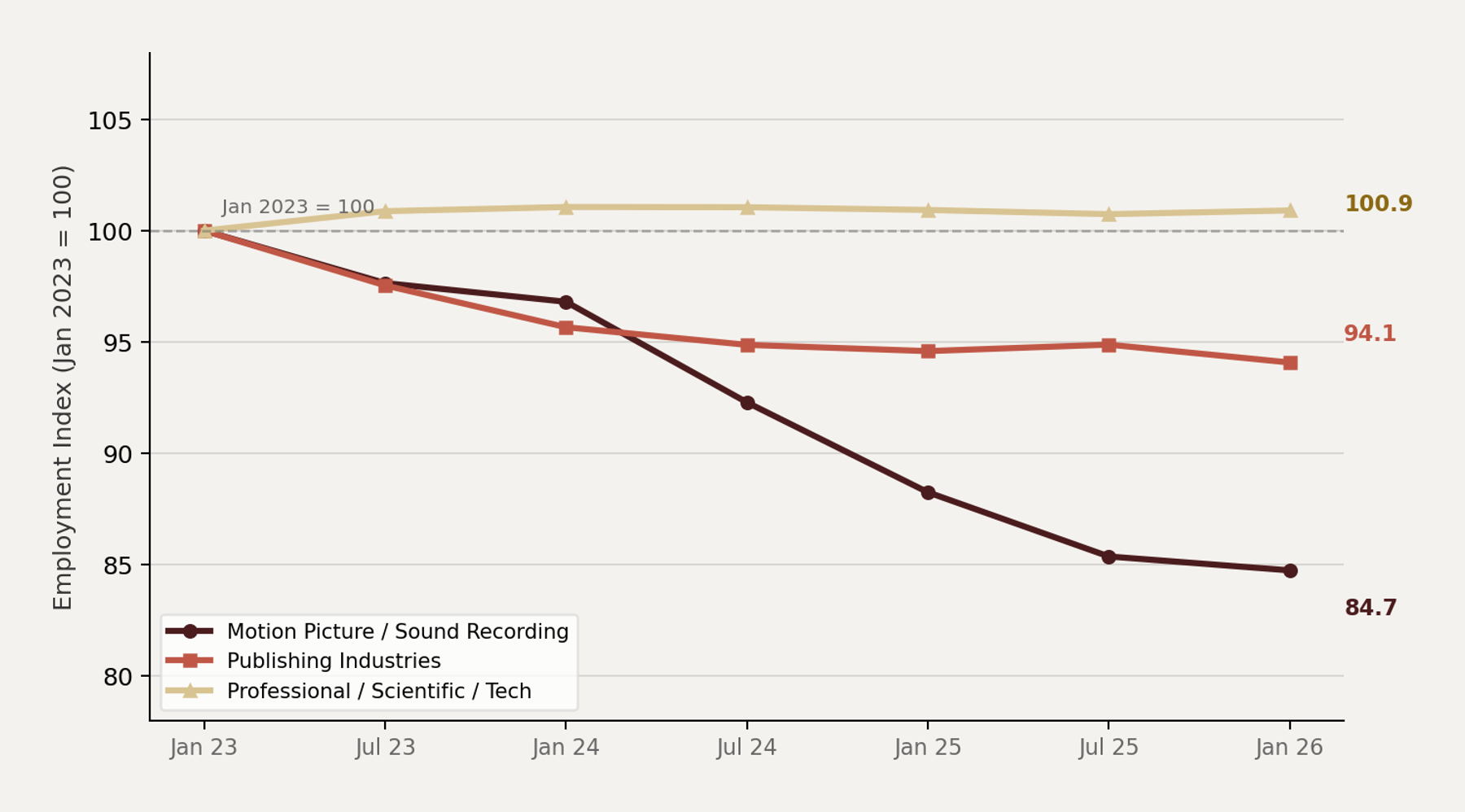
Source: Bureau of Labor Statistics, Current Employment Statistics. Indexed to January 2023 = 100.
The Harvard Business School research published in March 2026 reinforces this. Analyzing nearly all U.S. job postings from 2019 through March 2025, researchers found that automation-prone roles saw a 13% decrease in postings since ChatGPT's launch, while analytical, technical, and creative roles saw a 20% increase.14 Job postings for automation-prone occupations also required 7% fewer skills.
Employers are not just posting fewer jobs. They are posting simpler ones, consistent with AI tools absorbing the complexity that once required a dedicated human.
The Counter-Argument
The strongest objection to this thesis is that the generational employment split may not be driven by AI at all. The Stanford researchers themselves acknowledge this. Interest rate tightening from 2022 to 2024 disproportionately affected sectors that hire young workers aggressively, particularly technology and startups.
Venture capital funding collapsed, Series A rounds dried up, and the entry-level tech pipeline that had absorbed thousands of new graduates every year simply closed. If hiring froze because capital froze, not because AI replaced workers, then the bifurcation is cyclical, not structural.
This is a legitimate challenge. The timing of the young-worker employment decline coincides almost perfectly with both the Federal Reserve's rate-hiking cycle and the commercial launch of ChatGPT. Disentangling the two effects is genuinely difficult.
A follow-up analysis from the Stanford Digital Economy Lab in late 2025 attempted exactly this, controlling for interest rate sensitivity, and found that the AI-exposure effect persisted even after accounting for monetary policy.15 But the confidence interval widened, and the AI-specific effect shrank from 16% to roughly 10%. The honest answer is that both forces are likely at work, with AI accounting for somewhere between half and two-thirds of the observed decline.
A second objection comes from the productivity data itself. If AI were truly replacing junior workers at scale, aggregate productivity should be surging. Instead, full-year 2025 productivity growth decelerated to 2.2% from 3.0% in 2024.16
The Kansas City Fed found that productivity gains remain concentrated in a small set of high-contributing industries, with generative AI accounting for just 5.7% of total work hours. Broad-based AI-driven productivity, the kind that would indicate wholesale labor substitution, has not materialized.
Third, history suggests technology-driven labor market disruptions tend to be temporary. ATMs did not destroy bank teller jobs, and spreadsheets did not eliminate accountants. The Luddite fallacy, the idea that technology permanently destroys more jobs than it creates, has been wrong for 200 years.
Yale's Budget Lab assessment as of early 2026 concludes that "the broader labor market has not experienced a discernible disruption" since ChatGPT's release.17 The World Economic Forum projects a net gain of 78 million jobs globally by 2030, with 170 million new roles emerging against 92 million displaced.
These are real objections, supported by real data. The thesis does not require mass AI displacement to hold. It requires only that the career ladder is breaking for a specific generation, and that the companies positioned on either side of that break are mispriced relative to the structural shift underway.
Key Data Table
| Name | Ticker | Market Cap | EV/EBITDA | YTD Return | 1Y Return | Thesis Role |
|---|---|---|---|---|---|---|
| ServiceNow | NOW | $94.6B | 31.2x | -38.7% | -45.3% | Augmentation seller |
| Block | SQ | $37.2B | 12.9x | -3.8% | +4.1% | Bifurcation operator |
| Robert Half | RHI | $2.4B | 17.7x | -13.0% | -53.8% | Entry-level pipeline victim |
| Chegg | CHGG | $93M | 9.5x | -15.1% | +65.2% | Education-pipeline canary |
Sources listed in endnotes. Market data as of April 9, 2026.
Catalyst Map
- April 29-30, 2026.
- May 2, 2026.
- May 14, 2026.
- Q2 2026 earnings season (late April through May).
- Summer 2026.
The Bottom Line
AI has not killed the job market, but the data is consistent with it hollowing out the first rung of the career ladder, and the macro aggregates are structurally incapable of showing it. The JOLTS hiring rate at a 6-year low, the 20% employment decline for young software developers, and the simultaneous employment gains for senior workers all point to a labor market bifurcating by experience rather than shrinking by headcount. The thesis breaks if the Fed cuts aggressively enough to restart the venture hiring pipeline, or if the Stanford age-cohort effect proves driven primarily by rates rather than AI.