Silvia Insights · April 8, 2026
Companies replacing workers with AI have lagged the S&P 500 by a landslide
Ten companies made public announcements about replacing human workers with artificial intelligence between April 2023 and January 2026. Nine of the ten have underperformed the S&P 500 since the day they made the announcement.
What to Know
- The Sell Signal: Nine of ten companies that publicly announced replacing workers with AI have underperformed the S&P 500 by an average of 60 percentage points. The market treats "we're replacing people with AI" as an admission of weakness, not a sign of innovation.
- The Exception Proves the Rule: IBM is the only outperformer (+35.7pp vs SPY) because it sells AI to other companies. When the vendor gains and every adopter loses, the technology works for sellers, not for buyers using it as a cost-cutting headline.
- The Actionable Trade: Short the next company that announces AI-driven layoffs within 30 days of the headline. The pattern has held across all sectors, market caps, and macro environments for three consecutive years.
Explicit AI Layoffs Have Led to Poor Stock Returns
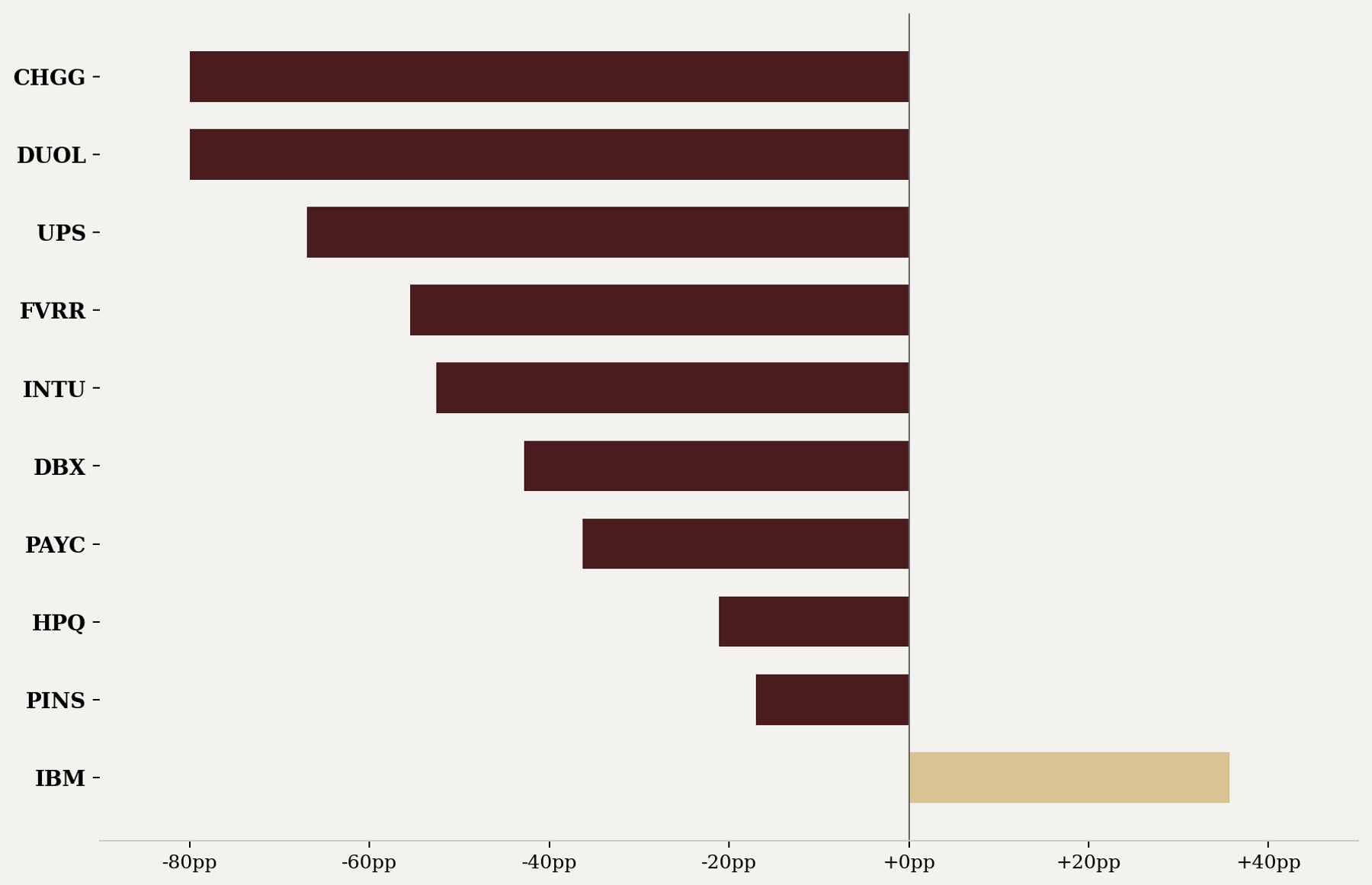
Data: OpenBB / S&P Global. Returns measured from close on announcement date through April 7, 2026. CHGG bar capped at −80pp for readability; actual excess return shown as label.
The Theme
Between April 2023 and January 2026, ten publicly traded companies made headline announcements about replacing human workers with artificial intelligence. The announcements ranged from Chegg's CEO admitting that ChatGPT was destroying student demand to Pinterest quietly replacing its content curation team with algorithmic systems. Every announcement was framed as forward-looking: leaner operations, smarter systems, a workforce rebuilt for the AI era.
The stock market disagreed. Nine of the ten companies underperformed the S&P 500 from the day of the announcement through April 7, 2026.
The average underperformance was 60 percentage points. The median was 53 percentage points. The worst performer, Chegg, trailed the S&P by 152 percentage points.
This is not a cherry-picked sample. The inclusion criteria were straightforward: the company had to be publicly traded, the announcement had to explicitly reference AI as the driver of workforce reduction, and the announcement had to be covered by major financial media.
The Consensus and Where It Breaks
The dominant narrative around AI and the labor market runs in one direction: companies that adopt AI faster will win. McKinsey's 2024 survey found 72% of companies had deployed generative AI in at least one business function, up from 55% the year prior. The assumption baked into most equity valuations is that AI adoption translates directly into margin expansion.
The data here breaks that narrative in a specific way. There is a difference between adopting AI quietly and announcing that you are replacing humans with AI. The first is operational; the second is a press release that signals defensive positioning.
Companies that made the public announcement underperformed because the market prices the signal immediately: this company's core business is under enough pressure that it needs to tell investors it found a cheaper labor model.
Forrester's 2025 enterprise survey found that 55% of companies that rushed AI deployment reported regret over the decision. BCG's follow-up study found 60% of large-scale AI initiatives delivered minimal gains relative to cost. The institutional consensus still treats "AI restructuring" as bullish rather than the admission of defensive positioning that the data shows it to be.
The Names That Express It
Chegg (CHGG): The original AI-layoff casualty. On May 2, 2023, CEO Dan Rosensweig told investors that ChatGPT was directly cannibalizing Chegg's homework-help business. The stock has underperformed the S&P by 152 percentage points since, as the company's paid answer service lost to a free alternative.
Duolingo (DUOL): On April 29, 2025, Duolingo announced it had replaced its contract translation workforce with AI systems. The stock has underperformed the S&P by 95 percentage points, as the market questioned whether a competitor could replicate the entire product if Duolingo's own technology had commoditized its human expertise.
UPS (UPS): On January 30, 2024, UPS announced 12,000 job cuts citing AI-driven automation of logistics planning. The stock has underperformed by 67 percentage points. The announcement read as a legacy industrial firm scrambling to cut costs amid margin compression from Amazon's in-house logistics buildout.
Fiverr (FVRR): On September 15, 2025, Fiverr filed a 6-K with the SEC containing CEO Micha Kaufman's letter announcing 250 layoffs, roughly 30% of the company's internal staff, to become an "AI-first company." The stock has underperformed by 56 percentage points. The market read the announcement as confirmation that AI tools were cannibalizing the freelance services Fiverr's platform exists to sell.
The Counter-Argument
The most immediate objection is that this basket is biased toward companies that were already struggling. Chegg was losing to free AI tutoring, UPS was losing ground to Amazon logistics. The AI layoff announcement, in this reading, was a symptom rather than a cause.
There is partial truth to this. Chegg and Fiverr were facing existential competitive threats that would have crushed their stocks with or without an AI-layoff press release.
But this objection does not explain the full basket. Intuit was growing revenue at 12% when it announced 1,800 AI-related layoffs in July 2024, and it still underperformed by 53 percentage points. Paycom was a mid-cap SaaS company with stable recurring revenue, and it still underperformed by 36 percentage points after announcing AI automation of payroll roles.
A second objection is that ten companies over three years is not a statistically robust dataset. This is fair. However, the consistency is notable: nine of ten names underperformed across sectors ranging from education technology to industrial logistics to enterprise software to social media.
The one exception, IBM, outperformed because it sells AI rather than using it as a cost-cutting defense. If this were random noise, you would expect more variance in direction.
A third objection is macro timing. Several announcements occurred during broader market rotation away from growth stocks, and the Fed held rates at elevated levels through most of 2024 and early 2025 before cutting three times between September and December 2025.
Rate-sensitive names in the basket may have underperformed partly due to the rate environment rather than the AI announcement alone. But this does not explain why IBM, announced in the same week as Chegg and Dropbox in May 2023, outperformed by 36 percentage points under identical macro conditions.
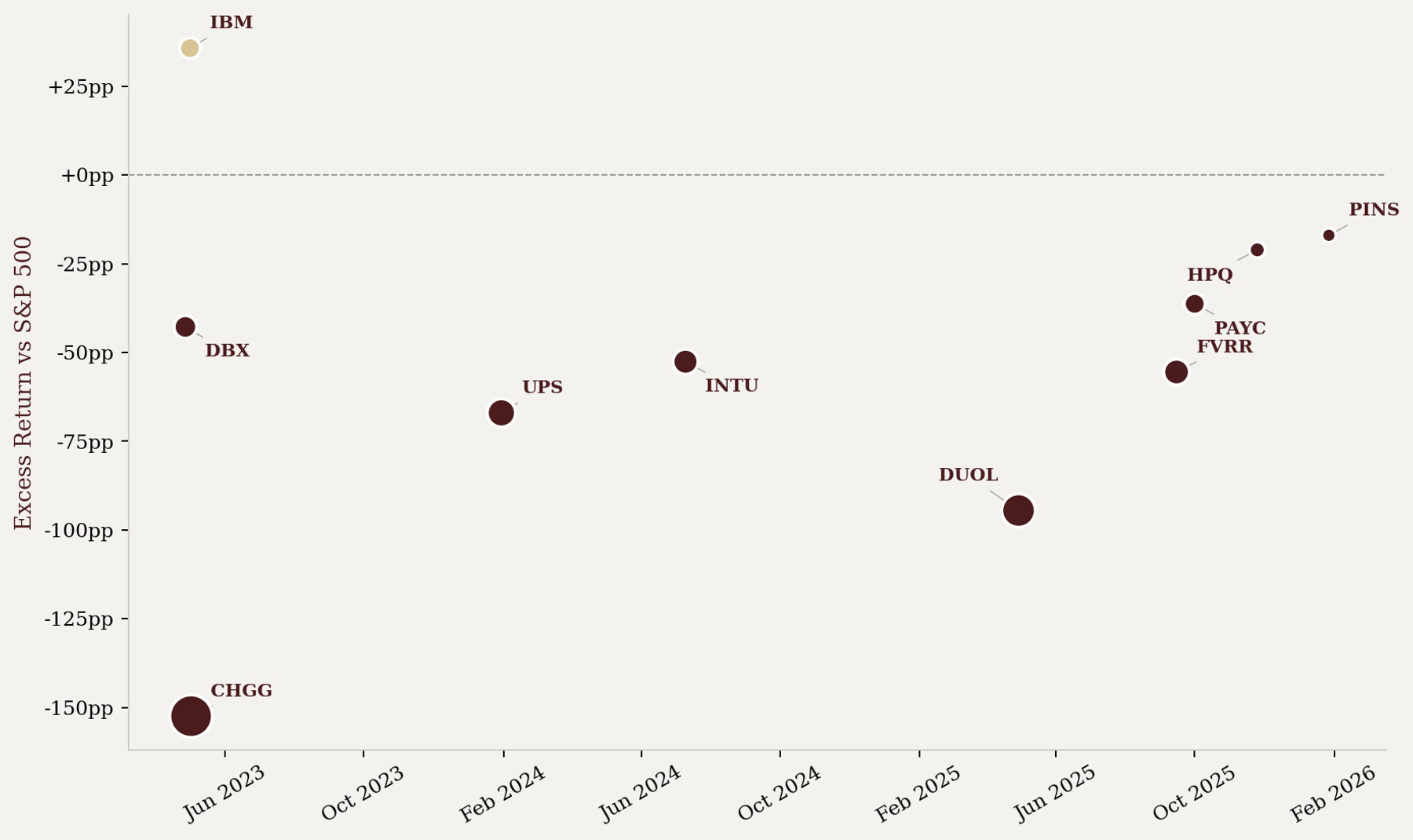
Data: OpenBB / S&P Global. Bubble size proportional to magnitude of excess return. Gold = outperformed; Mahogany = underperformed.
Key Data Table
| Ticker | Company | Announcement | What Was Announced | Stock Return | SPY Return | Excess vs SPY |
|---|---|---|---|---|---|---|
| CHGG | Chegg | May 2, 2023 | CEO said ChatGPT hurting growth | −91.9% | +60.5% | −152.4pp |
| DUOL | Duolingo | Apr 29, 2025 | Replaced contract translators with AI | −75.6% | +18.9% | −94.5pp |
| UPS | UPS | Jan 30, 2024 | Cut 12,000 jobs citing AI automation | −32.7% | +34.3% | −67.0pp |
| FVRR | Fiverr | Sep 15, 2025 | Laid off 30% of staff to become AI-first | −55.7% | −0.3% | −55.5pp |
| INTU | Intuit | Jul 10, 2024 | Laid off 1,800 to reallocate to AI | −35.2% | +17.5% | −52.6pp |
| DBX | Dropbox | Apr 27, 2023 | Cut 16% of workforce, pivoting to AI | +17.0% | +59.8% | −42.8pp |
| PAYC | Paycom | Oct 1, 2025 | Automated payroll roles with AI | −37.6% | −1.4% | −36.3pp |
| HPQ | HP Inc. | Nov 25, 2025 | Cut workforce citing AI restructuring | −23.5% | −2.3% | −21.1pp |
| PINS | Jan 27, 2026 | Cut 15% of staff to reallocate to AI | −22.3% | −5.2% | −17.0pp | |
| IBM | IBM | May 1, 2023 | Pausing hiring for AI-replaceable roles | +94.4% | +58.7% | +35.7pp |
Sources listed in endnotes. All returns calculated from closing price on announcement date through April 7, 2026. SPY used as S&P 500 proxy.1,2
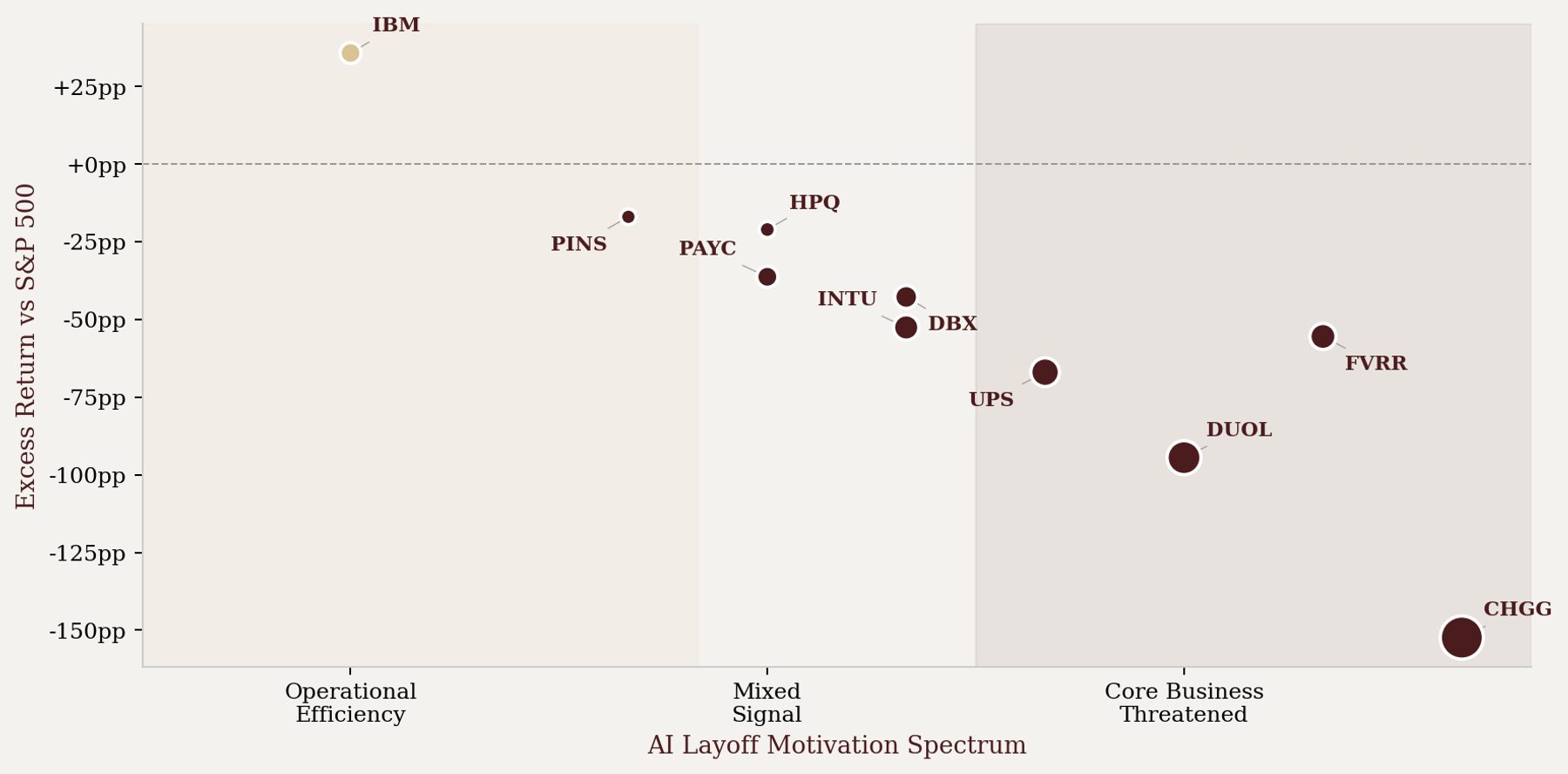
ProCap analysis. Desperation score reflects whether AI layoffs addressed a core business threat (right) vs. operational efficiency (left). Higher desperation correlates with worse performance.
Catalyst Map
Q2 2026 Earnings Season (April-May): Chegg, Duolingo, Intuit, and Fiverr all report Q1 results. Any commentary about AI replacing additional roles or continued revenue declines will reinforce the pattern. Watch for whether any company reverses course and begins re-hiring.
Fed Policy Decision, May 6-7, 2026: CME FedWatch as of April 2026 shows 95% probability the Fed holds rates at 4.25-4.50%. A surprise cut would help rate-sensitive names in the basket but would not change the underlying business deterioration for most of these companies.
Block/Square (XYZ) Watch: Block announced AI-driven workforce reductions on February 26, 2026. The position is too recent at six weeks to include in the data set, but it is the next live test of the pattern. If XYZ underperforms SPY by 10+ percentage points within 90 days, it extends the streak to ten of eleven.
AI Regulation Pipeline: The EU AI Act's workplace provisions take effect in August 2026, imposing compliance costs on any company in the basket operating in Europe. The U.S. Senate AI labor bill introduced in March 2026 would require 90-day notice for AI-driven layoffs exceeding 50 employees, raising the cost of the exact announcements that triggered this sell signal.
The Bottom Line
When a company tells the market it is replacing workers with AI, the market hears a confession, not a strategy. Nine of ten companies that made this announcement have underperformed the S&P 500 by an average of 60 percentage points, and the one exception is an AI vendor that profits from the trend. The pattern breaks if a non-vendor company makes the announcement and outperforms, which has not happened in three years of data.
Endnotes
1 Stock price data: OpenBB Terminal / Financial Modeling Prep (Tier 0). Daily closing prices for CHGG, DBX, IBM, UPS, INTU, DUOL, FVRR, PAYC, HPQ, PINS, and SPY from January 2023 through April 7, 2026.
2 Announcement dates verified via SEC filings where available: PINS 8-K Item 2.05 (Jan 27, 2026), HPQ 8-K Items 2.02/2.05 (Nov 25, 2025), FVRR 6-K (Sep 15, 2025). PAYC announcement sourced from company press release and financial media (Yahoo Finance, NPR/KOSU). Original six names sourced from SEC filings, earnings call transcripts, and major financial media.
3 Federal funds rate data: FRED Series DFF (Tier 0). Three 25bp cuts between September and December 2025. Current effective rate 4.33% as of April 2026.
4 CPI data: FRED Series CPIAUCSL (Tier 0). Year-over-year CPI as of February 2026: 2.4%.
5 Forrester "AI Regret" survey (2025): 55% of enterprises reported regret over rushed AI deployment. BCG AI at Scale study (2025): 60% of large-scale AI initiatives delivered minimal gains vs. cost.
6 CME FedWatch Tool: 95% probability of rate hold at April 2026 FOMC meeting as of April 7, 2026.
Disclosures: ProCap Insights is published for informational purposes only and does not constitute investment advice. The authors may hold positions in securities mentioned. Past performance does not guarantee future results. All data sourced from OpenBB Terminal (Tier 0), FRED, SEC filings, and named research firms as cited. Readers should conduct their own due diligence before making investment decisions.